-
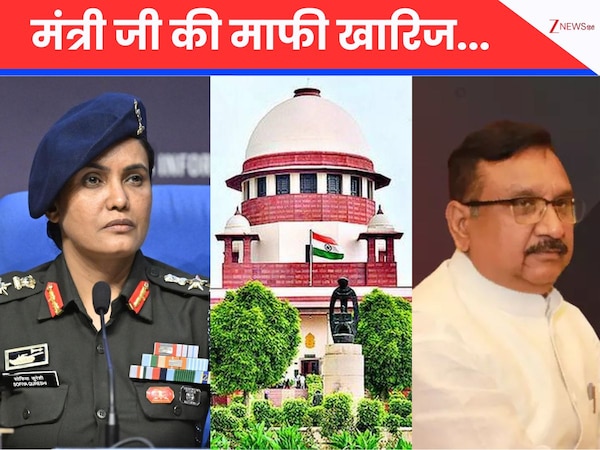
Colonel Sofia: Regarding Colonel Sofia Qureshi, who came into discussion during Operation Sindoor, a state minister had made objectionable remarks. He has since been repeatedly apologizing before the Supreme Court. However, today the Supreme Court refused to accept his apology for the second time. The court also stated that it is now too late.
The bench was hearing petitions filed by him challenging a suo motu order of the Madhya Pradesh High Court which had directed the registration of an FIR against him. During this, the court further remarked that we had seen earlier what kind of apology you had tendered. Here, the court was referring to the apology sought earlier by him, which the court had rejected, stating that it was merely ‘crocodile tears’ to avoid legal entanglements.
Awaiting State Government’s Sanction for Prosecution
The SIT constituted by the court to investigate this matter reported that it has completed the investigation and submitted the final report to the court and is now awaiting the state government’s sanction to prosecute in this case. The court has told the state government to decide within two weeks on granting its sanction for prosecution.
State Government Directed to Take a Decision
The bench further stated that the SIT had presented its report to the state government for sanction, which is necessary for courts to take cognizance of offenses under Section 196 of the Bharatiya Nyaya Sanhita 2023. The court was informed that the state government had not taken any decision on the request for sanction, citing the pending matter in the Supreme Court. Regarding this, it was said, ‘We are informed that in view of the pending matter in this court, no decision has been taken by the state government and thereafter, the State of Madhya Pradesh is directed to consider the issue of sanction and take an appropriate decision within two weeks.’
Colonel Sofia
“Colonel Sofia” is not a widely recognized historical or cultural site. It may refer to a local monument, street, or establishment named in honor of a military figure named Sofia. Without a specific location or context, it is not possible to provide a verified historical summary.Supreme Court
The Supreme Court of the United States is the highest federal court in the nation and the head of the judicial branch, established by Article III of the U.S. Constitution in 1789. Its primary role is to interpret the Constitution and federal law, with the power of judicial review to overturn laws it deems unconstitutional, a principle solidified by the landmark 1803 case *Marbury v. Madison*. The Court’s decisions on critical issues like civil rights, free speech, and presidential powers have profoundly shaped American society and governance.Operation Sindoor
“Operation Sindoor” is not a recognized historical place or cultural site. It appears to be a reference to a fictional or codenamed military or espionage operation, possibly from literature, film, or online narratives, rather than an actual location. Therefore, it does not have a verifiable history as a cultural or heritage site.Madhya Pradesh High Court
The Madhya Pradesh High Court is the highest judicial authority in the state of Madhya Pradesh, India. It was originally established as the Nagpur High Court in 1936 for the Central Provinces and Berar, and was renamed after the reorganization of states in 1956. The principal seat of the court is in Jabalpur, with additional benches in Gwalior and Indore.SIT
Based on the provided term “SIT,” it is not possible to provide a specific summary, as it is too ambiguous. It could refer to many different things, such as:* **An educational institution:** For example, the **Singapore Institute of Technology**, a public university founded in 2009.
* **A cultural or historical site:** Potentially a shorthand for a specific site, but none are commonly known by this acronym.
* **A general concept:** Such as “Situation” or a specific program.To give an accurate summary, please provide the full name or more context for “SIT.”
State Government
The term “State Government” refers to the governing body of a constituent state within a federal system, such as in the United States, Australia, or India. Its history is tied to the development of federalism, where sovereignty is constitutionally divided between a central national government and regional state governments, each with their own defined powers, legislatures, and executives. This structure was famously established in the U.S. by the Constitution in 1789, creating a model for balancing national unity with regional self-governance.Bharatiya Nyaya Sanhita 2023
The Bharatiya Nyaya Sanhita 2023 is a proposed new penal code for India, intended to replace the Indian Penal Code (IPC) of 1860. It was introduced in the Indian Parliament in August 2023 as part of a set of three bills aimed at comprehensively overhauling the country’s colonial-era criminal laws. The legislation reflects a modernizing effort to update legal definitions, procedures, and punishments to align with contemporary societal needs and challenges.State of Madhya Pradesh
The State of Madhya Pradesh, located in central India, is historically known as the “Heart of India” due to its geographical position. It is home to a rich tapestry of cultural heritage, including three UNESCO World Heritage Sites: the ancient Buddhist monuments at Sanchi, the rock shelters of Bhimbetka (with prehistoric art dating back 30,000 years), and the Khajuraho Group of Monuments famed for their intricate temple sculptures from the Chandela dynasty (c. 10th-12th centuries).