Immersive art facilities continue to open in Yokohama, attracting repeat visitors.
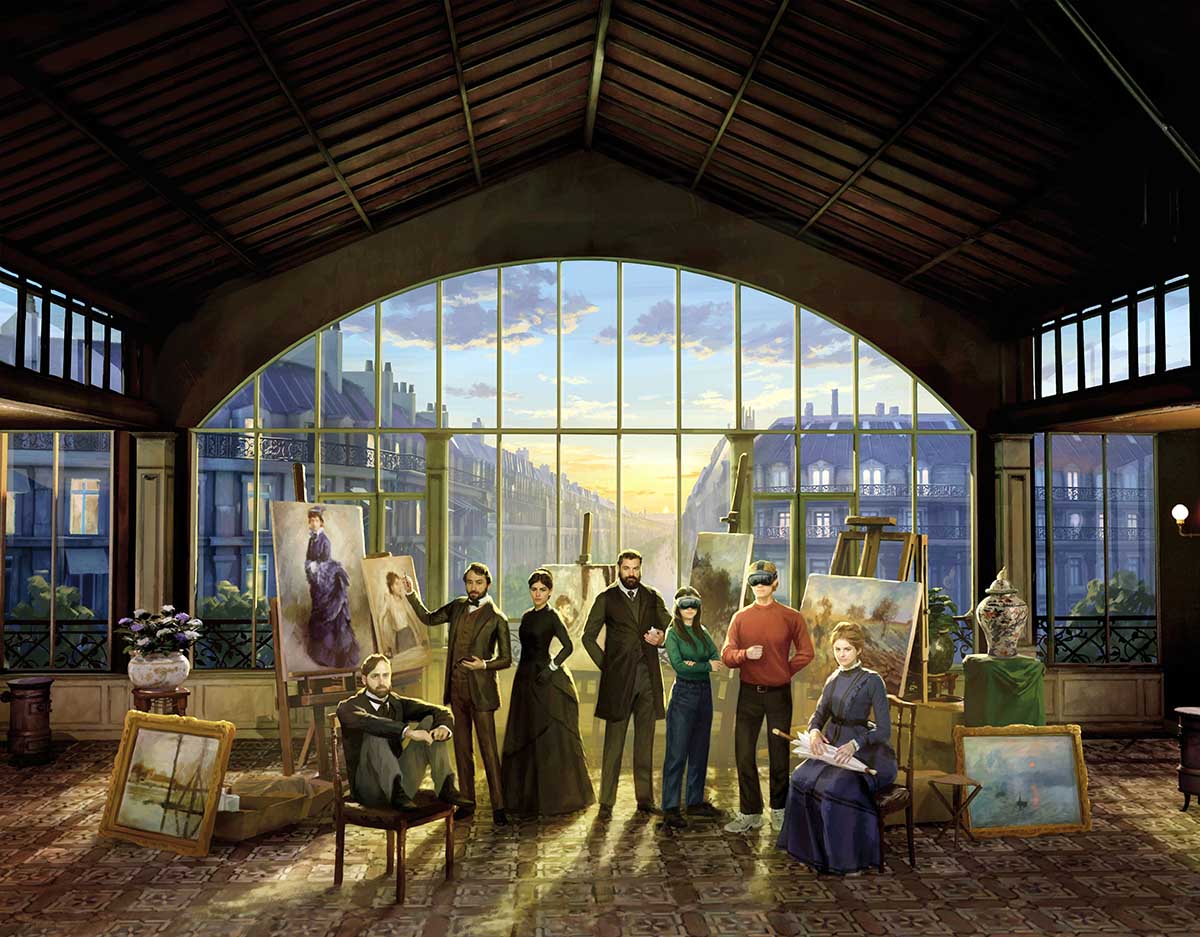
Image for “A Night with the Impressionists” (C) Excurio – GEDEON Experiences – Musée d’Orsay
This winter in Yokohama, a number of facilities are opening one after another, allowing visitors to immerse themselves in the world of 19th-century masterpieces using the latest digital technology.
The entertainment facility “Immersive Journey,” located within the commercial complex “Asobiiru” directly connected to the south east exit of Yokohama Station, is presenting the Japan premiere of a visual work titled “A Night with the Impressionists.” Using XR (Cross Reality) technology that blends the real and virtual worlds, it recreates Paris, France in 1874. Monet and Renoir appear.
Goods themed on “A Night with the Impressionists” are also on sale inside the facility.
The setting is the “First Impressionist Exhibition,” where about 30 painters presented over 165 works. It’s a story of walking through Paris of that era with the masters while touring the exhibited works. For example, one can catch a glimpse of Monet creating the work “Impression, Sunrise”—which gave the “Impressionist” art movement its name—in a room at a hotel in Le Havre.
This visual work was originally premiered worldwide at the Musée d’Orsay in Paris in 2024. According to the film production company that decided to bring it to Japan, similar to the audience in Paris, it is popular with women in their 40s to 60s who are art lovers in Yokohama, and repeat visitors are increasing. The president stated, “Cutting-edge technology is perfectly suited for art.”
“The Museum Yokohama,” where one can enjoy light and sound effects.
Appearing in a warehouse at Yamashita Pier in Yokohama Port is “The Museum Yokohama,” handled by the Toyota Group. It expresses the works and worldviews of Austrian painters Klimt and Schiele using 75 projectors.
Projected onto the floors and walls, the previously flat world of painting expands across the entire space, allowing visitors to enjoy the sensation of melting into the artwork. The exhibition period runs until the end of March this year.
Musée d’Orsay
The Musée d’Orsay in Paris is a major museum housed in a former Beaux-Arts railway station, the Gare d’Orsay, which was built for the 1900 World’s Fair. It primarily displays French art from 1848 to 1914, including the world’s largest collection of Impressionist and Post-Impressionist masterpieces by artists such as Monet, Renoir, Van Gogh, and Cézanne. The museum opened in its current form in 1986, transforming the magnificent station into a celebrated home for art from the pivotal period between the collections of the Louvre and the Musée National d’Art Moderne.
Yokohama Station
Yokohama Station is a major railway hub in Kanagawa Prefecture, Japan, first opening in 1872 as the terminal station for Japan’s first railway connecting Yokohama and Shimbashi (Tokyo). The current large-scale station complex, with its iconic shopping malls and skyscrapers, was largely developed in the late 20th century to serve the rapidly growing city and now stands as one of the busiest stations in the world by passenger count.
First Impressionist Exhibition
The First Impressionist Exhibition was a groundbreaking independent art show held in Paris in 1874, organized by artists including Monet, Renoir, and Degas who were rejected by the official Salon. It introduced the term “Impressionism” to the public, derived from Monet’s painting *Impression, Sunrise*, and marked the birth of a revolutionary new movement that emphasized light, everyday scenes, and visible brushstrokes over traditional academic ideals.
Le Havre
Le Havre is a major port city in Normandy, France, founded in 1517 by King Francis I. Its historic center was almost entirely rebuilt in a distinctive modernist style by architect Auguste Perret after being devastated during World War II, a reconstruction for which it was designated a UNESCO World Heritage Site in 2005.
Yamashita Pier
Yamashita Pier is a historic waterfront area in Yokohama, Japan, originally constructed in the 1920s and named after the city’s mayor at the time. It served as a major international passenger terminal for decades, welcoming famous ocean liners and symbolizing Japan’s post-war recovery and connection to the world. Today, it is a popular public park and promenade offering scenic views of Yokohama Bay.
Yokohama Port
Yokohama Port is Japan’s first major modern international port, officially opened in 1859 after the country ended its long period of national isolation. Its rapid development, following the arrival of foreign trade and influence, was central to Japan’s industrialization and modernization in the late 19th and early 20th centuries. Today, it remains one of the country’s largest and busiest harbors, with its historic waterfront area being a major cultural and tourist destination.
Klimt
“Klimt” most commonly refers to the Austrian symbolist painter Gustav Klimt (1862–1918), a founding member of the Vienna Secession art movement. He is world-renowned for his iconic, gold-leafed paintings like *The Kiss* and *Portrait of Adele Bloch-Bauer I*, which epitomize the Art Nouveau style and Viennese modernism at the turn of the 20th century. While not a physical site, his legacy is celebrated at institutions like the Belvedere Museum in Vienna, which houses many of his masterpieces.
Schiele
“Schiele” most commonly refers to the **Leopold Museum** in Vienna, Austria, which houses the world’s largest collection of works by the Austrian Expressionist painter **Egon Schiele** (1890–1918). The museum, opened in 2001, is part of the MuseumsQuartier and is built around the extensive private collection of Rudolf and Elisabeth Leopold, who began acquiring Schiele’s provocative and emotionally intense artworks in the 1950s. It serves as a central institution for understanding Schiele’s brief but prolific career, alongside major works by his contemporaries like Gustav Klimt.