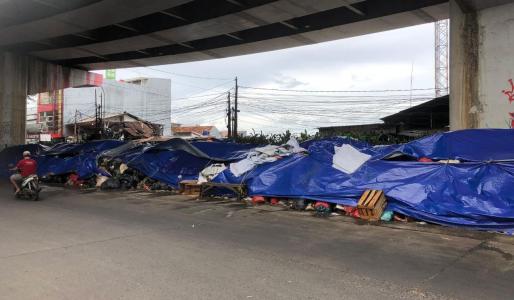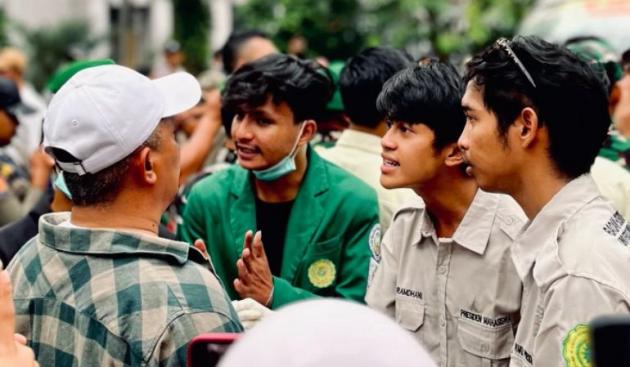
Students from the BEM UMJ during a protest regarding waste management in South Tangerang City.
Following a demonstration by the Student Executive Board of Muhammadiyah University of Jakarta (BEM UMJ) concerning waste handling, South Tangerang Mayor Benyamin Davnie immediately spoke out.
Benyamin stated that the concerns of students and the public serve as a reminder for the government to work harder and more transparently in improving environmental governance in the “Orchid City.”
According to him, every point of the demands presented is valuable input.
Currently, the South Tangerang City Government has declared an accelerated waste handling status through a measurable 100-day work program involving a cross-sectoral task force team.
“I hear and feel the concerns of the students and residents. This criticism is energy for us. We are not standing idle. Currently, the task force team is working in the field within the framework of the 100-day program to ensure no more waste is left neglected in public spaces,” he said at the South Tangerang City Hall.
Strategic Steps and Downstream Solutions
Benyamin acknowledged the existence of significant technical obstacles, especially following the closure of the Cipeucang Landfill and the temporary halt in cooperation with the Cilowong Landfill.
This condition had temporarily clogged the waste disposal flow.
“We apologize for this inconvenience. As a quick step, we have secured cooperation with the Cileungsi Landfill so that waste disposal from accumulation points, including in the Ciputat area, has now begun to flow again,” he explained.
100-Day Work Target
Based on the acceleration team’s achievement plan, the South Tangerang City Government has prepared a strict timeline to restore the city’s cleanliness.
Several main targets for the next 100 days include massive and regular waste collection at points that have been locations for illegal dumping.
Furthermore, optimizing the fleet by increasing the frequency of collection trips and repairing hampered vehicle units.
“In addition, accelerating the readiness of residue processing technology as a long-term solution to no longer be fully dependent on landfills outside the region,” he said.
Benyamin added that his administration is also opening communication channels for residents to report waste accumulation directly so it can be promptly followed up by the task force.
He emphasized that coordination between regional government agencies, from the Environmental Service down to the sub-district level, is now conducted daily to ensure these targets are achieved on time.
“This is collective work. I assure you the South Tangerang City Government is fully responsible. We want students and the public to continue overseeing this process so that South Tangerang becomes clean and comfortable again for all of us,” concluded Benyamin.