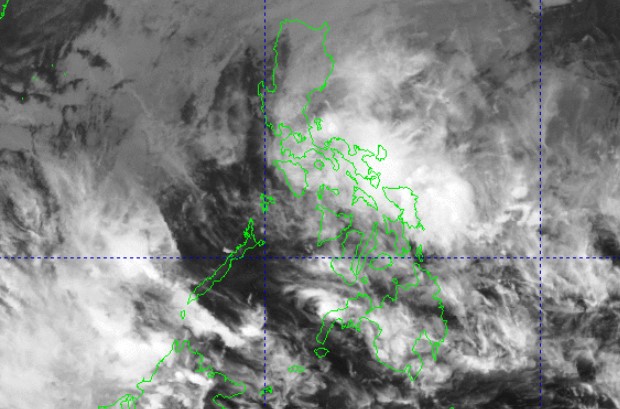
Rains will drench different areas of the country as the effects of three weather systems are forecast to be felt.
According to a daily weather bulletin, a shear line will bring cloudy skies with scattered rains and isolated thunderstorms over the Bicol region, Aurora, Quezon, Rizal, Laguna, Marinduque, Romblon, and Northern Samar.
The Amihan or Northeast Monsoon will cause cloudy skies with light rains over Metro Manila, Cagayan Valley, Cordillera Administrative Region, Nueva Ecija, and Bulacan. Partly cloudy to cloudy skies with isolated light rains will affect the rest of Luzon.
Other parts of Eastern Visayas, Dinagat Islands, and Surigao del Norte will have cloudy skies with scattered rains and thunderstorms, as the rest of the country experiences partly cloudy to cloudy skies with isolated rain showers or thunderstorms caused by the easterlies.
Flash floods or landslides may occur in some areas as a result of these weather conditions.
Meanwhile, moderate to strong winds with moderate to rough waters will be felt over Luzon and the eastern section of Visayas.
The rest of the country will observe light to moderate winds with slight to moderate seas.
Sunrise in Metro Manila will be at 6:24 a.m. on Saturday.
Bicol region
The Bicol Region is a peninsula in southeastern Luzon, Philippines, known for its iconic Mayon Volcano and rich cultural heritage. Historically, it was a significant trade hub and was among the first areas in the country to be colonized by Spain in the 16th century, which led to the widespread adoption of Catholicism. Today, it is celebrated for its spicy cuisine, vibrant festivals like the Penafrancia Fluvial Procession, and resilient communities that have adapted to the area’s frequent volcanic and typhoon activity.
Aurora
“Aurora” most commonly refers to the **Aurora Borealis (Northern Lights)**, a natural light display in Earth’s sky, predominantly seen in high-latitude regions. It is caused by collisions between charged particles from the sun and gases in Earth’s atmosphere, a phenomenon understood through science but which has inspired countless myths and legends in Arctic cultures throughout history. Alternatively, if referring to a place like **Aurora, Illinois**, it is a historic city founded in 1834, once a major manufacturing center and now known for its preserved architecture and being one of the first U.S. cities to use electric street lighting.
Quezon
Quezon is a province in the Philippines named after Manuel L. Quezon, the country’s second president and a prominent advocate for Philippine independence from American rule. Historically, the area was part of the larger Quezon province established in 1946, which was later divided, with the remaining part retaining the name to honor the former president. It is known for its natural attractions, such as beaches and the iconic Mount Banahaw, as well as cultural festivals like the *Pahiyas* in Lucban.
Rizal
Rizal refers to José Rizal, a national hero of the Philippines, rather than a specific place. He was a writer and key figure in the peaceful reform movement against Spanish colonial rule in the late 19th century. His execution in 1896 galvanized the Philippine Revolution.
Laguna
“Laguna” is a common Spanish and Portuguese geographical term for “lagoon,” but it is most famously associated with **Laguna Beach**, a coastal city in California, USA. Historically, it was inhabited by the indigenous Acjachemen people before becoming an artists’ colony in the early 20th century, known for its natural coves and vibrant arts scene. Alternatively, it can refer to **Laguna (Province)**, a historic province in the Philippines founded in 1571, notable for being the birthplace of national hero José Rizal and home to the country’s largest lake, Laguna de Bay.
Marinduque
Marinduque is a heart-shaped island province in the Philippines, known as the country’s “Heart of the Philippines” and for its annual **Moriones Festival** during Holy Week, where participants wear masks and costumes reenacting the story of the Roman soldier Longinus. Historically, it was a significant site of early Spanish colonization and is believed by some historians to be the island called “Malandon” by 16th-century explorer Miguel López de Legazpi. The island also gained archaeological importance with the 1976 discovery of the **Marao wreck**, a pre-Hispanic balangay (boat), indicating early maritime trade and settlement.
Romblon
Romblon is a province in the Philippines known as the “Marble Capital of the Country,” famed for its high-quality marble quarries and intricate craftsmanship. Historically, it was a strategic port frequented by Spanish galleons, and its name is derived from the Romblomanon word “Nagalumyom,” meaning a place with many “lomlom” or sitaw trees. Today, its main attractions include its pristine beaches, Spanish-era forts like Fort San Andres, and the annual Biniray Festival.
Northern Samar
Northern Samar is a province in the Philippines, part of the Eastern Visayas region, historically known for its rugged terrain and as a site of early resistance during the Spanish colonial period. It is home to significant natural attractions like the Sohoton Caves and Natural Bridge, and its history includes the tragic “Balangiga Encounter” of 1901 during the Philippine-American War, which occurred in the neighboring town of Balangiga (now part of Eastern Samar). The province’s culture and economy remain closely tied to agriculture, fishing, and its resilient coastal communities.