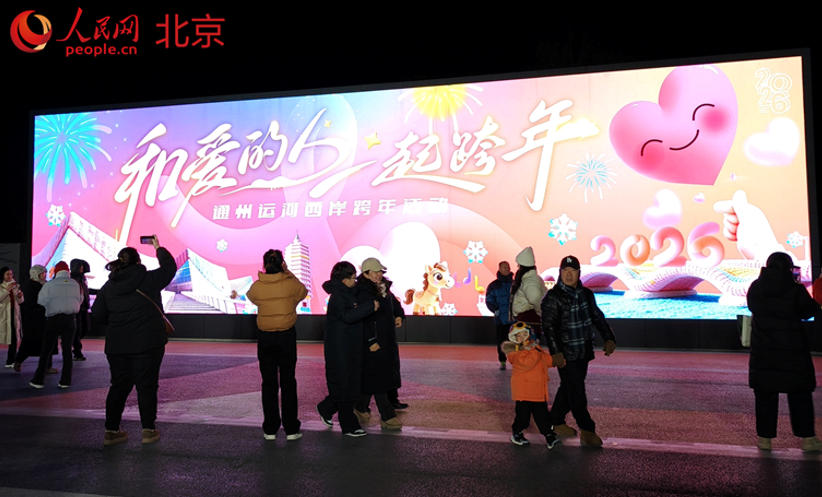
Intangible cultural heritage lantern displays, the Grand Canal cultural and creative IP “He Xi,” the Grand Canal Music Festival mascot “GULULU,” lion dances, and glowing stilt walker parades lit up the atmosphere. On the evening of December 31, 2025, a New Year’s Eve celebration themed “Ring in the New Year with Loved Ones” concluded on the west bank of the canal in Beijing’s sub-center, with a total daily visitor count reaching 33,900.
Scene from the event.
That night, a 1.3-kilometer stretch of the sub-center’s waterfront was transformed into a sea of joy. The activities on the canal’s west bank combined fun interactions and diverse performances, centered around a “Love Time Handbook” stamp collection plan that linked all interactive activities. Ten unique interactive stations were set up, allowing visitors to strengthen bonds by participating in various fun games.
A multi-dimensional performance matrix and themed parades were a major highlight of the evening. The main stage featured non-stop excitement from 7:30 PM to midnight, with a rotating lineup of electronic music, pop songs, horsehead fiddle performances, and more. Six auxiliary stages simultaneously offered “sing-along” experiences and joyful performances, catering to the entertainment needs of different audiences.
Seven parade teams completed four rounds of interactive parades that night, culminating in a final performance in front of a large screen just before midnight, pushing the New Year’s Eve atmosphere to its peak.
As midnight approached, the entire audience counted down together with synchronized light sticks, while a building laser show displayed the countdown visuals. Amid a chorus of “Happy New Year,” they welcomed the arrival of 2026.
“The intangible cultural heritage lanterns and the ‘He Xi’ IP parade were particularly distinctive. We specifically brought our child to experience the New Year’s atmosphere and learn about canal culture. It was very meaningful,” said a resident.
“The transportation from Yanjiao to Tongzhou is very convenient now. We heard about the New Year’s event here and came over. It was a chance to enjoy happy times with family and also feel the convenience brought by the coordinated development of the Beijing-Tianjin-Hebei region,” said a visitor from Yanjiao, Hebei.
Relevant officials stated that as a distinctive cultural and tourism activity by the Tongzhou Grand Canal, this New Year’s feast, with its rich content and vibrant atmosphere, not only created an unforgettable year-end experience for residents and visitors but also highlighted the charm of canal culture and the urban vitality of the sub-center, becoming a new cultural and tourism scene that fosters emotional connections and spreads warmth.
Intangible cultural heritage lantern displays
Intangible cultural heritage lantern displays are a traditional art form, often linked to festivals like China’s Lantern Festival, which dates back over 2,000 years to the Han Dynasty. These displays involve crafting and exhibiting decorative lanterns, symbolizing prosperity, hope, and the driving away of darkness. Recognized by UNESCO in some regions, this living tradition is passed down through generations, blending craftsmanship, folklore, and community celebration.
Grand Canal cultural and creative IP ‘He Xi’
The Grand Canal cultural and creative IP “He Xi” is a modern creative interpretation of the ancient Grand Canal’s heritage, designed to promote its cultural legacy through contemporary media and products. It draws inspiration from the canal’s 2,500-year history as a UNESCO World Heritage site and vital economic artery in China. This IP aims to make the canal’s history accessible and engaging, especially to younger audiences, by blending traditional elements with innovative storytelling and design.
Grand Canal Music Festival mascot ‘GULULU’
The “GULULU” mascot was created for the Grand Canal Music Festival, an annual cultural event held along China’s historic Grand Canal to celebrate music and heritage. It is a friendly, blue, water-drop shaped character symbolizing the canal’s life-giving waters and the fluid, connecting power of music.
lion dances
Lion dances are a traditional Chinese performance art often seen during festivals like Chinese New Year, believed to bring good luck and ward off evil spirits. Historically, they date back over a thousand years to the Tang Dynasty, with legends suggesting origins tied to a mythical beast called the *Nian*. The dance involves performers in an elaborate lion costume mimicking the animal’s movements to the beat of drums and cymbals.
glowing stilt walker parades
The “glowing stilt walker parades” are a modern spectacle, most famously associated with the annual **Nuit Blanche** festival in Amiens, France. Inspired by the city’s historic floating market gardens (*hortillonnages*), the parades feature performers on towering, illuminated stilts silently processing through the streets and waterways, creating a magical fusion of contemporary art and local heritage.
Grand Canal
The Grand Canal is a vast artificial waterway in eastern China, stretching over 1,100 miles from Beijing to Hangzhou. Its oldest sections date back to the 5th century BC, but it was significantly expanded and connected during the Sui Dynasty (6th-7th century AD) to transport grain and unify the empire. For centuries, it served as a vital economic and cultural artery, and it remains the world’s longest canal, recognized as a UNESCO World Heritage Site.
horsehead fiddle
The horsehead fiddle, known as the morin khuur, is the national instrument of Mongolia. Its origins trace back to the nomadic herding cultures of Central Asia, with a history often intertwined with folklore about a musician’s beloved horse. The instrument’s distinctive carved horse head at the top of its neck symbolizes the deep reverence Mongolians have for the horse, a central figure in their history and daily life.
Beijing-Tianjin-Hebei region
The Beijing-Tianjin-Hebei region is a major economic and cultural hub in northern China, anchored by the capital Beijing, the port city Tianjin, and the industrial province of Hebei. Historically, Beijing served as the imperial capital for centuries, while Tianjin grew as a strategic treaty port in the 19th century. Today, the region is being integrated through a national development strategy to create a coordinated megacity cluster.