Arab leaders offer condolences to Libya on the death of the Chief of the General Staff of the Libyan Army and his companions.
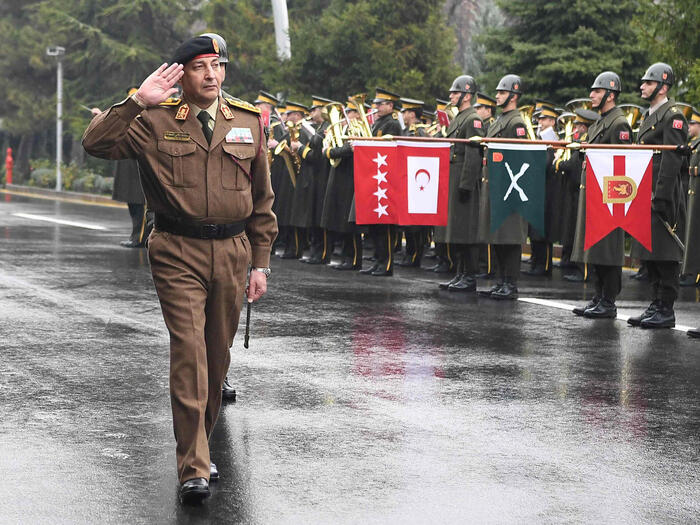
Tripoli – The President of the Presidential Council received cables of condolence and sympathy from a number of Arab leaders following the death of the Chief of the General Staff of the Libyan Army, Lieutenant General Muhammad al-Haddad, and his companions, in the crash of the plane carrying them near the Turkish capital, Ankara.
The Emir of the State of Qatar sent a cable of condolence for the death of the Chief of the General Staff of the Libyan Army, Lieutenant General Muhammad al-Haddad, and his companions, praying to God Almighty to envelop them in His vast mercy and forgiveness and to grant patience and solace.
The President of the United Arab Emirates sent a cable of condolence expressing his sincere condolences and heartfelt sympathy to Libya’s leadership and people in this grave tragedy.
Similar cables of condolence were also received from the Vice President and Prime Minister of the UAE and Ruler of Dubai, and from the Deputy Prime Minister and Presidential Court Chairman, both expressing their deep sorrow and sympathy with the Libyan people, praying to God Almighty to envelop the deceased and his companions in His vast mercy and to grant their families beautiful patience and solace.
The President of the Islamic Republic of Mauritania sent a cable of condolence to the President of the Presidential Council expressing his profound sorrow over the death of the Chief of Staff and his companions, offering the sincerest expressions of condolence and sympathy to the Libyan government and people and to the families of the victims, praying to God to grant them spacious abodes in His Paradise.
In the same context, a cable of condolence was received from the President of the State of Palestine, who affirmed his sharing of Libya’s grief in this painful tragedy, expressing his condolences to the Libyan people, its leadership, the Libyan army, and the families of the victims, and beseeching God to envelop them in His vast mercy and to protect Libya and its people from all harm.
Tripoli
Tripoli is the capital and largest city of Libya, located on the country’s Mediterranean coast. Historically, it was founded by the Phoenicians in the 7th century BCE and has since been ruled by the Romans, Arabs, Ottomans, and Italians, which is reflected in its diverse architecture, such as the ancient Red Castle (Assaraya al-Hamra) and the old medina. Today, it serves as Libya’s major political, economic, and cultural center.
Libyan Army
The Libyan Army, formally known as the Libyan Arab Armed Forces, is the official military force of Libya. It was originally established after Libya’s independence in 1951 and was significantly expanded under Muammar Gaddafi’s rule (1969-2011). Following the 2011 civil war and Gaddafi’s fall, the army fractured, and today it is largely under the command of the Government of National Stability in eastern Libya, operating in a country divided by ongoing conflict and rival administrations.
Ankara
Ankara is the capital city of Turkey, located in the central Anatolia region. While its history dates back to ancient civilizations like the Hittites, it gained modern prominence in 1923 when Mustafa Kemal Atatürk chose it as the capital of the newly founded Republic of Turkey, replacing Istanbul. Today, it is a major political and administrative center, home to landmarks such as the ancient Roman Temple of Augustus and the grand Anıtkabir, the mausoleum of Atatürk.
State of Qatar
The State of Qatar is a sovereign nation on the northeastern coast of the Arabian Peninsula, historically shaped by its Bedouin heritage and maritime pearl-diving economy. It transformed dramatically after gaining full independence from Britain in 1971 and the subsequent large-scale exploitation of its vast natural gas and oil reserves. Today, it is a modern, influential global hub known for its ultramodern architecture, hosting major events like the 2022 FIFA World Cup, and preserving its cultural identity through institutions like the Museum of Islamic Art.
United Arab Emirates
The United Arab Emirates (UAE) is a modern federation of seven emirates on the Arabian Peninsula, established in 1971 following the end of British protection. Historically a region of pearl diving, fishing, and Bedouin tribes, its transformation was fueled by the discovery of oil in the mid-20th century. Today, it is globally renowned for its rapid development, iconic landmarks like the Burj Khalifa, and a blend of deep Islamic heritage with cosmopolitan culture.
Dubai
Dubai is a major global city and emirate in the United Arab Emirates, historically a small fishing and pearling village. Its modern transformation began with the discovery of oil in the 1960s, but it is now best known for its ambitious architecture, luxury shopping, and tourism, having strategically diversified its economy. Iconic landmarks like the Burj Khalifa and Palm Jumeirah symbolize its rapid development into a futuristic hub for business and travel.
Islamic Republic of Mauritania
The Islamic Republic of Mauritania is a country in Northwest Africa, not a single cultural site. Historically, it was a crossroads for ancient Saharan trade routes and home to powerful Berber kingdoms. It gained independence from France in 1960 and is named for the ancient Berber kingdom of Mauretania, with Islam as the state religion and a culture deeply shaped by its Moorish (Arab-Berber) and Sub-Saharan African heritage.
State of Palestine
The State of Palestine is a partially recognized sovereign state in the Middle East, comprising the West Bank and the Gaza Strip. Its modern political history is rooted in the Israeli-Palestinian conflict, with the Palestine Liberation Organization (PLO) founded in 1964 and the Palestinian National Authority established in 1994 following the Oslo Accords. It is a region of profound historical and religious significance, home to ancient cities like Bethlehem and Jericho, and is central to the cultural heritage and national aspirations of the Palestinian people.