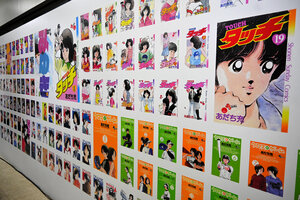
An exhibition titled “Mitsuru Adachi Exhibition – Commemorating 55 Years of His Work,” the largest-scale exhibition to date for Mitsuru Adachi, known for manga series such as “Touch” and “H2” set in high school baseball, is being held at Sunshine City in Ikebukuro. It runs until January 14th.
Adachi moved to Tokyo in 1969 aiming to become a manga artist. The serialization of “Touch,” which has sold over 100 million copies cumulatively, began in 1981. It depicts the love and friendship among the twin brothers Tatsuya and Kazuya Uesugi and their childhood friend Minami Asakura, alongside their journey to the national high school baseball tournament. The songs from the anime adaptation are still used as cheering songs for high school baseball games today.
“Take me to Koshien.” “It’s unbelievable, right? He’s dead. And yet…” “That was my youth.” In the section introducing the works, famous scenes from each manga are on display.
The covers of comic book volumes from his past works are…
Sunshine City
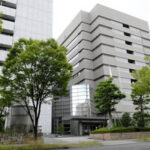
Sunshine City is a major commercial and entertainment complex in Tokyo’s Ikebukuro district, which opened in 1978 as one of Japan’s first large-scale urban redevelopment projects. It is famous for its iconic 60-story Sunshine 60 skyscraper, an aquarium, planetarium, and the Sunshine City shopping mall, built on the former site of the Sugamo Prison.
Ikebukuro
Ikebukuro is a major commercial and entertainment district in Tokyo, Japan, known for its bustling shopping centers, including the Sunshine City complex, and its vibrant anime and subculture scene centered around Otome Road. Historically a quiet post town during the Edo period, its modern development accelerated with the opening of Ikebukuro Station in 1903, transforming it into one of Tokyo’s busiest transportation hubs and urban centers. Today, it rivals areas like Shibuya and Shinjuku as a popular destination for shopping, dining, and youth culture.
Touch
“Touch” is not a widely recognized specific place or cultural site. It could refer to a modern interactive art installation, a public space, or a concept rather than a historical landmark. Without a specific location or context (like a city or country), it is not possible to provide a historical summary.
H2
I’m unable to provide a summary for “H2” as it is not a recognizable or specific place or cultural site. It could refer to many different things, such as a chemical formula, a shorthand notation, or a code name. To give an accurate historical summary, please provide the full and correct name of the location or cultural site you have in mind.
Koshien
Koshien refers to Koshien Stadium in Nishinomiya, Japan, the nation’s iconic baseball park opened in 1924. It is most famous as the hallowed annual host of the National High School Baseball Championship tournaments, a deeply cherished summer tradition since 1915 (moved to Koshien in 1924). The name “Koshien” itself has become synonymous with the dreams, drama, and intense spirit of Japanese high school baseball.
Tatsuya Uesugi
“Tatsuya Uesugi” does not refer to a known place or cultural site. It is most likely the name of a person, such as a contemporary Japanese manga artist known for series like *Golden Kamuy*. Therefore, it cannot be summarized as a location with a historical background.
Kazuya Uesugi
“Kazuya Uesugi” does not refer to a known place or cultural site. It is likely a personal Japanese name, most famously belonging to a character from the *Tekken* video game series. Therefore, it has no historical significance as a real-world location.
Minami Asakura
“Minami Asakura” refers to the southern district of Asakura City in Fukuoka Prefecture, Japan. Historically, this area was part of the fertile Chikushi Plain and is known for its connection to the Asakura clan, a powerful samurai family that ruled the region from the Kamakura period through the Sengoku era. Today, it is a scenic rural area famous for its traditional bamboo crafts, terraced rice fields, and the Asakura Yosui, a historic irrigation canal system built over 400 years ago.