Photos: Minister of Tourism Launches “Northern Route”.. A Blend of History and Nature in One Destination
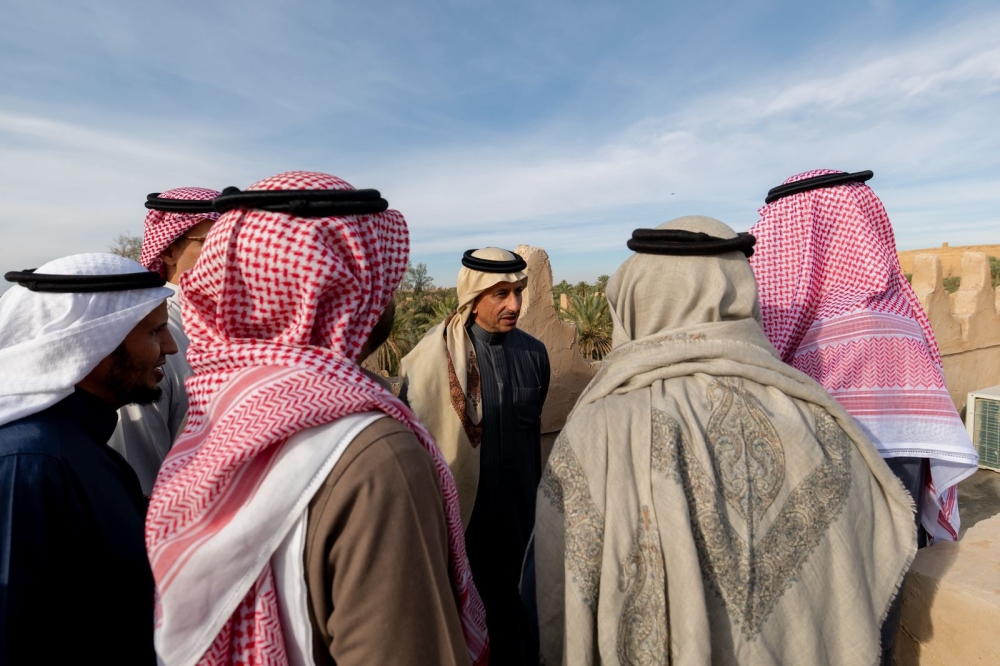
The Minister of Tourism launched the first trips of the “Northern Tourist Pathway” as part of the “Saudi Winter” program, during an extensive field tour starting from the capital, Riyadh, passing through the Al-Qassim governorates and reaching Hail. The aim is to highlight the unique geographical and heritage diversity of the Kingdom and enhance the status of northern tourist destinations as a strategic winter choice for visitors from within and outside the country.
The minister began his exploratory tour from the Thadiq governorate, where he conducted a field visit to the “Riyadh North Geopark,” which is one of the most important global geological heritage sites recognized by UNESCO.
Integrating Sustainable Tourism
The minister inspected the rock formations and natural valleys in the geopark, emphasizing the importance of integrating sustainable tourism with scientific knowledge to preserve this rare geological legacy under the supervision of the National Center for Vegetation Cover Development.
The first stop included a visit to the Al-Ghamrah Tourist Village and the Heritage Village in Thadiq, where the minister toured the mud-brick buildings and traditional markets that reflect the authentic Najdi identity and the deep history of the region.
The journey’s route later moved to the Al-Qassim region, where the minister reviewed the growing rural tourism experiences, inspecting the “Al-Bustan” farm in Buraidah as a living model for integrating agriculture with attractive tourist activity.
The minister visited the Al-Qassim Cultural Heritage Center, praising the increasing turnout of visitors to the center and its role in preserving the cultural memory of the region and presenting it to the world in a modern way.
The Minister of Tourism concluded the pathway in the Hail region, where he explored the historical depth at the “Umm Sinman” mountain site in Jubbah, which is registered on the UNESCO World Heritage List and documents human inscriptions dating back more than ten thousand years.
The minister reviewed the readiness of hiking trails in the Aja Mountains and desert adventure experiences, in addition to visiting the houses of Hatim Al-Tai and the Al-Didhan Reserve, to assess the integration of the tourist experience.
The Northern Tourist Pathway, extending from the center of the Kingdom to its north, represents a qualitative product that connects heritage with nature, offering visitors of “Saudi Winter” a comprehensive journey through time and geography.
Riyadh North Geopark
The Riyadh North Geopark is a UNESCO Global Geopark in Saudi Arabia, recognized for its exceptional geological heritage showcasing over 540 million years of Earth’s history, including ancient marine fossils and volcanic structures. It serves as a major educational and touristic site, highlighting the region’s dramatic desert landscapes and its deep connection to the natural history of the Arabian Peninsula.
Al-Ghamrah Tourist Village
Al-Ghamrah Tourist Village is a modern recreational and cultural complex located in the Al-Ahsa Oasis of Saudi Arabia, designed to reflect traditional Najdi architecture. It was developed as part of regional efforts to promote tourism and showcase local heritage, offering visitors experiences like traditional markets, cafes, and craft demonstrations. While it does not have a deep ancient history itself, it serves as a gateway to the historic Al-Ahsa region, a UNESCO World Heritage site known for its ancient palm groves and human settlement dating back thousands of years.
Heritage Village in Thadiq
The Heritage Village in Thadiq is a cultural and historical site in Saudi Arabia’s Riyadh Province, designed to preserve and showcase the traditional Najdi architecture and way of life. It features restored mud-brick buildings, a museum with local artifacts, and spaces for cultural events, reflecting the region’s history before the modern development spurred by the discovery of oil.
Al-Bustan farm
Al-Bustan farm is a historic agricultural estate and cultural site located in the Shouf region of Lebanon. Originally established in the 19th century, it is renowned for its traditional terraced gardens and its role in preserving local farming heritage. Today, it operates as an eco-tourism destination and educational center focused on sustainable practices and Lebanese rural traditions.
Al-Qassim Cultural Heritage Center
The Al-Qassim Cultural Heritage Center, located in the city of Buraydah in Saudi Arabia, is a museum and cultural institution dedicated to preserving and showcasing the rich heritage of the Al-Qassim region. It highlights the area’s history, traditional architecture, crafts, and Bedouin way of life, with exhibits often featuring historical artifacts, reconstructions of old buildings, and displays on local agriculture and date palm cultivation. The center serves as an important hub for educating both residents and visitors about the region’s deep-rooted customs and its role in the cultural fabric of Saudi Arabia.
Umm Sinman mountain site in Jubbah
The Umm Sinman mountain site in Jubbah, located in northern Saudi Arabia, is a UNESCO World Heritage site renowned for its vast collection of ancient rock art. The carvings and inscriptions, some dating back over 7,000 years, were created by successive cultures who inhabited the area when it was a lush lakeside landscape. They depict a rich visual record of human and animal life, including now-extinct species, from the Neolithic period through the Bronze Age.
Houses of Hatim Al-Tai
The Houses of Hatim Al-Tai are the ruins of an ancient palace complex in the Hail region of Saudi Arabia, traditionally linked to the legendary pre-Islamic Arab poet Hatim al-Tai, known for his extreme generosity. The site, dating to the 6th-7th centuries CE, consists of stone foundations and walls that offer a glimpse into the architectural style of the late pre-Islamic period in northern Arabia. It stands as a significant cultural landmark, embodying the region’s history and the enduring folkloric tales of Arabian hospitality.
Al-Didhan Reserve
Al-Didhan Reserve is a protected natural area located in Saudi Arabia’s Al-Qassim region, known for its diverse desert wildlife and scenic landscapes. Historically, the region has been part of the traditional grazing lands for Bedouin communities, and it was officially designated as a reserve to conserve its unique ecosystem and native species, such as the Arabian oryx and gazelles. Today, it serves as an important site for environmental education and eco-tourism.