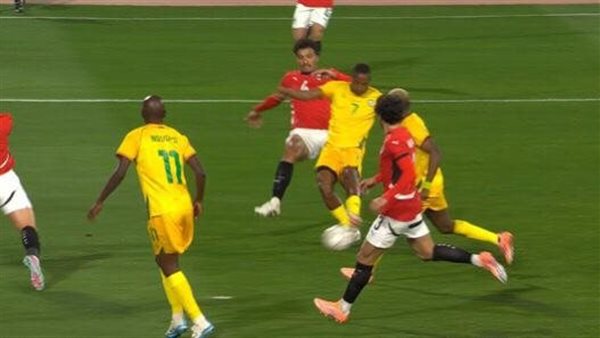
The events of the first half have concluded in the match currently taking place between the two national teams at the Adrar Stadium in the Moroccan city of Agadir, as part of the first round of the group stage for the Africa Cup of Nations being held in Morocco.
Egypt vs Zimbabwe Match Result
The first half result saw the Egyptian national team trailing by one goal to nil. Egypt’s net conceded the first goal from the Zimbabwe national team in the 20th minute through player Prince Dube, following a defensive coverage error by Egypt’s center-back Hossam Abdel Majeed.
The Egyptian national team started the match with strong attacking pressure, and there were multiple attempts by Egypt’s players to score the first goal for the Pharaohs. However, contrary to the run of play, the Zimbabwe national team exploited a defensive error by Hossam Abdel Majeed to score their first goal in the match.
After conceding the goal, haste dominated the movements of the Egyptian national team players. A substitution was made in the 33rd minute, with striker Mostafa Mohamed coming on instead of Emam Ashour.
The Egyptian national team started the match with the following lineup:
Goalkeeper: Mohamed El Shenawy
Defense: Mohamed Hany – Yasser Ibrahim – Hossam Abdel Majeed – Mohamed Hamdy
Midfield: Marwan Attia – Emam Ashour – Hamdy Fathy
Attack: Mahmoud Hassan Trezeguet – Omar Marmoush – Mohamed Salah
On the substitutes’ bench for the Egyptian national team were: Ahmed El Shenawy – Mostafa Shobier – Khaled Sobhi – Ahmed Eid – Ahmed Fotouh – Rami Rabia – Mohamed Shehata – Mahmoud Saber – Mohanad Lasheen – Mostafa Fathi – Ibrahim Adel – Ahmed Sayed Zizo – Osama Faisal – Salah Mohsen – Mostafa Mohamed.
Adrar Stadium
Adrar Stadium is a multi-purpose sports venue located in Agadir, Morocco, primarily used for football matches and as the home ground of the local club Hassania Agadir. It was inaugurated in 2013 to replace the older Stade Al Inbiaâte, built to meet modern standards and host matches for the 2013 FIFA Club World Cup. The stadium is named after the nearby Adrar mountain and reflects Agadir’s status as a major coastal and tourist hub.
Morocco
Morocco is a North African country with a rich history shaped by indigenous Amazigh (Berber) cultures, Arab influence from the 7th-century Islamic conquests, and later European colonial interests. It is renowned for its diverse cultural heritage, visible in historic imperial cities like Marrakech and Fez, which feature ancient medinas, palaces, and mosques. Today, it is a constitutional monarchy known for its unique blend of Arab, African, and Mediterranean traditions.
Agadir
Agadir is a major coastal city in southwestern Morocco, known today for its modern beach resorts and vibrant tourism. Its history is marked by tragedy, as the original city was almost completely destroyed by a devastating earthquake in 1960. It was subsequently rebuilt a short distance south of the ruins, which is why it features a contemporary grid layout distinct from Morocco’s older, labyrinthine medinas.
Africa Cup of Nations
The Africa Cup of Nations (AFCON) is the premier international men’s football competition in Africa, first organized in 1957. Founded with just three participating nations, it was initially a symbol of pan-African unity and independence. It has since grown into a major global sporting event, held every two years and featuring 24 national teams competing for the continent’s top football honor.
Egypt
Egypt is home to one of the world’s oldest civilizations, with a recorded history spanning over 5,000 years, famously unified under its first pharaoh around 3100 BCE. Its iconic cultural sites, such as the Pyramids of Giza and the temples of Luxor, are monumental legacies of the ancient pharaonic kingdoms that once ruled the Nile Valley. Today, these ancient wonders exist alongside vibrant Islamic, Coptic, and modern Egyptian culture, making the country a profound historical and living cultural destination.
Zimbabwe
Zimbabwe is a country in southern Africa that takes its name from the ancient city of Great Zimbabwe, a UNESCO World Heritage site. This impressive stone complex, built between the 11th and 15th centuries by the Shona civilization, served as a royal palace and trading hub. Today, the modern nation preserves this legacy, with the stone ruins standing as a powerful symbol of pre-colonial African achievement and statecraft.
Pharaohs
“Pharaohs” refers to the divine kings of ancient Egypt who ruled for over 3,000 years, from around 3100 BCE to 30 BCE. They were considered living gods and were the central political and religious figures responsible for monumental construction projects like the pyramids and temples, which were designed to ensure their legacy in the afterlife. Their history is divided into periods such as the Old, Middle, and New Kingdoms, ending with the death of Cleopatra VII and Egypt’s absorption into the Roman Empire.
Mohamed Salah
Mohamed Salah is not a place or cultural site, but a world-renowned Egyptian professional footballer. He is a forward for Liverpool FC and the Egypt national team, known for his speed, skill, and goal-scoring record. His cultural significance lies in his role as a modern icon who has inspired pride and brought global attention to Egyptian and Arab athletes.