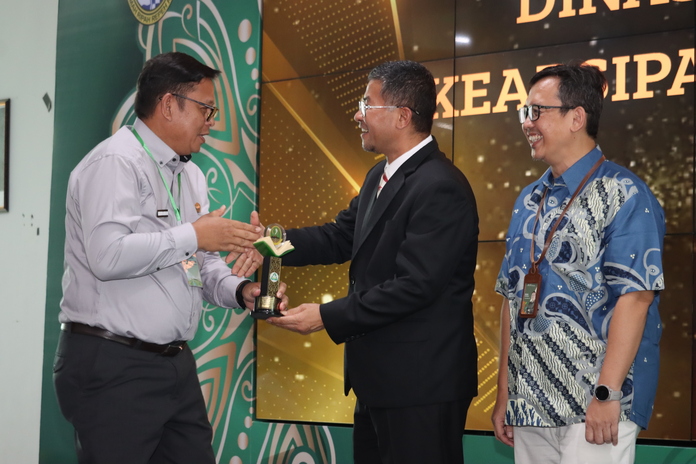
The West Java Provincial Government has awarded the 2025 Governor’s Award for the Environment to local governments, schools, communities, regional agencies, and businesses assessed as consistently undertaking concrete actions for environmental protection and management.
The awards were presented at a ceremony held by the West Java Provincial Environmental Service at the Environmental Service Building Hall in Bandung City.
This activity is part of the West Java Provincial Government’s efforts to encourage cross-sectoral involvement in maintaining environmental quality.
It was stated that this is a strategic regional government program to appreciate parties committed to environmental sustainability.
“Philosophically, Raksa means protector, while Prasada is interpreted as a shelter, representing our shared responsibility to protect our Earth,” it was explained.
It was detailed that in 2025, a total of 160 recipients from six categories received the provincial-level award.
These categories include 124 Environmentally Cultured Schools (Adiwiyata), Businesses Fostering Environmental Services, Businesses Fostering Biodiversity Parks, ProKlim (Climate Village Program) Facilitators in six regencies/cities, 25 Climate Community Program locations, and Environmentally Cultured Offices (Eco Office) in three regional agencies.
It was emphasized that West Java’s economic progress must go hand in hand with environmental protection.
Based on 2024 Environmental Quality Index data, the achievement stands at 66.09 points or in the moderate category, although it has improved compared to the previous year.
According to the data, air quality is currently in the good category and shows a positive trend. However, water and land quality remain challenges, especially in areas with industrial activity.
A call was made for local governments to be bold and firm against companies proven to pollute the environment, including imposing sanctions as stipulated.
Furthermore, waste management issues remain a significant task. The West Java Provincial Government is encouraging a shift in waste management patterns from upstream to downstream, focusing on community-based reduction, sorting, and processing.
One award recipient, the Principal of SDN Sertajaya 05 in Bekasi Regency, mentioned this award is a form of recognition for the long process undertaken by their school.
“Despite being in a densely populated area with limited land, the school has been able to create green spaces through the innovative use of used bottles and gallon containers as planting media,” it was stated.
Through the 2025 Award, the West Java Provincial Government hopes that good environmental management practices can be widely replicated, so that environmental quality in West Java continues to improve sustainably.
West Java Provincial Government
The West Java Provincial Government is the administrative authority governing Indonesia’s most populous province, centered in Bandung. Its history is rooted in the 1950 establishment of the province following Indonesian independence, with its governance structures evolving through the nation’s political changes. Today, it manages the region’s development, culture, and public services from the **Gedung Sate** complex, a historic Dutch colonial building that serves as its iconic headquarters.
Environmental Service Building Hall
The Environmental Service Building Hall is a modern facility typically found in municipal or corporate campuses, designed to house departments focused on sustainability, waste management, and ecological protection. Its history is generally tied to the late 20th or early 21st-century institutional shift toward dedicated environmental governance and green architecture. As a functional administrative center, it symbolizes a community’s or organization’s formal commitment to environmental stewardship.
Bandung City
Bandung is the capital of West Java, Indonesia, famously known as the “Paris of Java” for its colonial-era art deco architecture and vibrant creative scene. Historically, it gained prominence as a planned Dutch colonial hill station in the 19th century and was the site of the pivotal 1955 Asia-Africa Conference, which solidified its role in the post-colonial era. Today, it is a major educational, technological, and cultural hub, celebrated for its universities, fashion, and culinary offerings.
Bekasi Regency
Bekasi Regency is a regency located in West Java, Indonesia, surrounding the independent city of Bekasi. Historically, it was part of the ancient Tarumanagara and Sunda Kingdoms before becoming a significant agricultural and, more recently, a major industrial and residential expansion zone for the Jakarta metropolitan area.
SDN Sertajaya 05
SDN Sertajaya 05 is a public elementary school (Sekolah Dasar Negeri) located in the Sertajaya village area of Cikarang Pusat, Bekasi Regency, West Java, Indonesia. As part of the national public education system, its history is tied to local community development, serving to provide foundational education to children in its surrounding sub-district for many years.
Adiwiyata
“Adiwiyata” is not a specific historical place or cultural site, but a national environmental education program in Indonesia. Launched by the Ministry of Environment in 2006, its goal is to encourage schools to integrate environmental values into their teaching and daily operations. The term itself means a “good place” where one can gain knowledge, norms, and ethics, with the program aiming to create a generation that cares for and is responsible for the environment.
ProKlim (Climate Village Program)
ProKlim (Climate Village Program) is an Indonesian government-led community initiative launched in 2012 to empower local villages in climate change adaptation and mitigation. It encourages communities to implement sustainable practices like waste management, energy conservation, and tree planting to build resilience. The program has grown into a nationwide movement, with thousands of villages recognized for their efforts in reducing emissions and environmental risks.
Eco Office
“Eco Office” is not a specific, widely recognized historical or cultural landmark. The term generally refers to a modern office building or workspace designed and operated with a strong focus on environmental sustainability, using principles like energy efficiency, renewable materials, and waste reduction. As a concept, it emerged prominently in the late 20th and early 21st centuries alongside the global green building movement, rather than having a long historical narrative.