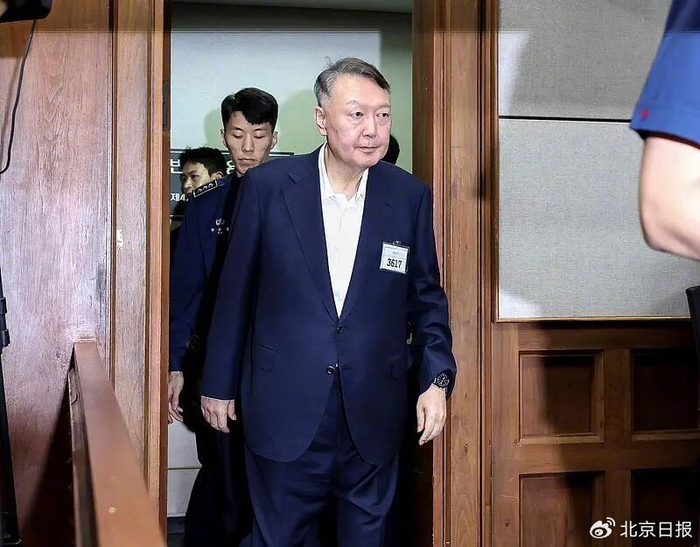
According to CCTV News, on the 15th local time, South Korea’s special investigation team probing the emergency martial law incident announced its final findings, indicting 24 individuals including former President Yoon Suk Yeol.
The report states that Yoon Suk Yeol planned to declare emergency martial law in order to “eliminate opposing political forces, monopolize and maintain power” by “using military force to halt political activities and parliamentary functions, and after seizing legislative and judicial power through an emergency legislative body replacing the National Assembly.”
The report further notes that to create a pretext for declaring emergency martial law, Yoon Suk Yeol and others attempted to induce a military attack from North Korea through irregular military operations, but failed as North Korea did not respond militarily.
Subsequently, Yoon Suk Yeol and others “defamed the political activities within the National Assembly as ‘anti-state acts’ and ‘anti-state forces’ plotting rebellion, and used this as a reason to declare emergency martial law.”
Yoon Suk Yeol “Premeditated”
The investigation report reveals that Yoon Suk Yeol had already begun preparations to declare emergency martial law before October 2023, entering a substantive preparation phase for it starting in October 2023.
The report claims that Yoon Suk Yeol had been considering “extraordinary powers” since the beginning of his term and mentioned it multiple times to those around him. A former high-ranking intelligence official testified that they had heard as early as July-August 2022 about Yoon Suk Yeol’s plan to implement martial law after the parliamentary elections.
The special investigation team found that Yoon Suk Yeol and others conducted personnel reshuffles of high-ranking military officials in October 2023, promoting figures like former Army Chief of Staff Park An-soo and former Defense Counterintelligence Commander Yeo In-hyung, who had played core roles in past martial law situations.
The special prosecution stated that from this period onward, preparations for emergency martial law by Yoon Suk Yeol and others were in full swing.
Yoon Suk Yeol and others set the timing for emergency martial law after the April 2024 parliamentary elections, deciding to forcibly implement it regardless of the election outcome, and continuously discussed specific implementation methods.
They also guided military commanders to perceive the then politically unfavorable situation for the government as a “national crisis caused by pro-North Korean leftist forces,” constantly instilling the notion that “the military must step in.” This was to make the military acknowledge the necessity of declaring emergency martial law and to repeatedly emphasize Yoon Suk Yeol’s firm determination to implement it.
The special investigation team concluded that Yoon Suk Yeol, not acting out of so-called conviction, defamed his opponents as anti-state forces and attempted to eliminate them through emergency martial law.
Timeline of South Korea’s Martial Law Controversy
December 3, 2024, 22:00: Then-President Yoon Suk Yeol issued an emergency martial law decree, facing strong opposition from National Assembly members.
December 4, 04:00: Yoon Suk Yeol announced the lifting of martial law, which lasted only 6 hours.
December 14: The South Korean National Assembly passed an impeachment motion against Yoon Suk Yeol, and his presidential powers were immediately suspended.
January 15, 2025: Yoon Suk Yeol was arrested for the first time, becoming the first sitting president in South Korea’s constitutional history to be arrested.
March 8: Yoon Suk Yeol was released.
April 4: The South Korean Constitutional Court announced the approval of Yoon Suk Yeol’s impeachment, removing him from the presidency.
July 10: The Seoul Central District Court issued an arrest warrant citing “concerns (the suspect) might destroy evidence.” Yoon Suk Yeol was arrested again after 124 days.
December 4: The special investigation team additionally indicted Yoon Suk Yeol on charges of perjury.