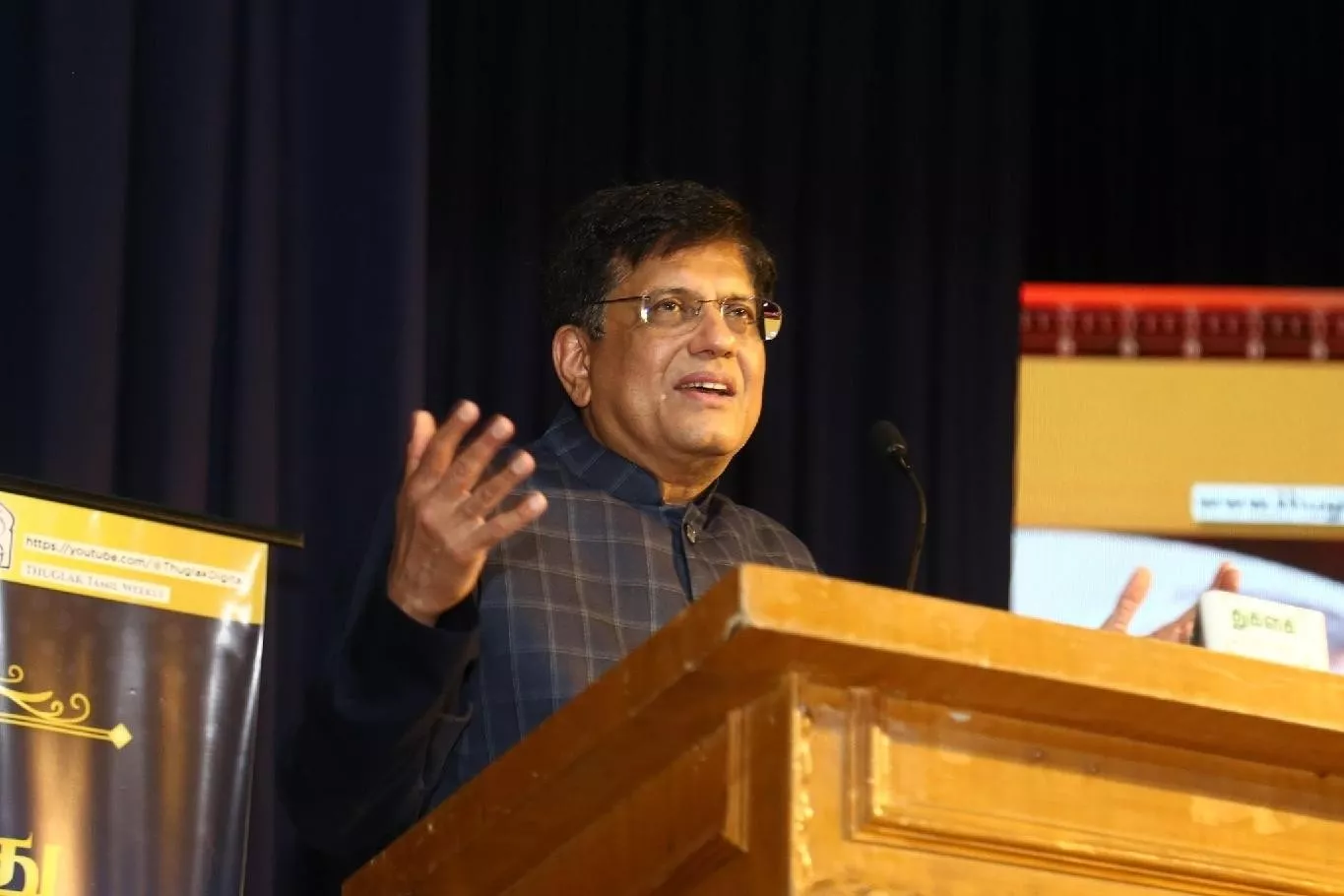
Commerce and Industry Minister Piyush Goyal said on Monday that due to sufficient power availability and a 500-gigawatt national grid capacity, India is emerging as a preferred destination for data centers. Goyal said at a press conference on the energy sector that there is no shortage of electricity in the country and there is full capacity to meet the growing demand.
Goyal said India’s 500-gigawatt national grid is one of the largest grids in the world. Goyal stated that Europe does not have a national grid. And America also does not have a national grid, but India has a national grid. This is why India is a preferred destination for data centers. Amidst plans for the expansion of data centers and global capability centers (GCCs) in the coming years, it will be ensured that the electricity needs of people, farmers, industry, and commercial establishments are met.
Trend of Global Tech Companies Making Major Data Center Investments in India
Goyal’s statement comes at a time when several global technology companies, including Google, Microsoft, and Amazon Web Services (AWS), have shown interest in making major investments in India. In October, Google announced a $15 billion investment for the development of artificial intelligence (AI) infrastructure in Andhra Pradesh. Under this project, Google will partner with the Adani Group to establish a gigawatt-scale data center, which is expected to create 5,000–6,000 direct and 20,000–30,000 total jobs in the state.
Last week, AWS also announced a $7 billion investment for expanding data centers in Telangana within the next 14 years. Prior to this, Microsoft announced plans for a $17.5 billion investment in building infrastructure and autonomous capabilities for an AI-focused future in India. Regarding the plan to increase coal-based thermal power capacity, Goyal said this step is being taken keeping in mind the needs of the country’s citizens.
Will Become a Global Example for a Developed India by 2047
Goyal said that India is a developing country and it needs low-cost energy with a short transition time. Increasing coal production will further reduce dependence on imports. The minister also stated that work is being done on alternatives like synthetic gas from coal. Goyal said that by 2035, the estimated requirement for thermal power could increase to 307 gigawatts.
Goyal also said that the financial condition of power generation companies has improved, and companies that were in debt of ₹1.4 lakh crore four years ago now have only ₹6,500 crore of debt remaining. He said that while moving towards making India a developed nation by 2047, India’s energy sector will become a global example of balancing scale, speed, and stability. Meanwhile, Minister of State for Power Shripati Naik said in a written reply in the Rajya Sabha that the current power requirement of data centers in the country is approximately one gigawatt, which is estimated to increase to 13.56 gigawatts by the financial year 2031-32.
India
India is a vast South Asian country with one of the world’s oldest continuous civilizations, dating back over 5,000 years to the Indus Valley. Its history is marked by the rise of major religions like Hinduism and Buddhism, a tapestry of powerful empires, and British colonial rule before gaining independence in 1947. Today, it is a vibrant, populous democracy renowned for its profound cultural diversity, ancient monuments, and deep spiritual heritage.
Europe
Europe is a continent with a rich and complex history, shaped by ancient civilizations like Greece and Rome, the transformative Middle Ages, the Renaissance, and periods of both empire and devastating conflict. Culturally, it is home to a vast array of UNESCO World Heritage sites, from medieval castles and Gothic cathedrals to artistic masterpieces and historic city centers. Its modern identity is defined by the post-World War II project of the European Union, promoting peace and integration among its diverse nations.
America
“America” generally refers to the United States of America, a nation founded in 1776 after declaring independence from Great Britain. Its history spans from indigenous civilizations, through European colonization, to becoming a global superpower shaped by immigration, industry, and ideals of democracy. Culturally, it is a vast and influential mosaic, known for its diverse population, popular culture, and significant impact on technology, media, and the arts.
Andhra Pradesh
Andhra Pradesh is a state in southeastern India, historically significant as the location of ancient kingdoms like the Satavahanas and Vijayanagara Empire. It is renowned for its rich cultural heritage, including classical Kuchipudi dance and distinctive Telugu-language literature and cinema. The state was reorganized in 2014 when its northwestern region was carved out to form the new state of Telangana.
Telangana
Telangana is a state in southern India, formed in 2014 after a movement to separate from Andhra Pradesh. Its history is deeply rooted in powerful dynasties like the Satavahanas, Kakatiyas, and the Qutb Shahis of Golconda, whose iconic fort in Hyderabad stands as a major cultural symbol. The region is known for its distinct Deccani culture, historic monuments, and as a major hub for information technology and pharmaceuticals.
Adani Group
The Adani Group is a major Indian multinational conglomerate founded in 1988 by Gautam Adani, starting as a commodity trading firm. It has since grown into a global infrastructure giant with core businesses in ports, logistics, energy, and resources, playing a significant role in India’s economic development. Its rapid expansion, particularly in renewable energy and infrastructure projects, has made it one of India’s most prominent and sometimes controversial corporate entities.
Rajya Sabha
The Rajya Sabha, or Council of States, is the upper house of India’s bicameral Parliament. Established in 1952 under the Constitution of India, it represents the states and union territories, providing a federal balance to the directly elected Lok Sabha. Its members are largely elected by state legislative assemblies, and it serves as a revising chamber for legislation.
2047
“2047” is not a widely recognized historical place or cultural site. It is most commonly referenced as a symbolic year representing the 50th anniversary of the end of British colonial rule in Hong Kong and the promise of its “one country, two systems” framework. As such, it is a date loaded with political and cultural significance regarding Hong Kong’s future, rather than a physical location with a history.