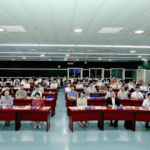
This morning, the municipal government information office held the 16th session of the “Practical Work Draws Answers, Relay for a New Blueprint” series of press conferences on the achievements of Shanghai’s 14th Five-Year Plan. Focusing on the theme of “Comprehensively Serving and Safeguarding National Strategies, Striving to Build the Yangtze River Delta Innovation Hub,” the Qingpu District Party Committee Secretary introduced the district’s construction and development achievements during the 14th Five-Year Plan period. The Deputy Secretary and District Chief of Qingpu, along with directors from the District Development and Reform Commission, Commerce Commission, Water Affairs Bureau, and Culture and Tourism Bureau, jointly attended the press conference and answered questions.
Since the beginning of the 14th Five-Year Plan period, Qingpu District has leveraged major strategic tasks such as serving the China International Import Expo, the Yangtze River Delta Integrated Development Demonstration Zone, the Hongqiao International Open Hub, and new city construction to seize opportunities and work collaboratively, driving economic and social development to new heights. In 2024, Qingpu’s GDP reached 182.5 billion yuan, 1.5 times that at the end of the 13th Five-Year Plan period. The urban image of “High Aesthetics, Most Jiangnan, Innovation Core, Warm Home” has become deeply rooted in people’s hearts.
I. The “High Aesthetics” Urban Image Rapidly Rises
Qingpu connects to the strong momentum of Greater Hongqiao in the east and links to the vast hinterland of the Yangtze River Delta in the west, while the central new city strengthens strategic connections with both wings. The city’s energy level and core competitiveness continue to climb, the regional appearance has been completely renewed, and the “High Aesthetics” urban image has become increasingly vivid.
Eastern Wing “Greater Hongqiao”: The International Open Hub Takes Shape. Qingpu is the permanent host of the China International Import Expo. The Hongqiao Qingpu area is accelerating the development of a private enterprise headquarters cluster zone and a Silk Road E-commerce Cooperation Pilot Zone, attracting leading companies such as Midea, NetEase, Anta, and Bosideng. The district has gathered 109 headquarters enterprises and 38 listed companies. From January to October, cross-border e-commerce import and export volume reached 8.29 billion yuan, ranking first in the city.
Western Wing “Demonstration Zone”: The “Innovation Green Core” Construction Advances Rapidly. Aligning with the requirements of an “innovation field” and incubator, efforts have been made to land Huawei’s largest global R&D center, gathering high-energy platforms such as the Xicen Science and Innovation Park, Innovation Intelligence Engine, and national key laboratories. Projects like the Demonstration Zone Line, Shanghai-Suzhou-Huzhou High-Speed Rail, and Line 17 Western Extension support the “Demonstration Zone on Rails.” The “One Courtyard Spanning Three Places” Square Hall Water Courtyard has become a new landmark for Yangtze River Delta integrated construction. Qingpu, Wujiang, and Jiashan have strengthened cross-regional coordination, achieving “one blueprint managing the entire area” and “one set of standards managing quality,” forming 154 institutional innovation achievements, with 61 replicated and promoted nationwide.
Central Qingpu New City: A Livable and Business-Friendly Future City Rapidly Rises. The new city’s central business district is taking initial shape, and the long-troubling old city area renovation has substantially started. Key industries such as high-end equipment manufacturing and biomedicine are gathering strength. Huawei’s “Yangtze River Delta AI+ Joint Innovation Center” has begun construction, and the brand of “First Stop for Yangtze River Delta Enterprises Entering Shanghai and Going Global” continues to gain recognition.
II. The “Most Jiangnan” Cultural Charm Fully Shines
Building on the blue-green foundation, the integration of agriculture, culture, tourism, commerce, sports, and exhibitions has been promoted, forming a unique “Most Jiangnan” cultural landscape.
Historical and Cultural Value Becomes More Prominent. The Songze Site was selected as one of the Top 100 Archaeological Discoveries of the Century, the Qinglong Town Site was included in the “14th Five-Year Plan” National Major Site List, and Shanghai’s only prehistoric civilization archaeological workstation is located at the Fuquanshan Site. From January to October, Zhujiajiao Ancient Town received 1.58 million foreign tourists, making it the “First Stop for Inbound Tourism to Chinese Ancient Towns.” Panlong Xintiandi was rated as the first national-level tourism and leisure street in the city’s