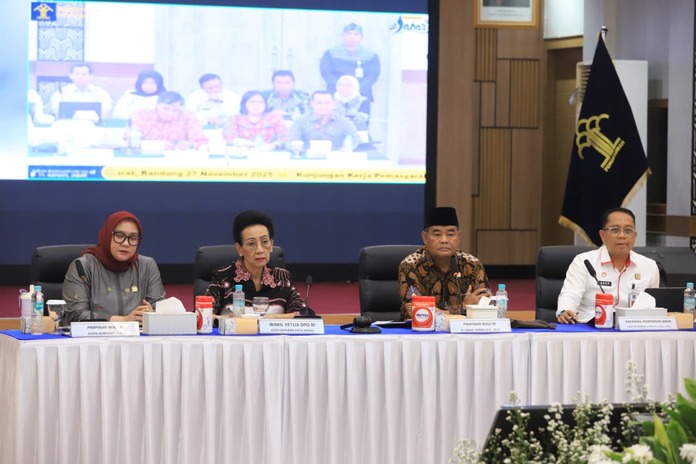
Efforts to strengthen regional autonomy have once again become a primary focus for the Indonesian Regional Representative Council. Accelerating regional independence can be achieved through solid regulatory harmonization between the central government and regional governments.
The Vice Chairperson for Regional Autonomy, Politics, and Law noted that many regional regulations still do not align with national policies, thereby hindering public services, investment, and regional development directions.
The harmonization agenda is not merely an administrative task but a foundation that determines how regions can effectively exercise their autonomy.
“We are not here to supervise or take over regional authority, but to ensure that central and regional policies do not operate in isolation. Everything must aim for one goal: the public interest,” stated the Vice Chairperson during a working visit of the Regional Legislative Affairs Body at the West Java Regional Office of the Ministry of Law and Human Rights, Jakarta Street, Bandung City.
The Vice Chairperson added that the lack of synchronization in several Regional Regulations, particularly in tourism, spatial planning, and village governance, indicates a need for significant updates in regional regulation formulation. Some regulations are even considered no longer relevant to national standards, especially those concerning human rights protection and inclusivity principles.
Since its establishment in 2019, the body has issued 13 decisions regarding the monitoring and evaluation of Regional Regulation Drafts and Regional Regulations. Many recommendations have subsequently been followed up by regional governments across Indonesia, covering issues from local taxes and levies, waste management, to spatial planning improvements. The peak was a spatial planning policy dissemination activity in July 2025, which recorded the highest response from regional governments.
A member of the council conveyed that based on monitoring in 34 provinces, almost all regions face similar problems in formulating Regional Regulations.
Four fundamental issues were identified: regulatory disharmony, limited human resources, weak inter-agency coordination, and low quality of academic manuscripts.
“This is not merely an administrative issue. Structure, methodology, and human resource readiness must be improved. Because weak Regional Regulations will result in weak implementation,” stated the member.
The member revealed that consultation forums like the one held in Bandung are crucial for exploring obstacles in Regional Regulation formulation in more detail.
The member expressed hope that this discussion would produce actionable recommendations for relevant ministries so that regions can obtain more appropriate, adaptive, and contextual authority spaces.
Meanwhile, the Vice Chairperson highlighted two main requirements for regions to produce strong regulations. First, regions must have sufficient authority to regulate local needs without always waiting for central regulations. Second, facilitation and harmonization processes must be strengthened by the central government, particularly through the Ministry of Home Affairs and the Ministry of Law and Human Rights, including capacity building for local legal product designers.
The Vice Chairperson emphasized that without such support, the concept of regional autonomy, which essentially aims to strengthen regional competitiveness, would move further out of reach.
“Normative, procedural, and institutional obstacles must be immediately addressed so that the Regional Regulation formulation process does not become merely about fulfilling legal formalities,” stated the Vice Chairperson.
The Vice Chairperson reaffirmed that synergy is key to sustainable regional development. Strong, adaptive Regional Regulations that align with national regulatory developments are believed to strengthen public services while opening broader spaces for investment and regional development.
“Asymmetric decentralization must continue to be encouraged. Regions must be given space to grow according to their characteristics, and our task is to oversee the regulations so they truly benefit the public,” said the Vice Chairperson.