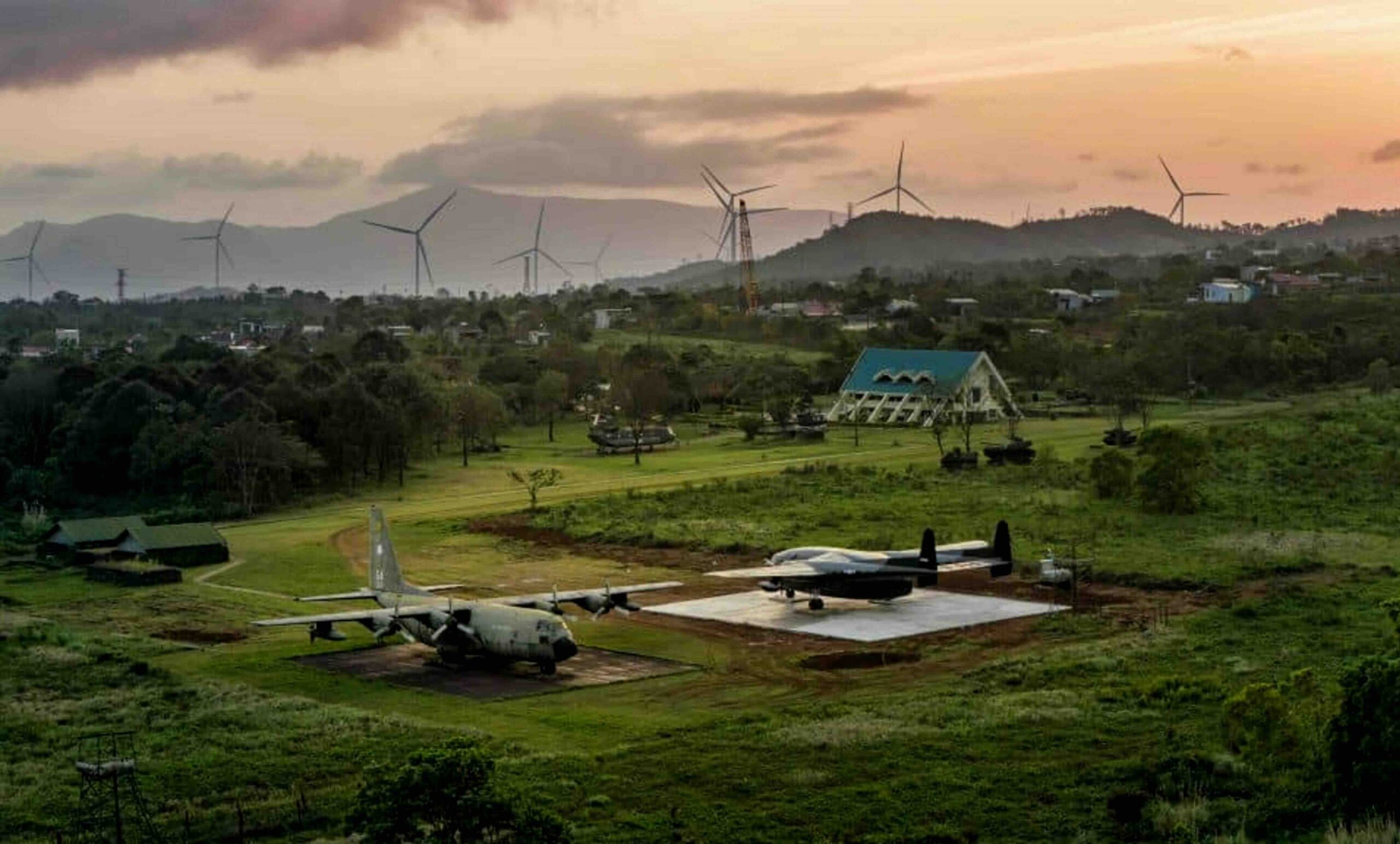
There was a time when this outpost was called an “impregnable fortress” on the northern edge of South Vietnam’s battlefield. Yet even fortresses fall. Today, decades after the guns fell silent, Ta Con Airport has become an open-air museum – a place where history rests quietly beneath the green folds of the Truong Son mountains.
On summer afternoons, sunlight drifts across the Ta Con valley in Khe Sanh, Quang Tri Province – one of Vietnam’s most storied former battlefields. Wild grass sways around aging aircraft, rusted shells and weathered fortifications. Visitors come not simply to see relics, but to understand a landscape that shaped one of the defining chapters of modern Vietnamese history.
Built by U.S. forces between 1966 and 1968, Ta Con served as the strategic center of the Khe Sanh combat base complex. Positioned near the Vietnam–Laos border along National Highway 9, it functioned as a logistics hub and air bridge capable of receiving heavy transport aircraft. The base also formed part of the McNamara electronic barrier system, designed to monitor movement along the Ho Chi Minh Trail.
During the 1968 Khe Sanh campaign, after months of intense fighting, U.S. forces abandoned the base, ending what had once been considered one of the strongest military positions in the region.
More than half a century later, Ta Con tells a different story.
The former airfield now stands as a national historical site and one of Quang Tri’s most distinctive destinations. Preserved aircraft, tanks, trenches and defensive works remain in place beside the Route 9–Khe Sanh Victory Museum, where photographs, maps and wartime artifacts help visitors visualize the conflict beyond the pages of history.
Yet Ta Con today is not defined by war alone. Around Khe Sanh, coffee plantations stretch across rolling hills and quiet villages. Morning mist softens the mountain ridges. By late afternoon, sunlight settles over old runways and turns the battlefield into something unexpectedly peaceful.
Ta Con does not ask visitors to relive war. It invites them to reflect on peace – and witness how landscapes, like people, learn to begin again.
Ta Con Airport museum complex
The Ta Con Airport museum complex in Quang Tri, Vietnam, preserves the remnants of a key U.S. military airbase used during the Vietnam War. Originally built by the French and later expanded by American forces, it served as a crucial supply and logistics hub until its capture by North Vietnamese forces in 1972. Today, the site features preserved bunkers, aircraft wreckage, and historical exhibits that offer insight into the war’s impact and the base’s strategic role.
Khe Sanh
Khe Sanh is a valley in Quang Tri Province, Vietnam, best known for the 1968 Battle of Khe Sanh during the Vietnam War, where U.S. Marines and South Vietnamese forces defended a combat base against a prolonged siege by North Vietnamese troops. The site became a symbol of the war’s intensity, with heavy aerial bombardment and fierce ground fighting. Today, it is a historic memorial and tourist destination, featuring preserved trenches, a museum, and remnants of the base.
Truong Son mountains
The Truong Son mountain range, also known as the Annamite Range, is a major mountain chain stretching over 1,100 kilometers along the border of Vietnam and Laos. Historically, it served as a crucial natural barrier and was famously the site of the Ho Chi Minh Trail, a vital supply route during the Vietnam War. Today, the range is recognized for its rich
Ta Con Airport museum complex
The Ta Con Airport museum complex, located in Khe Sanh, Vietnam, is a historic site that preserves the remnants of the former Ta Con Air Base, a key U.S. military installation during the Vietnam War. It played a central role in the 1968 Battle of Khe Sanh, one of the war’s longest and most controversial sieges. Today, the complex features preserved bunkers, aircraft wreckage, and exhibits that educate visitors about the battle and the broader conflict.
Khe Sanh
Khe Sanh is a village in central Vietnam, best known for the Khe Sanh Combat Base, a U.S. Marine Corps outpost that was the site of a major siege during the Vietnam War in 1968. The 77-day battle was a significant and controversial event, with American forces eventually withdrawing after heavy casualties. Today, the area is a historical site, with a museum and remnants of the base serving as a memorial to the conflict.
Truong Son mountains
The Truong Son mountain range, also known as the Annamite Range, stretches over 1,100 kilometers along the border of Vietnam and Laos, forming a natural barrier between the two countries. Historically, it was a strategic region during the Vietnam War, as the Ho Chi Minh Trail—a crucial supply route—ran through its dense jungles and rugged terrain. Today, the mountains are celebrated for their rich biodiversity and are home to several ethnic minority communities.
Ta Con valley
Ta Con Valley, located in Vietnam’s Quang Tri Province, was a key strategic area during the Vietnam War, known for the intense Battle of Khe Sanh in 1968. This former U.S. Marine combat base and surrounding valley witnessed heavy fighting and is now a historic site, attracting visitors interested in war history and the resilience of the region. Today, it serves as a memorial to the conflict, with preserved bunkers and remnants of the wartime landscape.
Khe Sanh combat base complex
The Khe Sanh Combat Base was a U.S. Marine Corps outpost in Quảng Trị Province, South Vietnam, most famously besieged for 77 days in early 1968 during the Vietnam War. The siege became a major propaganda battle, with American forces ultimately holding the base, though it was later abandoned in mid-1968 due to shifting strategy. Today, the site is a historical memorial and museum, preserving bunkers and artifacts that commemorate the intense fighting and its strategic significance.
Route 9–Khe Sanh Victory Museum
The Route 9–Khe Sanh Victory Museum, located in Quang Tri Province, Vietnam, commemorates the historic 1968 Battle of Khe Sanh during the Vietnam War. The museum displays artifacts, photographs, and military equipment from the intense 77-day siege, highlighting the strategic importance of Route 9 and the resilience of Vietnamese forces. It serves as both a memorial to those who fought and an educational site for understanding this pivotal conflict.
Ho Chi Minh Trail
The Ho Chi Minh Trail was a vast network of supply routes running from North Vietnam through Laos and Cambodia into South Vietnam during the Vietnam War. Originally established in 1959, it was used by the North Vietnamese army and the Viet Cong to transport troops, weapons, and supplies, playing a crucial role in the conflict. Despite relentless bombing by U.S. forces, the trail remained operational and became a symbol of Vietnamese resilience and ingenuity.
National Highway 9
National Highway 9 is a major roadway in India that connects the cities of Malout in Punjab to Pithoragarh in Uttarakhand, passing through Haryana, Delhi, and Uttar Pradesh. Historically, it has served as a key route for trade and transportation, linking the agricultural heartlands of northern India to the Himalayan foothills. The highway has undergone significant upgrades over the years to improve connectivity and support economic growth in the regions it traverses.