Once seen as a “ticket to a better life” and a guarantee of a stable future, the luster of a university degree in the United States is now fading.
Amid a wave of government spending cuts, wars, and pressure from artificial intelligence (AI), America’s young workforce is entering the toughest job market in years.
Anxiety after graduation
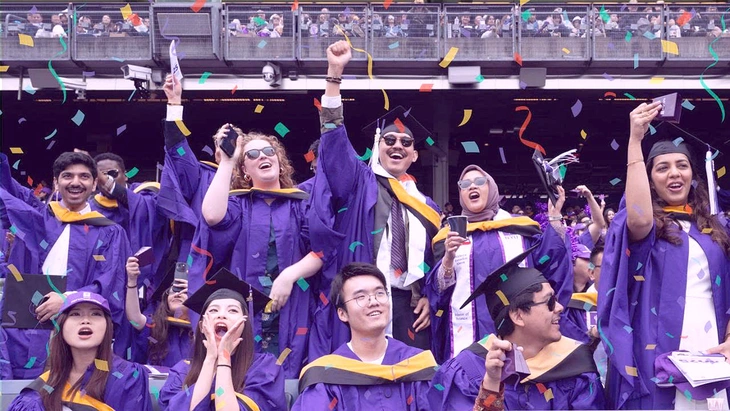
As a long-standing tradition, every May, soon-to-be college graduates flock to Washington Square Park in New York in colorful regalia.
Students in their twenties gather for photos, celebrating the moment they become new graduates. But behind those smiles now lies anxiety about their job prospects.
Julie Patel, who just completed a master’s degree in public health, shared with Al Jazeera on May 17 that the gloomy job market has dimmed the joy of graduation day.
Similarly, Salvadore (23 years old) told CNBC that she has sent out hundreds of applications without any response.
“When someone asks what you’re doing, I can only sadly reply: I’m at my parents’ house, glued to LinkedIn 24 hours a day,” Salvadore confessed.
In an NBC News survey of over 100 recent college graduates in the US, many described their job search journey with phrases like “falling into a black hole,” “discouraging,” or “feeling like a college degree doesn’t mean much anymore.”
According to the Federal Reserve Bank of New York, the unemployment rate for recent graduates in 2025 rose to 5.3%, higher than the roughly 4% rate for the entire workforce—a rare occurrence in the history of the US job market.
The situation on the employer side is also not optimistic. Data from Handshake, a recruitment platform for US students, shows that job postings decreased by 15-16% between August 2024 and August 2025 compared to the same period the previous year, while the number of applications per position increased by 26-30%.
A survey by Cengage Group also found that only about 30% of 2025 graduates found full-time jobs in their field of study.
Multiple reasons since the COVID-19 pandemic
According to analysts, the difficulties for young graduates stem from the post-COVID-19 hiring slowdown. However, they confirm that this situation is worsening due to corporate caution amid economic uncertainty, especially with constant changes in tariff policies and federal spending under the Trump administration.
Last spring, the Department of Government Efficiency (DOGE), led by billionaire Elon Musk, implemented a series of cuts to federal programs and budgets, resulting in a significant reduction in the public sector workforce.
Furthermore, many universities and research institutes have been forced to freeze hiring or cut staff. Recently, schools like Duke, Harvard, Maryland, and Princeton have all announced hiring restrictions or layoffs.
Alongside this, geopolitical upheavals, from prolonged conflicts to escalating US-Israel-Iran tensions, have added to global business uncertainty.
“Recent times have seen enormous uncertainty around tariffs, interest rates, inflation, and geopolitics. That leads many businesses to choose to wait rather than risk hiring more people,” economist Brad Hershbein told Newsweek.
In this context, the rapid and massive rise of AI further threatens the young labor market. Many companies have started using AI to replace positions like customer service or basic programming.
According to Fortune magazine, in just the first seven months of 2025, AI caused over 10,000 job cuts in the US. A Goldman Sachs survey in April 2026 also showed that AI is causing the US economy to lose an average of about 16,000 jobs per month.
Anthropic CEO Dario Amodei has repeatedly warned that AI could wipe out half of all low-level office jobs within the next five years.
BlackRock CEO Larry Fink also stated that 2026 graduates may face the highest unemployment rate ever, partly because AI is replacing more and more entry-level positions.