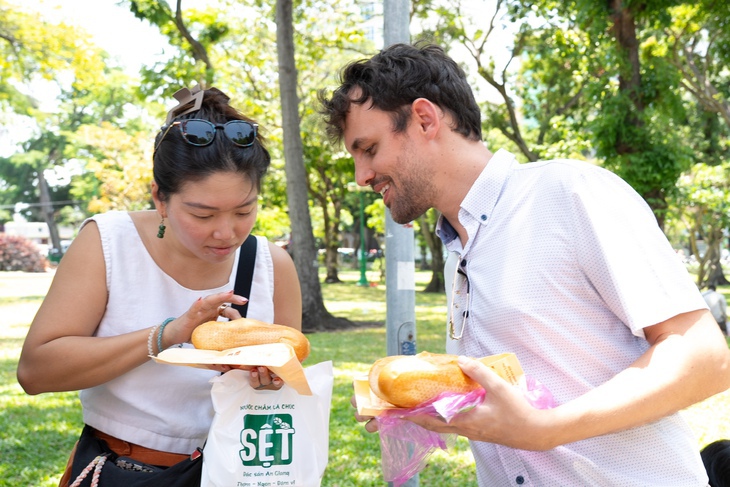
Amid the April heat of Ho Chi Minh City, a long line of people formed in front of the bread stalls at Le Van Tam Park during the 4th Vietnam Bread Festival, an image that goes beyond ordinary culinary experience.
It is also a cultural snapshot, where a seemingly simple dish becomes a meeting point for many nationalities, many stories, and many emotions.
In that crowd, many tourists could not stop praising that although they have eaten many delicious dishes around the world, bread is still their number one food.
Perhaps we have become so accustomed to bread that we forget it is a very unique “cultural miracle” of Vietnam. From an ingredient perspective, bread is nothing too special: a crispy loaf, a few slices of meat, some vegetables, a bit of sauce.
But what makes its vitality lies not in the individual components but in the blend. It is the story of a cuisine that knows how to receive, transform, and innovate.
From the French baguette, over time, the Vietnamese turned it into Vietnamese bread – smaller, crispier, more flavorful, and most importantly, “more Vietnamese.”
In each loaf of bread is the intersection of history, taste, urban life, and the fast pace of life.
Therefore, bread is not just a dish but has become a symbol of adaptation and creativity. And also a symbol of a culture that knows how to “make it its own” from things that seemingly do not belong to it.
Notably, while Vietnamese people eat bread daily, often just as a convenient choice, international tourists see it as a special experience. They are willing to queue in the sun at this festival, willing to try different varieties, and even take them back to their hotels to eat more.
Why is there this difference? Perhaps because outsiders look at it with curiosity, while insiders sometimes look at it out of habit. We are used to it, so we no longer find it strange; we are used to it, so we no longer value it.
In fact, the bread festival is not just a place for eating but an opportunity to consciously retell the story of Vietnamese bread.
When a dish is elevated into a festival, organized systematically, promoted, and experienced, it is no longer just “food” but becomes a “value” – if preserved and developed in the right direction, it can go very far, as the theme of this year’s festival states: “Vietnamese Bread: Value – Spreading to the Five Continents.”
The story of bread is also the story of Vietnamese culture in the context of integration. How can the most ordinary things become highlights? How can a street food item stand alongside global culinary brands?
The answer lies in understanding and preserving identity. A delicious loaf of bread does not need to be elaborate. It needs the right flavor. The right crispness of the crust, the right softness of the crumb, the right richness of the filling. And above all, it needs to retain its “soul” – something that cannot be measured by a recipe.
Just like culture, when the “soul” is lost