
The UK-Vietnam financial cooperation is focusing on three priorities: access to finance, green transition, and strengthening the financial system.
Over the past decade, Vietnam has achieved strong economic transformation. Export growth, an expanding middle class, and increasingly deep integration have made Vietnam one of Asia’s most dynamic economies.
Behind this development lies the role of an increasingly modern financial system, helping businesses access capital, manage risks, and expand operations in an ever more competitive business environment.
In this context, financial cooperation between Vietnam and the United Kingdom is expanding. As the home of one of the world’s leading financial centers, the UK participates in this process through investment, market development, and support for improving the institutional framework.
“Financial cooperation between Vietnam and the United Kingdom is not only aimed at expanding capital flows but also focuses on sharing experience, promoting innovation, and supporting the building of foundations necessary for long-term growth.”
 |
According to the above, current cooperation activities focus on three main areas: expanding access to finance, promoting green transition, and strengthening the foundations of the financial system.
Expanding Access to Finance
Access to capital remains one of the most important factors for the development of Vietnamese businesses, especially as export activities continue to drive growth. However, many businesses, particularly small and medium-sized enterprises (SMEs), still face difficulties in accessing financial sources for trade and expansion.
Through cooperation with domestic partners, UK banks such as HSBC and Standard Chartered are expanding trade finance, supply chain financing, and working capital solutions. These tools help connect international capital with the Vietnamese market, supporting businesses in scaling up and participating more deeply in global value chains.
Alongside short-term capital for production, long-term investors are also playing an important role in the development of Vietnam’s capital market. Dragon Capital currently manages about $5 billion, while Eastspring Vietnam manages about $7 billion. The presence of these institutions reflects the increasing maturity of Vietnam’s financial market as well as the long-term interest of international investors.
These activities show that Vietnam-UK financial cooperation is not only focused on expanding capital sources but also aims at developing the financial market in depth and enhancing the ability to mobilize resources for the economy.
Financing for Green Transition
The demand for investment in renewable energy, green transport, and sustainable infrastructure is rising as Vietnam pursues its net-zero emissions target by 2050.
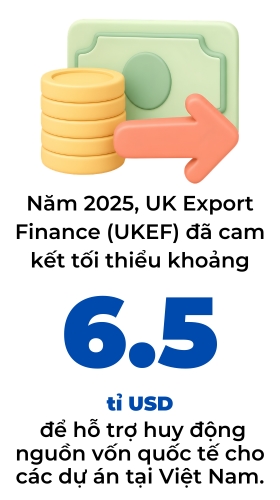 |
In 2025, British International Investment (BII) provided a $50 million loan to VPBank to expand credit for climate projects. In the same year, UK Export Finance (UKEF) committed at least £5 billion (approximately $6.5 billion) to support mobilizing international capital for projects in Vietnam.
In October 2025, the Vietnamese Ministry of Finance and UKEF signed a Memorandum of Understanding (MoU) during a visit to London, creating a basis for expanding cooperation in the coming period.
In addition to providing financial resources, UKEF is involved in supporting the financial structuring of metro and high-speed rail projects in Hanoi and Ho Chi Minh City, while working with PetroVietnam and PTSC on offshore wind development opportunities. These initiatives aim to attract additional private capital for large-scale infrastructure and energy projects.
Strengthening the Foundations of the Financial System
Beyond capital flows, the UK is also helping Vietnam build a more transparent and robust financial system. Trust is a core element of any economy. Financial institutions need trust to lend, and investors need trust to invest. This requires a transparent, well-regulated system with modern infrastructure.
The UK is closely cooperating with Vietnam in many areas, from fintech and legal frameworks to capital market development. Many leading UK fintech companies such as Revolut, Wise, Ozone API, Raidiam, Sumsub, iProov, Elliptic, and Traydstream are involved.