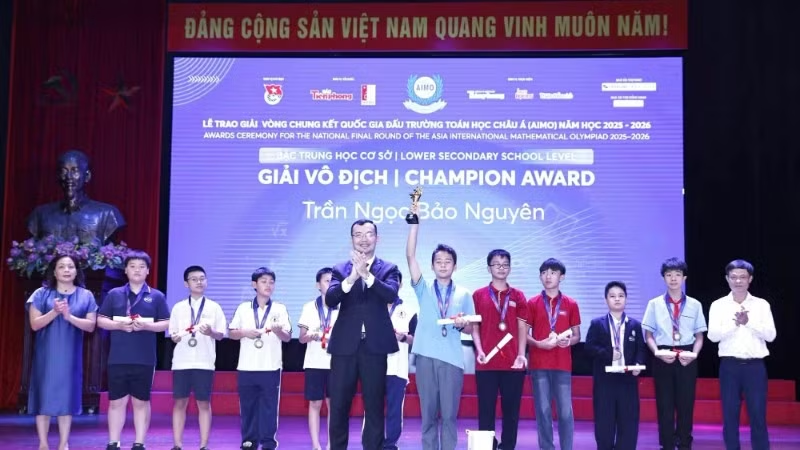
At the recent national finals of the Asian International Mathematical Olympiad (AIMO) held in Hanoi, students from the Gifted Secondary School (Hanoi National University of Education) made a strong impression with outstanding achievements, securing 1 National Championship title for Grade 6 along with 20 medals, including 7 Gold, 9 Silver, and 4 Bronze medals.
This achievement not only affirms the students’ abilities but also demonstrates the effectiveness of the school’s approach to identifying and nurturing mathematical thinking and international integration skills from the secondary school level.
An exchange was held with the Principal of the Gifted Secondary School regarding the school’s orientation for discovering and nurturing gifted students, as well as building an educational environment for comprehensive student development.
Question: The results of Gifted Secondary School students at AIMO 2025-2026 reflect the quality of the school’s training in identifying and nurturing gifted students. How has the school built this process?
Principal: At our school, the process of discovering and nurturing gifted students is not a short-term “cramming” campaign, but a long-term, systematic process with a clear roadmap, creating a sustainable educational ecosystem. From the initial admissions stage, through a comprehensive competency assessment, the school selects students with strong thinking abilities. Then, as soon as they enter 6th grade, through a core curriculum combined with a rich system of subjects (Mathematics, Math in English, Informatics, Natural Sciences and Technology, STEM, Literature, English…), the school creates space for students to naturally express their thinking. Teachers act as observers, identifying students’ outstanding abilities for timely guidance.
Each gifted student is a unique individual. The school builds a flexible training roadmap suited to each student’s pace of development. Alongside academic advancement, the school focuses on developing specialized English skills and psychological resilience. Success at an internationally standardized competition like AIMO requires students to have sharp logical thinking in a global language and strong composure under pressure. This is the result of a comprehensive training process.
The school’s long-term goal is to create the most solid launchpad in terms of knowledge, skills, and character from the secondary level, so students are ready to excel at higher levels and become future global citizens.
Question: In your opinion, where should the identification of mathematical ability in secondary school students begin, what factors should it be based on, and how can students with outstanding thinking qualities be recognized, rather than just evaluating through grades?
Principal: For the Gifted Secondary School, identifying mathematical ability in particular and other outstanding abilities does not start from grades or how many difficult problems students solve, but from the teacher’s keen observation based on core factors: Curiosity and questioning ability; logical thinking and abstraction ability; flexibility and creativity in problem-solving; and above all, the student’s own passion and perseverance.
Each gifted student is a unique individual. The school builds a flexible training roadmap suited to each student’s pace of development.
Principal – Gifted Secondary School (Hanoi National University of Education)
Question: Many opinions suggest that students today face significant pressure for achievement. How does the school ensure that nurturing gifted students does not become a pressure but truly ignites a passion for learning?
Principal: The school always affirms that discovering and nurturing gifted students requires a process and must be carried out systematically by capable and experienced teachers. At the school, students are encouraged to express and fully develop their potential. Pressure sometimes comes not from the curriculum but from family expectations and anxieties. Understanding this, from the beginning of the school year, the school organizes meetings and discussions between psychology experts, educators, and
<div class="my-4 p-4 rounded-lg shadow-md bg-blue-50 border-l-4 border-blue