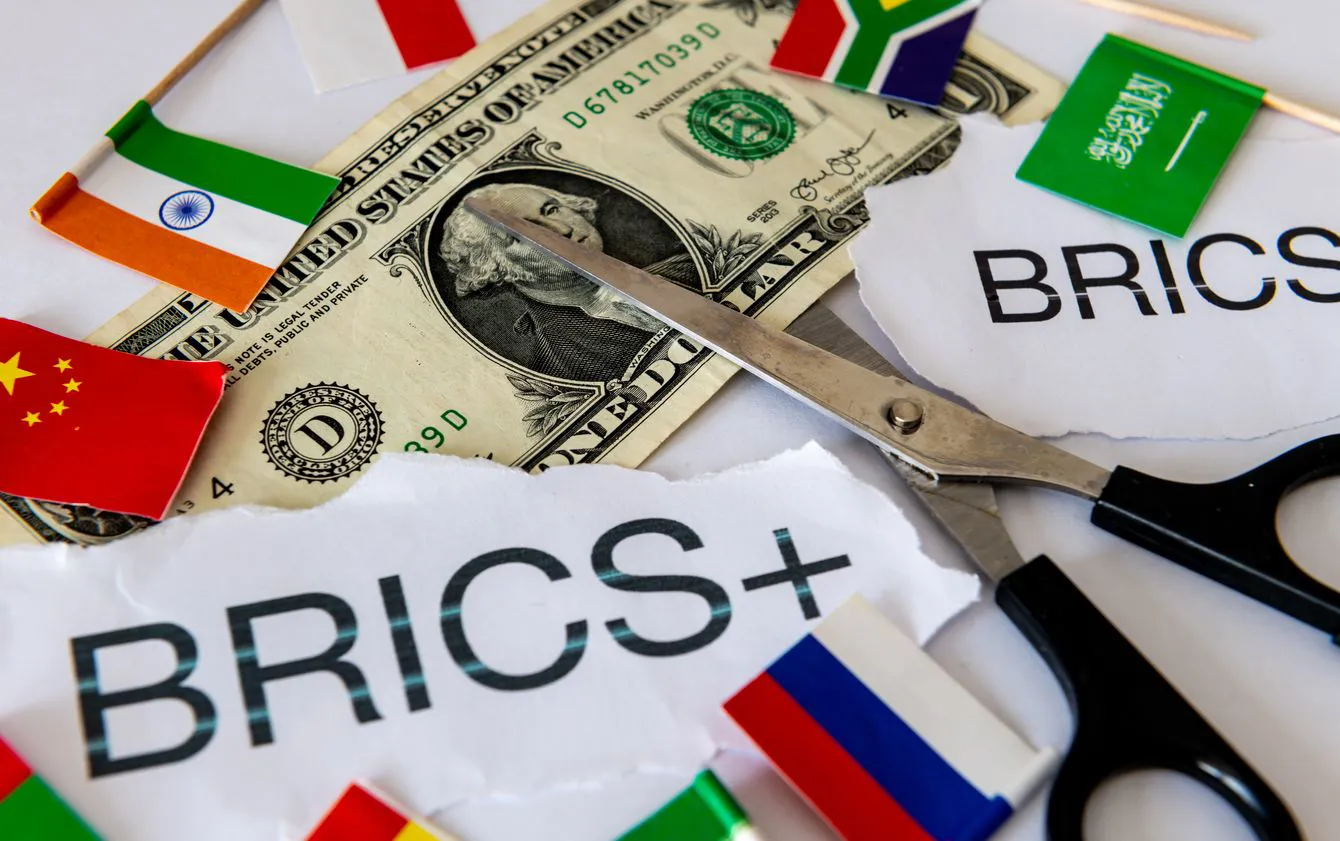
Ahead of the BRICS summit in India later this year, the central focus of discussion is not a common BRICS currency but a new global payment system aimed at reducing reliance on the USD-centric SWIFT network.
At the 2026 BRICS summit hosted by India, developing a payment infrastructure based on mutually compatible central bank digital currencies is seen as a key agenda item.
This approach avoids symbolic slogans like “de-dollarization” or a common BRICS currency. Instead, it allows trade transactions to be settled directly in the member countries’ national currencies, thereby reducing dependence on the SWIFT payment network and the US dollar.
Rather than direct confrontation, BRICS is choosing to build new “rails,” enabling countries to settle trade directly using their own digital currencies.
Following shocks like Russia’s removal from SWIFT and the freezing of hundreds of billions of dollars of the Russian Central Bank’s assets by the West, BRICS views building a new payment system as a strategic imperative.
The new initiative does not require member countries to surrender monetary sovereignty or cede control to a supranational body. Past proposals in this direction have stalled due to differences in inflation control mechanisms, capital controls, and concerns about the dominance of China’s digital yuan.
The current direction is more pragmatic: connecting existing central bank digital currencies, such as India’s digital rupee, China’s digital yuan, or Russia’s digital ruble, through a common infrastructure.
Each currency remains fully under national sovereignty but can connect more efficiently for cross-border payments. The benefits of the new payment system are clear: faster transactions, lower costs, and reduced risk of asset freezes or financial sanctions.
In this process, India’s role is particularly prominent. As the host nation shaping the agenda, the South Asian country has strongly promoted interoperability among central banks, reflecting the successful domestic digital payment philosophy embodied in its Unified Payments Interface (UPI) system.
The Reserve Bank of India has repeatedly stated that the digital rupee is not a cryptocurrency, nor a stepping stone to a currency union, but simply a state-guaranteed digital version of cash.
“Laying the First Rails”
The formation of the new BRICS payment system is forecast to proceed cautiously and step-by-step. It will begin by leveraging existing bilateral mechanisms before expanding into a multilateral network. In the initial phase, the bloc will test payment connectivity between India and the United Arab Emirates (UAE), along with a few other countries.
India’s UPI system is already compatible with the UAE’s Instant Payment Platform (IPP), allowing for fast, low-cost cross-border money transfers. This payment corridor is seen as a proven model that could serve as a technical template for other BRICS partners.
In the next phase, expansion could focus on countries with developed instant payment systems, such as Brazil’s PIX or China’s CIPS infrastructure and digital yuan.
In the long term, BRICS aims to form a unified payment platform, allowing for direct transactions in member countries’ national currencies on a voluntary basis.
BRICS, initially comprising Brazil, Russia, India, China, and South Africa, has expanded in recent years to include countries like the UAE, Iran, Indonesia, and others. The bloc’s increasing geographic and economic diversity makes the need for a common payment infrastructure more urgent.
The path ahead still has many technical and legal hurdles, but the direction is becoming clearer: the unipolar financial order will not collapse overnight. However, BRICS—with India in a leading role—is quietly laying the first bricks for an alternative.
BRICS nations appear to be directly challenging the US dollar’s dominant role by rapidly accumulating gold reserves and building an independent transaction infrastructure, thereby turning this metal, once considered “obsolete,” into the core foundation of a new multipolar financial system shaped by Moscow and Beijing.
Russia and China are leading the wave of gold accumulation. In 2024, Beijing produced 380 tons of gold, while Moscow contributed 340 tons, as both countries pursue systematic diversification strategies to gradually reduce dependence on USD-denominated assets.
With 68% of the bloc’s global trade transactions no longer using the US dollar and the greenback experiencing its sharpest decline since 1973, the question of whether BR
BRICS summit
SWIFT network
Unified Payments Interface (UPI)
Instant Payment Platform (IPP)
PIX
* **Pixar Animation Studios**, a film studio.
* A colloquial term for **pictures or photographs**.
* An acronym or brand name for a **company, event, or venue**.
To provide an accurate summary, please specify which “PIX” you are referring to (e.g., a location, a festival, or an institution).