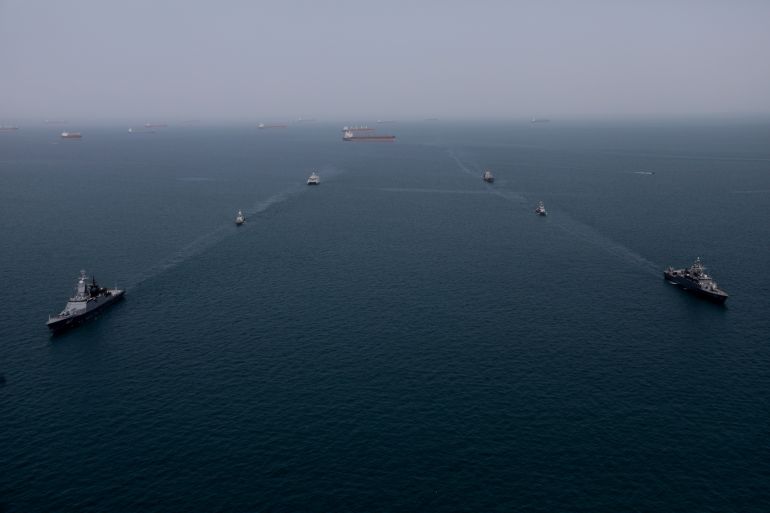
The United States Central Command announced its intention to impose a comprehensive naval blockade on Iranian ports, starting on April 13 at 10:00 AM, a move that represents a new escalation in the ongoing confrontation.
In a statement, the Command said the blockade will include all Iranian ports facing the Gulf of Oman, confirming it will target all commercial ships of any nationality, whether entering or leaving Iranian territorial waters.
It added that it will issue an official notice containing additional details for commercial mariners shortly before the blockade begins.
At the same time, the US Central Command emphasized that its forces “will not impede freedom of navigation” for ships transiting the Strait of Hormuz to and from non-Iranian ports, in an attempt to reassure international trade.
Port of Bandar Abbas
The Port of Bandar Abbas is a major seaport and the capital of Hormozgān Province in southern Iran, strategically located on the Strait of Hormuz. Historically, the city was developed as a port by Shah Abbas I in the early 17th century after he captured it from the Portuguese, and it has since served as Iran’s primary naval and commercial gateway to the Persian Gulf and beyond. Today, it remains a vital hub for trade, fishing, and naval operations.
Strait of Hormuz
The Strait of Hormuz is a strategically vital maritime chokepoint connecting the Persian Gulf with the Gulf of Oman and the wider Indian Ocean. Historically, it has been a key trade route for centuries, but in the modern era, its significance is defined by the transit of about one-fifth of the world’s oil supply. This has made it a focal point of geopolitical tensions and international security concerns.
Gulf of Oman
The Gulf of Oman is a strategic waterway connecting the Arabian Sea to the Strait of Hormuz and the Persian Gulf. Historically, it has been a vital maritime trade route for centuries, used by merchants from ancient Mesopotamia, the Indus Valley, and later European colonial powers. Today, it remains critically important for global oil shipments and regional geopolitics.