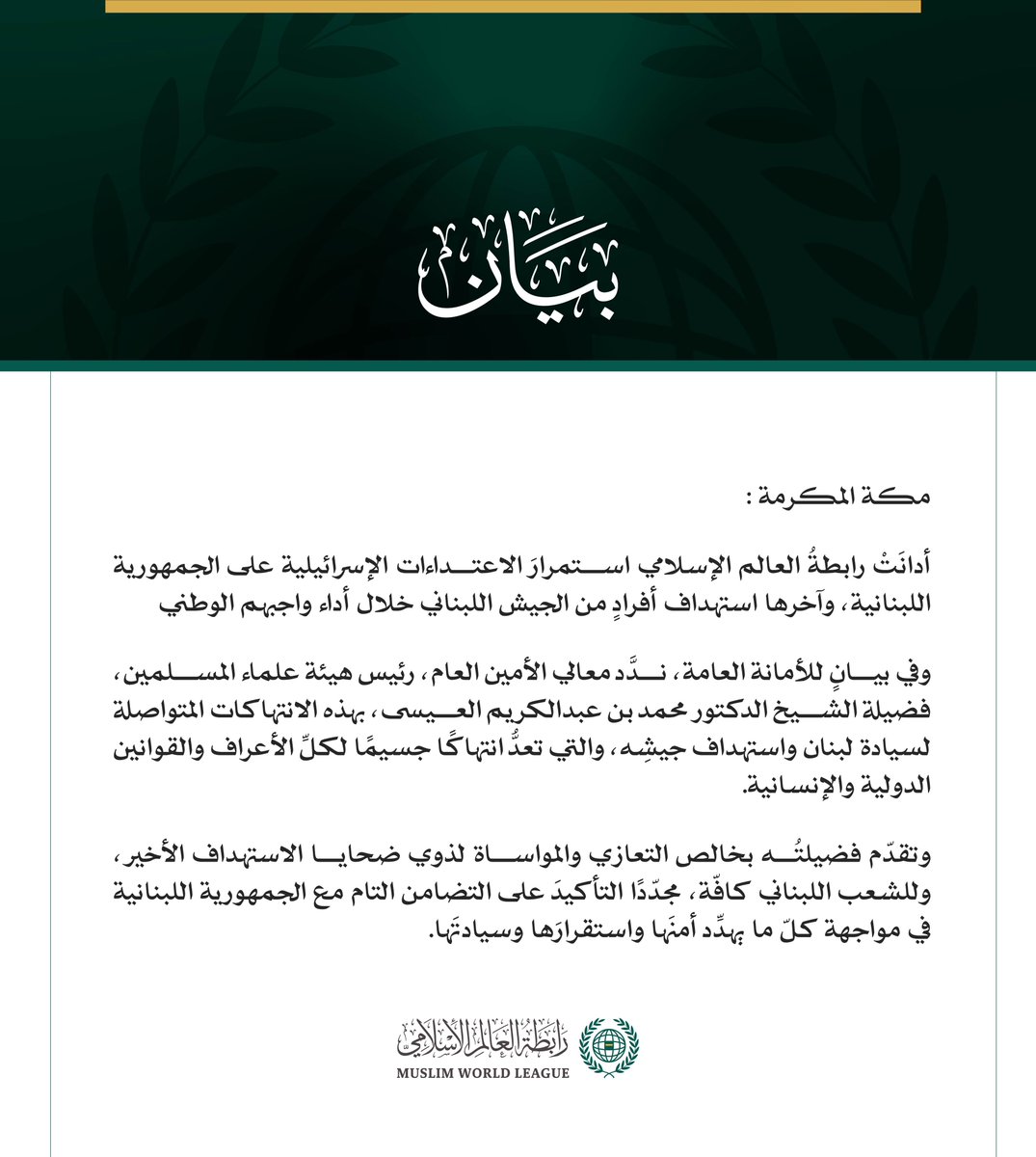
The Muslim World League condemned the ongoing Israeli attacks on the Lebanese Republic, the latest of which targeted members of the Lebanese army while they were performing their national duty.
In a statement from the General Secretariat, the Secretary-General, Chairman of the Council of Muslim Scholars, His Eminence Sheikh Dr. Muhammad bin Abdulkarim Al-Issa, denounced these continuing violations of Lebanon’s sovereignty and the targeting of its army, which constitute a grave violation of all international and humanitarian norms and laws.
His Eminence extended his sincere condolences and sympathy to the families of the victims of the latest attack, and to the entire Lebanese people, reaffirming full solidarity with the Lebanese Republic in facing everything that threatens its security, stability, and sovereignty.
Muslim World League
The Muslim World League (MWL) is an international non-governmental Islamic organization based in Mecca, Saudi Arabia, founded in 1962. It was established to promote Islamic unity, spread the message of Islam, and address issues facing the global Muslim community, including education, humanitarian aid, and interfaith dialogue. Over the decades, the MWL has played a significant role in fostering cooperation among Islamic nations and advocating for peace and mutual understanding between different religions and cultures.
Lebanese Republic
The Lebanese Republic, located in the Middle East along the Mediterranean coast, has a rich history as a crossroads of civilizations, including Phoenician, Roman, and Ottoman influences. It gained independence from French mandate rule in 1943, establishing a unique sectarian political system. Despite periods of conflict and prosperity, Lebanon remains known for its cultural diversity, vibrant capital Beirut, and historic sites like the ancient city of Byblos.
Council of Muslim Scholars
The Council of Muslim Scholars is an influential religious body that represents Islamic scholars in various countries, most notably in Saudi Arabia and Iraq. In Saudi Arabia, the Senior Council of Scholars was established in 1971 to issue fatwas and guide religious affairs, while in Iraq, the Muslim Scholars Association formed after the 2003 invasion to advocate for Sunni interests. These councils play a key role in interpreting Islamic law and addressing contemporary issues within their respective contexts.