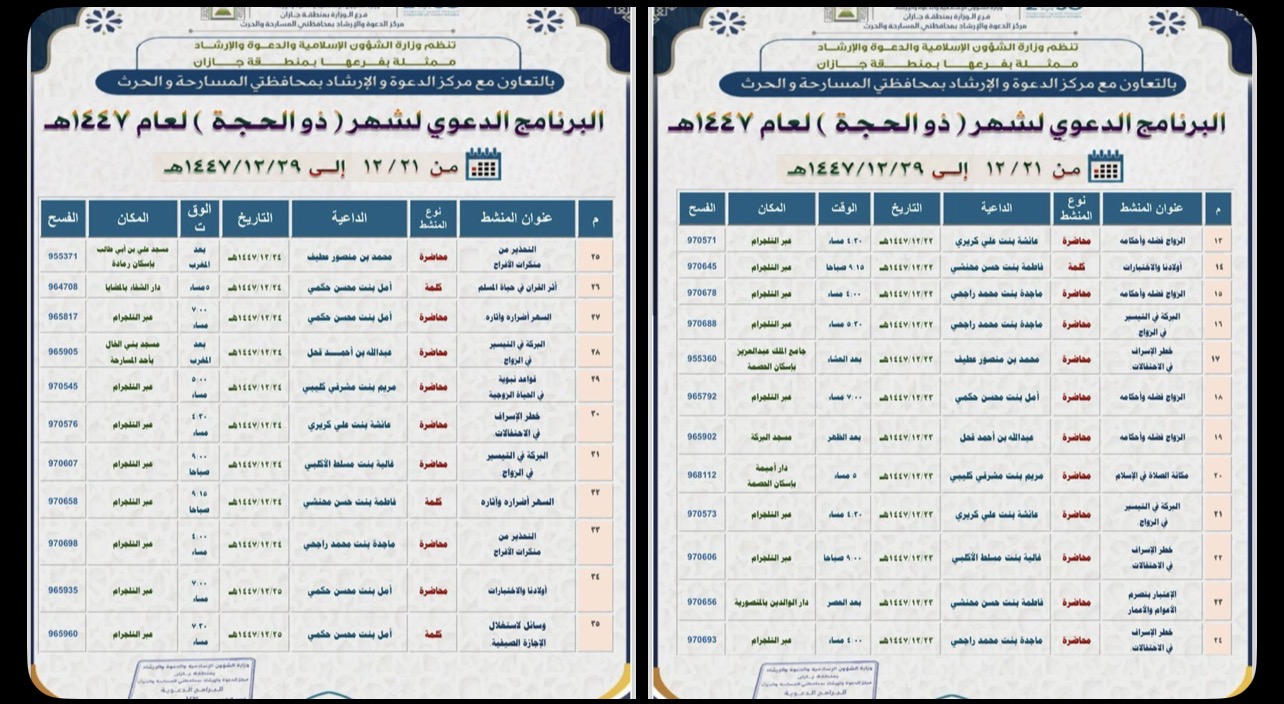
The Ministry of Islamic Affairs, Dawah and Guidance, through its branch in the Jazan region — the Dawah Center in the governorates of One Al-Masarhah and Al-Harth — launches this evening, Sunday, a series of religious and awareness activities as part of the approved Dawah program for the month of Dhul-Hijjah.
A group of official preachers participate in implementing these activities, covering a number of religious and social topics, including: warning against extravagance in celebrations and wedding parties, explaining the harms of staying up late, and the importance of reflecting on the passage of days and years.
These activities are held in several mosques and women’s centers in the two governorates, in addition to being broadcast remotely via live streaming.
These activities, which continue until the end of the current month, aim to educate the community about matters of their religion and worldly life, and to enhance religious and educational awareness among the region’s sons and daughters.
Ministry of Islamic Affairs, Dawah and Guidance
The Ministry of Islamic Affairs, Dawah and Guidance is a government body in Saudi Arabia responsible for overseeing Islamic affairs, promoting the propagation of Islam (dawah), and providing religious guidance. Established in 1993, it manages mosques, Islamic education, and the supervision of religious publications and activities. The ministry plays a key role in shaping the country’s religious policies and supporting the spread of Islamic teachings both domestically and internationally.
Jazan region
The Jazan region, located in southwestern Saudi Arabia along the Red Sea coast, is known for its lush agricultural landscapes and the historic Al-Darb village. Strategically positioned near the Yemeni border, it has long served as a trade and cultural crossroads, with its heritage reflecting a blend of Arabian and African influences. The region features the ancient Farasan Islands, which were once a major center for pearl diving and now offer rich archaeological sites.
Dawah Center in the governorates of One Al-Masarhah and Al-Harth
The Dawah Center in the governorates of One Al-Masarhah and Al-Harth is a religious and cultural institution focused on Islamic outreach and community education. It serves as a hub for spreading Islamic teachings, organizing religious lectures, and supporting local social initiatives. While specific historical details are limited, the center plays a key role in fostering religious awareness and unity among the diverse communities in these regions.
Ministry of Islamic Affairs, Dawah and Guidance
The Ministry of Islamic Affairs, Dawah and Guidance is a government body in Saudi Arabia responsible for overseeing Islamic affairs, promoting religious guidance, and managing mosques and Quranic memorization centers. Established in 1993, it replaced the earlier Ministry of Hajj and Endowments to focus more broadly on Islamic propagation (dawah) and religious education. The ministry also supervises the printing and distribution of the Quran and works to ensure adherence to Islamic principles in public life.
Jazan region
The Jazan region, located in the southwestern corner of Saudi Arabia along the Red Sea, is known for its lush agricultural landscapes and unique cultural heritage. Historically, it served as a vital trade route and has been influenced by various civilizations, including the
Ministry of Islamic Affairs, Dawah and Guidance
The Ministry of Islamic Affairs, Dawah and Guidance is a government body in Saudi Arabia responsible for overseeing Islamic affairs, including the management of mosques, religious guidance, and the promotion of Dawah (Islamic propagation). Established to coordinate religious activities and ensure alignment with Islamic teachings, it also supervises the printing and distribution of the Quran and other religious materials. The ministry plays a key role in shaping the country’s religious policies and supporting global Islamic outreach efforts.
Jazan region
The Jazan region, located in southwestern Saudi Arabia along the Red Sea coast, is known for its lush agricultural landscapes and historical significance as a key trade and cultural crossroads. Its history dates back to ancient times, with influences from various civilizations, including the Himyarites and Ottomans, and it was later integrated into the modern Saudi state in the early 20th century. Today, the region is celebrated for its unique architecture, such as the mud-brick houses in the old city of Jazan, and its vibrant festivals like the Jazan Winter Festival.
Dawah Center in the governorates of One Al-Masarhah and Al-Harth
The Dawah Center in the governorates of One Al-Masarhah and Al-Harth is a religious and cultural institution dedicated to Islamic outreach and community education. It serves as a hub for spreading Islamic teachings, organizing religious lectures, and providing guidance to local residents. The center likely reflects the region’s commitment to preserving Islamic traditions and fostering community cohesion.
Red Sea
The Red Sea is a narrow, elongated seawater inlet of the Indian Ocean, lying between Africa and Asia. Historically significant as a vital trade route since ancient times, it connects to the Mediterranean Sea via the Suez Canal, which opened in 1869. Its name may derive from seasonal blooms of red algae or the reddish-hued mountains surrounding its shores.
Al-Darb village
Al-Darb is a historic village located in the Aseer Province of southwestern Saudi Arabia, known for its traditional stone and mud-brick architecture nestled in the Sarawat Mountains. Historically, it served as an important stop along ancient trade and pilgrimage routes, with its strategic position and fertile terraced fields supporting local agriculture. The village retains much of its cultural heritage, including distinctive multi-story buildings and ancient irrigation systems, offering a glimpse into the region’s pre-modern way of life.
Farasan Islands
The Farasan Islands, located in the Red Sea off the coast of Saudi Arabia, are a coral archipelago known for their rich biodiversity and historical significance. Once a key stop on ancient trade routes, the islands were also a center for pearl fishing and were later influenced by Ottoman and Yemeni rule. Today, they are a protected nature reserve, home to unique wildlife and archaeological remnants like the Ottoman-era Al-Rifai House.