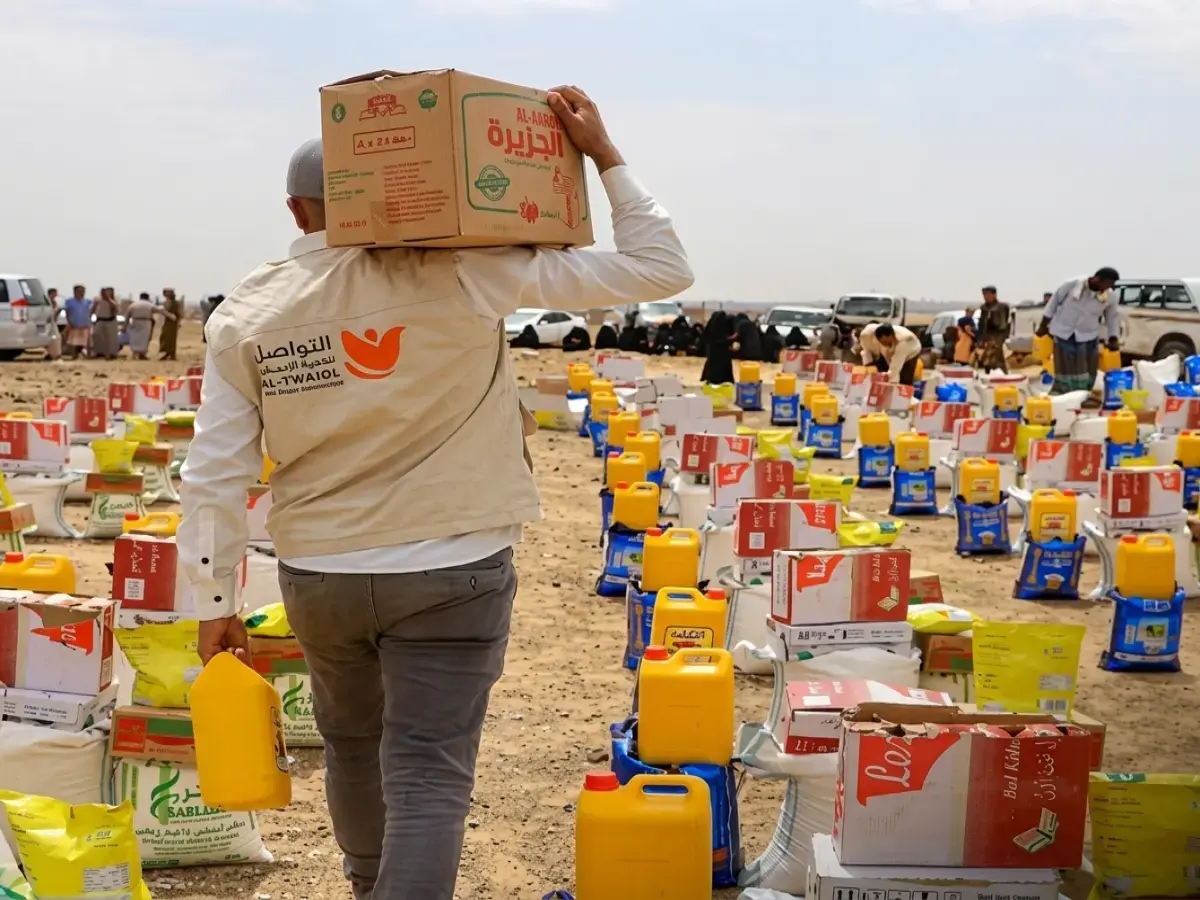
Five million people in areas under the Yemeni government are currently in the “crisis” phase or worse, according to a shocking new report on food security levels. This number represents one out of every two people in those areas, where ongoing economic decline and reduced aid have left millions unable to meet their basic food needs.
The report shows that about 1.4 million Yemenis have entered the fourth phase, known as the “emergency” phase, widening food consumption gaps and pushing families to adopt harsh coping strategies such as selling property or begging to survive. The report noted that “without the limited humanitarian aid provided to about 1.7 million people during the past period, food insecurity levels would have been even worse.”
The population covered by the analysis reached 10.5 million people, with 47 percent of them suffering from “phase three or higher” according to the Integrated Food Security Phase Classification. Despite the severity of the crisis, the report recorded a slight seasonal improvement in food availability compared to the previous period, when the population in the fourth phase reached about 1.6 million. This limited improvement is due to increased local agricultural production, expanded aid, and community support through zakat, but it remains insufficient.
About 60 percent of Yemeni families rely on agriculture as a main source of livelihood, while local production covers only between 25 and 30 percent of national needs, making Yemen vulnerable to global price fluctuations and supply chain disruptions. The report classified all 12 Yemeni governorates under government control as phase three or higher.
Warnings of rapid deterioration
- The warning was issued that any further escalation in the conflict or reduction in humanitarian funding would widen food gaps and accelerate the population’s resort to more fragile coping mechanisms.
- The report expects a rapid deterioration during the dry season from June to September, with the population in phase three or higher rising to 5.4 million people (51% of the analyzed population), including 1.6 million in phase four.
- These figures represent an increase of about 400,000 people compared to the same period last year.
- It warns that severe funding shortages will reduce food security programs to cover only about 1.2 million people, with one-third of the standard food ration.
The worsening food situation will exacerbate the crisis during the last quarter of this year, with the number of people classified as in “emergency” expected to rise to about 1.8 million. This deterioration reflects the population’s heavy reliance on external aid to secure minimum food, along with the fragility of livelihoods and the local economy.
Yemen
Yemen is a country in the Arabian Peninsula with a rich history dating back to ancient civilizations such as the Sabaean kingdom, often linked to the legendary Queen of Sheba. It was a key center for the frankincense and myrrh trade and later became an early center of Islam. In modern times, Yemen has faced political instability and conflict, including a devastating civil war that began in 2014, yet its cultural heritage, including the unique architecture of Sana’a and the island of Socotra, remains globally significant.
United Nations
The United Nations (UN) is an international organization founded in 1945 after World War II to promote peace, security, and cooperation among nations. Its headquarters in New York City serves as a global forum where member states address issues like human rights, climate change, and armed conflicts. The UN replaced the ineffective League of Nations and has since expanded to include 193 member countries, playing a key role in shaping modern international law and diplomacy.
Yemen
Yemen
Yemen is a country in the southwestern corner of the Arabian Peninsula with a rich history dating back to ancient civilizations such as the Sabaean Kingdom—often linked to the legendary Queen of Sheba. It was a major center for the frankincense and myrrh trade and later became a key region in the early Islamic world. Today, Yemen is known for its unique cultural heritage, including the historic walled city of Shibam and the old city of Sana’a, a UNESCO World Heritage site.
Arabian Peninsula
The Arabian Peninsula is a historic region in Southwest Asia, known as the birthplace of Islam and home to its holiest cities, Mecca and Medina. For centuries, it was a crossroads for trade and culture, inhabited by nomadic Bedouin tribes and powerful empires. Today, the peninsula is dominated by modern nations like Saudi Arabia, Yemen, Oman, and the United Arab Emirates, with its economy largely driven by vast oil reserves.
Sabaean kingdom
The Sabaean kingdom, also known as Sheba, was an ancient civilization in present-day Yemen that flourished from around the 8th century BCE to the 3rd century CE. Renowned for its wealth from the trade of frankincense and myrrh, it is famously linked to the biblical Queen of Sheba’s visit to King Solomon. The kingdom’s capital, Marib, featured impressive engineering feats like the Marib Dam, which supported a thriving agricultural society.
Queen of Sheba
The Queen of Sheba is a legendary figure known from biblical and Quranic traditions, believed to have ruled a wealthy kingdom in the region of modern-day Yemen or Ethiopia. According to the Bible, she visited King Solomon of Israel to test his wisdom, bringing lavish gifts, and their encounter has been a subject of myth and cultural significance for centuries. Her story symbolizes wealth, wisdom, and cross-cultural exchange, and she remains a prominent icon in Ethiopian and Yemeni heritage.
Sana’a
Sana’a is the capital of Yemen and one of the oldest continuously inhabited cities in the world, with a history dating back over 2,500 years. It is renowned for its unique architectural heritage, particularly the Old City, a UNESCO World Heritage site famous for its distinctive, multi-story tower houses decorated with geometric patterns. Historically, Sana’a was a major center for the spread of Islam and served as a key trading hub along ancient incense routes.
Socotra
Socotra is a remote Yemeni archipelago in the Indian Ocean, renowned for its extraordinary biodiversity and unique flora, such as the iconic Dragon’s Blood Tree. Geologically isolated for millions of years, it has a long history as a strategic trading hub, referenced in ancient texts and visited by Greek, Portuguese, and British explorers. Its cultural and natural significance led to its designation as a UNESCO World Heritage site in 2008.
United Nations
The United Nations (UN) is an international organization founded in 1945 after World War II to promote peace, security, and cooperation among nations. Its headquarters in New York City serves as a global forum where member states address issues like human rights, climate change, and conflict resolution. The UN has played a key role in shaping modern international law and humanitarian efforts.
New York City
New York City, originally founded as a Dutch trading post called New Amsterdam in 1624, grew into a major global hub after being renamed by the English in 1664. It played a pivotal role in U.S. history as the first capital and a gateway for immigrants through Ellis Island. Today, it is a cultural and financial epicenter, famous for landmarks like the Statue of Liberty, Times Square, and Central Park.