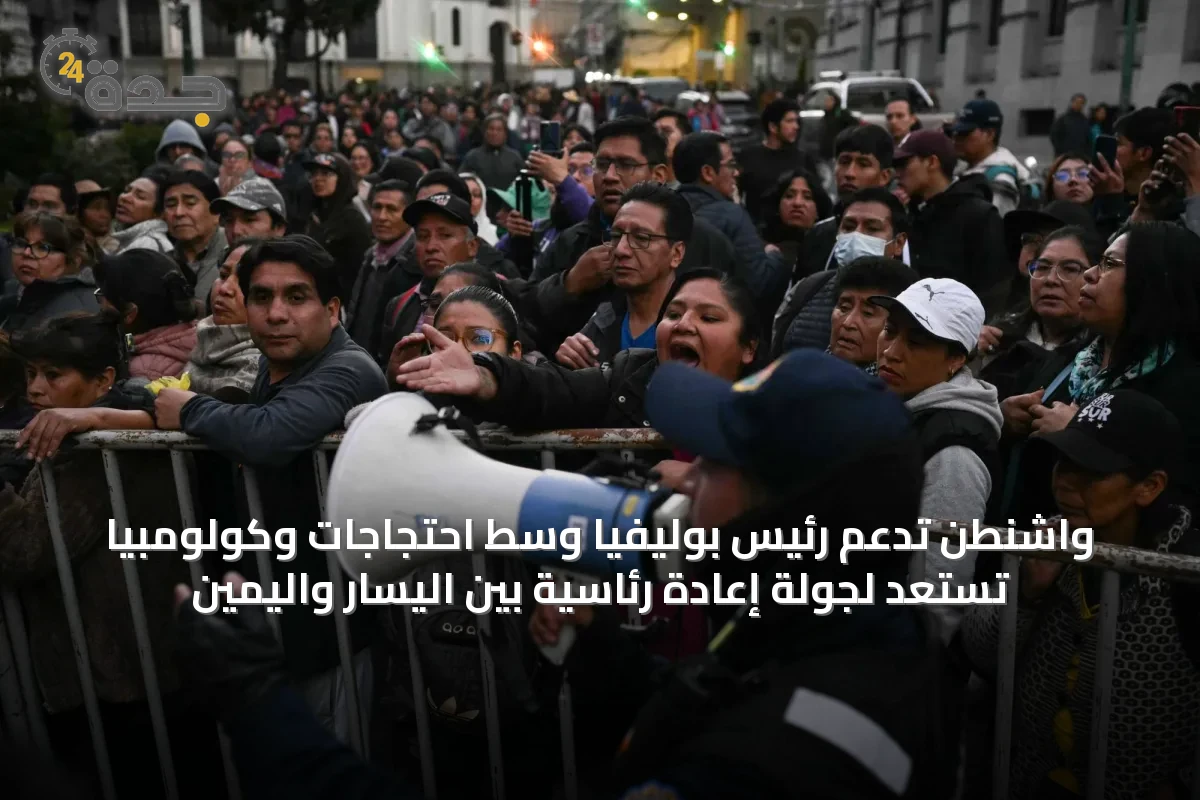
The United States announced on Thursday its support for Bolivian President Rodrigo Paz, who is facing growing popular protests, and offered emergency aid, while also warning against any attempts to overthrow the government. Paz is facing massive protests across the country and increasing calls for his resignation.
US support for the Bolivian president
During a phone call with Paz, US Secretary of State Marco Rubio confirmed that Washington is “intensifying efforts to provide emergency aid and logistical support” to help Bolivians suffering from “severe shortages of food and medicine” due to road blockades, according to a US State Department spokesperson. Meanwhile, Secretary of Defense Pete Hegseth denounced “attempts to overthrow the legitimate government” of Paz, who is a centrist. Hegseth wrote on platform X: “The United States is monitoring the situation,” pledging continued support for Paz “to ensure that terrorist drug traffickers are deterred from profiting from death and destruction in our region.”
Worsening food crisis in Bolivia
The conservative and pro-business Paz took office about seven months ago after historic elections that ended two decades of hardline leftist rule. Paz quickly restored severed relations with the United States and introduced comprehensive economic reforms, including cutting fuel subsidies that had burdened public finances, but angry reactions erupted across Bolivia. Facing demands for his resignation, Paz announced he had prepared a bill authorizing the military to suppress demonstrations and restore public order. In La Paz, thousands of Bolivians lined up for hours to buy chicken, a clear sign of how families are suffering from food shortages exacerbated by the protests.
Colombia: Runoff between left and right
In Colombia, leftist candidate Ivan Cepeda and right-wing candidate Abelardo de la Espriella will compete in the second round of the presidential elections on June 21, according to partial results from the first round. The electoral authority announced that right-wing candidate Abelardo de la Espriella won 44 percent of the vote, ahead of leftist candidate Ivan Cepeda who received 41 percent, and a group of other candidates. A candidate needed to secure 50 percent of the vote to avoid a runoff.
The country is experiencing its worst wave of violence since the signing of the peace agreement with the Revolutionary Armed Forces of Colombia (FARC) in 2016, with the assassination of many community leaders and the killing of civilians in car bomb and drone attacks, as well as the murder of a presidential candidate. A decade after the historic peace agreement, pockets of Colombia remain under the control of dissident armed groups that dominate cocaine production. The constitution prohibits a second term for Gustavo Petro, the first leftist president in the country’s history, whose “total peace” strategy failed to reach an agreement to end the conflict with armed groups. Critics of Petro’s policy say his strategy gave criminal groups free rein, leading to escalating violence and record-high cocaine exports. Catalina Devia, a 42-year-old advertising manager and mother of two who voted for de la Espriella, said: “This government has empowered armed groups by being too lenient,” adding: “Many Colombians are thinking about emigrating.”
The right and left candidates and their positions
De la Espriella (47 years old) is an outsider figure, a supporter of US President Donald Trump, and calls himself “the Tiger.” He campaigned from behind bulletproof glass and vowed to confront armed groups in the air, on land, and at sea. De la Espriella said in his victory speech while wearing a Colombia national football team jersey: “I will kill myself for Colombia if necessary.” He will now face Cepeda in the runoff, who is the son of an assassinated communist leader and an architect of the historic 2016 peace agreements with the FARC. He has pledged to continue pursuing “total peace” and expand social programs in a deeply unequal society.
Cepeda, who had expected to lead the vote, questioned the accuracy of the initial results but stopped short of claiming the election was rigged, vowing to defeat “fascist far-right” in the second round. Supporters of his political line point to the increase in the minimum wage, higher education spending, and land transfers to poor communities. Cepeda supporters expressed disappointment at his second-place finish. Andres Alba, a 42