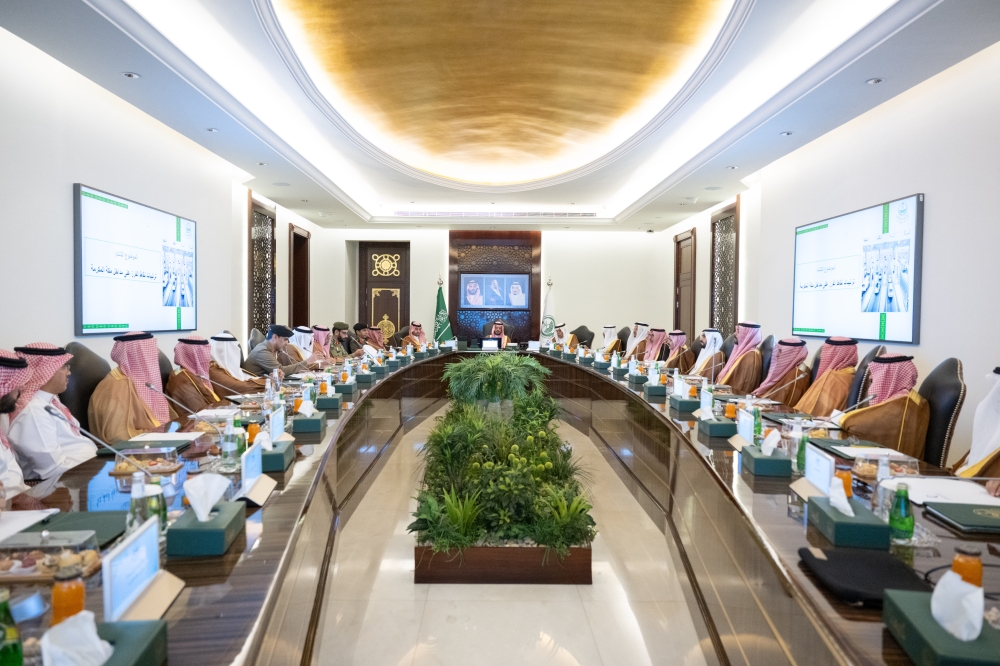
His Royal Highness Prince Saud bin Mishal bin Abdulaziz, Deputy Governor of the Makkah Region, chaired the meeting of the Permanent Committee for Hajj and Umrah, following the directive of the Advisor to the Custodian of the Two Holy Mosques, the Governor of the Makkah Region and Chairman of the Committee, His Royal Highness Prince Khalid Al-Faisal.
At the outset of the meeting, His Highness the Deputy emphasized the necessity of implementing the directives of the wise leadership, which consistently stress the importance of early preparation for the Hajj season and the integration of efforts from all sectors to provide the finest services to the Guests of the Most Merciful.
Hajj Season Plans
The committee reviewed the latest developments regarding the departure of Umrah performers to their countries after completing their rituals, with a focus on providing them with comfort and care. The readiness of the plans of the relevant authorities for the 1447H Hajj season and the efforts of the security sectors at sorting points and the entrances to the Holy Capital were also reviewed.
In addition, the progress of vital projects in Makkah and the holy sites, as well as the implemented field scenarios, were followed up to ensure the highest levels of readiness, enabling pilgrims to perform their rituals with ease and tranquility. The committee also discussed a number of items on the agenda and made the necessary recommendations regarding them.
Makkah Region
The Makkah Region, located in western Saudi Arabia, is the spiritual heart of Islam and home to the religion’s holiest city, **Makkah (Mecca)**. Its history is defined by the birth of the Prophet Muhammad in the 6th century and the subsequent establishment of Islam, with the **Kaaba** at the Masjid al-Haram mosque serving as the ancient focal point for Muslim pilgrimage (*Hajj* and *Umrah*). Today, it is a region of profound religious significance, visited by millions of Muslims from around the world annually.
Two Holy Mosques
The Two Holy Mosques refer to Al-Masjid al-Haram in Mecca, which houses the Kaaba and is the holiest site in Islam, and Al-Masjid an-Nabawi in Medina, the mosque built by the Prophet Muhammad. Their history dates to the founding of Islam in the 7th century, with both sites undergoing continuous expansion over centuries to accommodate millions of pilgrims. They are the focal points of the annual Hajj pilgrimage and central to Islamic faith and worship.
Holy Capital
The “Holy Capital” typically refers to the city of **Kyoto, Japan**, which served as the imperial capital for over a thousand years (from 794 to 1868). Renowned for its well-preserved temples, shrines, and traditional arts, it remains the spiritual and cultural heart of Japan, embodying the legacy of classical Japanese civilization.
Makkah
Makkah (Mecca) is the holiest city in Islam, located in present-day Saudi Arabia. It is the birthplace of the Prophet Muhammad and the site of the Kaaba, the most sacred shrine in Islam, which Muslims believe was built by the Prophet Abraham and his son Ishmael. Every year, millions of Muslims perform the Hajj pilgrimage to Makkah, a mandatory religious duty that traces its rituals back to these ancient origins.
holy sites
Holy sites are sacred locations of religious significance, such as temples, churches, mosques, or natural landmarks, revered by followers of a faith. Their history often spans centuries or millennia, frequently marking events from a religion’s founding, revelations, or the lives of key figures. These places serve as enduring centers for pilgrimage, worship, and communal identity, preserving spiritual traditions across generations.