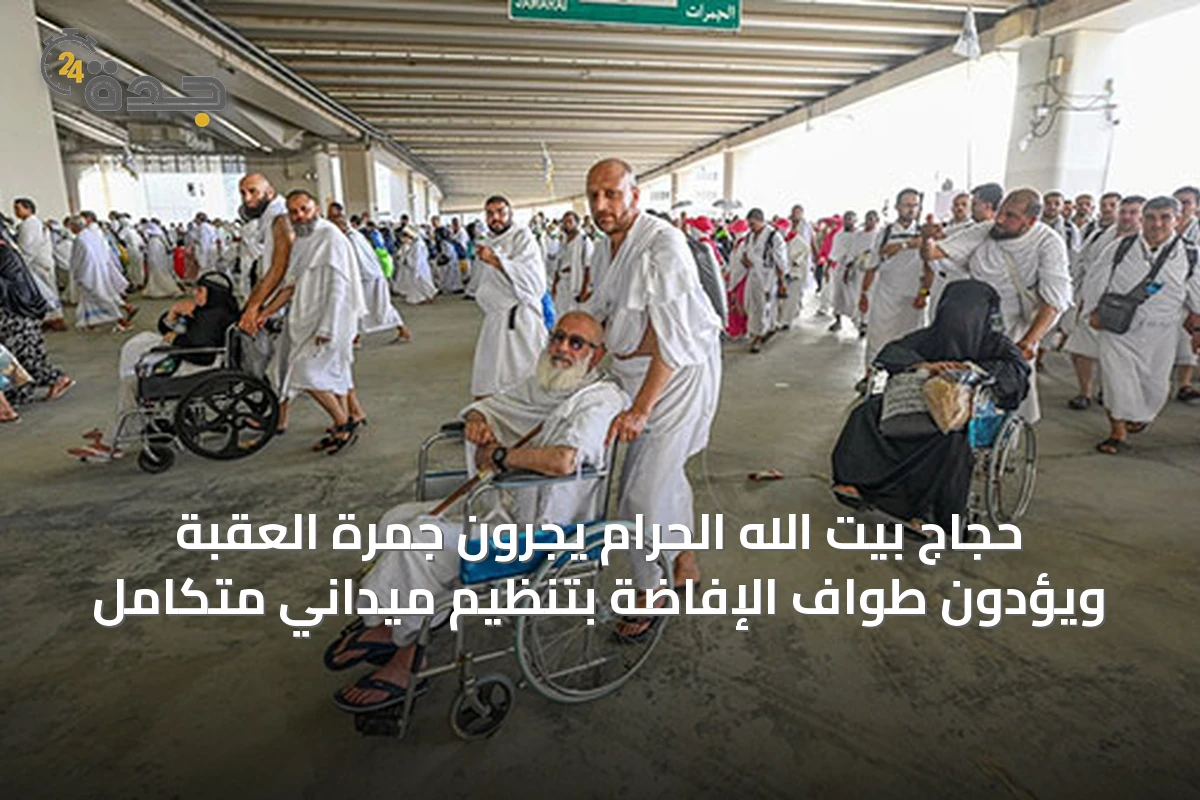
Pilgrims of the Sacred House of God performed the stoning of the Great Jamrat al-Aqaba in Mina yesterday, Wednesday, amidst organized crowd flow and high fluidity within the Jamarat facility. An integrated operational, security, and health system was activated, with all relevant authorities dedicating full capabilities to serve the guests of the Most Merciful.
Organizing Crowd Flow Inside the Jamarat Facility
The Jamarat facility witnessed the arrival of pilgrim groups through multiple pre-prepared pathways designed to distribute human densities across different floors and bridges, ensuring reduced congestion and ease of movement. This plan relies on advanced engineering infrastructure connecting the facility to pilgrim camps, the Mashair train, and surrounding areas in Mina.
Security and Health Support
Security authorities managed crowd movement inside and outside the site, supported by a wide deployment of ambulance teams, civil defense, and health personnel who worked around the clock to ensure rapid response to emergencies and provide field services to pilgrims during the performance of rituals.
Fluidity of Movement Within Mina
Movement within Mina was characterized by high flexibility and smooth flow, based on precise plans that distributed crowds in successive batches, ensuring pilgrim safety and ease of transit between stoning sites and their camp accommodations.
Observance of Sacrifice Rituals and Ifadah Tawaf
After completing the stoning of the Jamrat al-Aqaba, pilgrims continued the rituals of the Day of Sacrifice, including slaughtering the sacrificial animal and shaving or trimming their hair, before proceeding to perform the Ifadah Tawaf at the Grand Mosque in Mecca, one of the essential pillars of Hajj. The corridors and courtyards of the Grand Mosque have been crowded with pilgrim masses since the early morning hours to perform the Tawaf in a spiritual atmosphere marked by security and tranquility, within an integrated operational service system that included organization, crowd management, cooling, and sterilization.
Entry and exit movement at the Grand Mosque recorded notable fluidity thanks to the approved organizational plans for managing pilgrim flow between the holy sites, alongside ongoing sterilization and disinfection work inside the Mataf courtyard, corridors, and courtyards using the latest equipment and machinery.
An integrated cooling system was also activated inside the Grand Mosque and surrounding courtyards, aiming to provide a comfortable environment for pilgrims during the performance of rituals amid high density and rising temperatures, as part of efforts to enhance the quality of services provided to the guests of the Most Merciful.
Relevant authorities in the Kingdom continue to provide their security, health, and organizational services around the clock, within an integrated operational system aimed at enabling pilgrims to perform their rituals with ease and safety, reflecting the level of readiness in crowd management during the Hajj season.
Jamarat al-Aqaba
Jamarat al-Aqaba is one of the three stone pillars involved in the Islamic Hajj pilgrimage ritual of “stoning the devil.” Located in Mina, Saudi Arabia, it represents the largest of the pillars and commemorates the Prophet Ibrahim’s rejection of Satan’s temptations. Historically, pilgrims throw pebbles at this site as a symbolic act of defiance against evil, a practice rooted in Islamic tradition dating back over 1,400 years.
Mina
Mina is a valley located near Mecca in Saudi Arabia, best known for its role in the annual Hajj pilgrimage. Historically, it is the site where the ritual of “stoning the devil” (Ramy al-Jamarat) takes place, commemorating the Prophet Abraham’s rejection of Satan’s temptations. During Hajj, millions of pilgrims camp in Mina, making it one of the largest temporary tent cities in the world.
Jamarat facility
Jamarat al-Aqaba
Jamarat al-Aqaba is the largest of three stone pillars located in Mina, Saudi Arabia, and is a key site in the annual Hajj pilgrimage. During the ritual of “stoning the devil,” pilgrims throw pebbles at this pillar to symbolize the rejection of evil, commemorating the Prophet Ibrahim’s defiance of Satan. The site has a long history tied to Islamic tradition, with modern expansions and a multi-level structure built to accommodate the millions of pilgrims who perform the ritual each year.
Mina
Mina is a valley located near Mecca in Saudi Arabia, best known for its role in the annual Hajj pilgrimage. Historically, it is the site where the Prophet Abraham is believed to have been commanded by God to sacrifice his son, an event commemorated by Muslims during the Eid al-Adha festival. Today, Mina is famous for its vast tent city, which temporarily houses millions of pilgrims who perform the ritual of stoning the devil at the nearby Jamarat pillars.
Jamarat facility
The Jamarat facility, located in Mina near Mecca, Saudi Arabia, is a key site for the annual Hajj pilgrimage, where pilgrims ritually stone pillars representing the devil. The modern facility, completed in the early 2000s, replaced older pillars with a multi-level bridge and walkways to improve safety and manage the massive crowds, following deadly stampedes in previous years. Its design reflects a significant evolution in Islamic pilgrimage infrastructure, balancing religious tradition with crowd control and safety measures.
Grand Mosque
The Grand Mosque, also known as the Sheikh Zayed Grand Mosque in Abu Dhabi, is one of the world’s largest and most opulent mosques. Completed in 2007, it was designed to unite the world’s diverse Islamic cultures with architectural influences from Persia, Morocco, and the Ottoman Empire. Its stunning white marble domes, intricate floral designs, and the world’s largest hand-knotted carpet make it a major cultural landmark and a symbol of religious tolerance.
Mecca
Mecca, located in western Saudi Arabia, is the holiest city in Islam and the birthplace of the Prophet Muhammad. It has been a center of pilgrimage for centuries, with the Kaaba—a sacred structure at the heart of the Grand Mosque—believed to have been built by Abraham and his son Ishmael. Today, millions of Muslims visit Mecca annually for the Hajj pilgrimage, a key religious duty.
Mashair train
The Mashair train, also known as the “Mashair” or “Al-Mashair” train, is a modern railway system in Saudi Arabia specifically built to transport pilgrims between the holy sites of Mina, Muzdalifah, and Arafat during the annual Hajj pilgrimage. Its history began with its inauguration in 2010, designed to replace bus and foot travel, significantly reducing congestion and travel time on the crowded route. The train is a key part of Saudi Arabia’s efforts to improve safety and efficiency for the millions of Muslims who perform Hajj each year.
Mataf
The Mataf is the open area surrounding the Kaaba in the Grand Mosque of Mecca, Saudi Arabia, where pilgrims perform the ritual of Tawaf—circling the Kaaba seven times during the Hajj and Umrah pilgrimages. Its history is deeply tied to Islamic tradition, as the Kaaba was originally built by the Prophet Abraham and his son Ishmael, and the Mataf has been a central site for worship and pilgrimage for centuries. Over time, the area has been expanded and renovated to accommodate the millions of Muslims who gather there annually.
Sacred House of God
The “Sacred House of God” is a reference to the Kaaba in Mecca, Saudi Arabia, the holiest site in Islam. According to Islamic tradition, it was originally built by the Prophet Abraham and his son Ishmael as a monotheistic house of worship, and it has been a center of pilgrimage for centuries. Today, Muslims around the world face the Kaaba during their daily prayers, and it is the focal point of the annual Hajj pilgrimage.