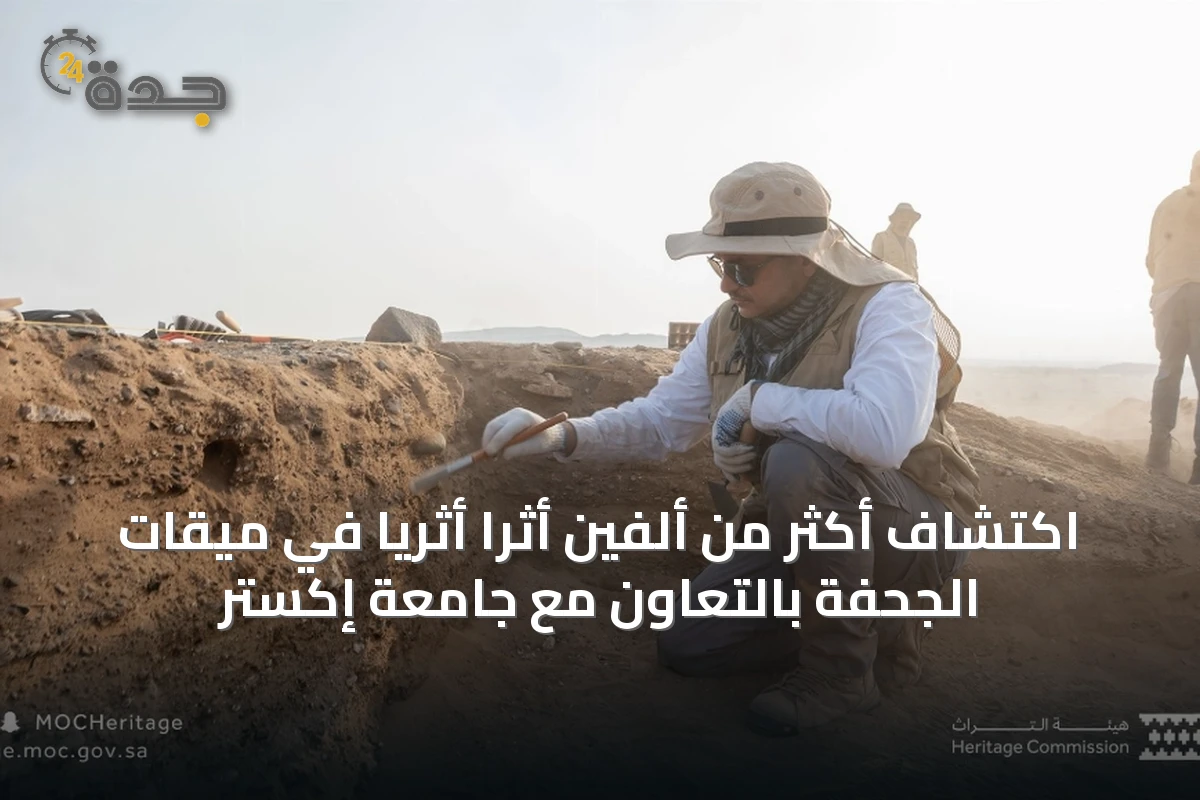
The Heritage Authority of the Kingdom completed the first phase of survey and documentation at the archaeological site of Al-Juhfa Miqat, in coordination with the University of Exeter in the United Kingdom. These efforts resulted in the recording of over two thousand seven hundred artifacts, including pottery, glass, and stone pieces, as well as shells and other crafts, confirming the site’s significance along the Egyptian Hajj route.
Types of Discovered Tools
The findings included a diverse range of tools used by people in various aspects of daily life, such as shells, beads, and metals. Additionally, six pottery kilns were identified, along with a water channel likely intended to facilitate the movement of pilgrims and travelers within the site. Furthermore, thirteen tombstones were recorded, some dating back to the Umayyad and Abbasid periods.
Sources of Artifacts and Geographical Diversity
Analyses showed that some of the finds originate from multiple regions, including the Levant, Egypt, and Abyssinia, indicating the flow of pilgrims from various areas to this miqat. This diversity highlights the historical importance of the site as a crossroads for pilgrimage routes.
Al-Juhfa Site and Its Historical Significance
Al-Juhfa Miqat is located 187 kilometers northwest of Mecca, and it is one of the established miqats since the early Islamic conquests. Historical sources link the Prophet’s passage through this location during his migration, and indicate the miqat’s prosperity in the second century of the Islamic calendar, with water facilities and shops serving visitors.
Authority’s Motivations and Future Aspirations
This phase of survey and excavation is part of the Heritage Authority’s effort to document and record features of archaeological sites along the migration route between Mecca and Medina. The authority aims to accelerate the pace of scientific research by relying on the latest technologies in surveying, diagnosis, and analysis of finds, to provide new data that deepens the cultural understanding of the Kingdom and reveals the historical sequence of these sites.
Al-Juhfa Miqat
Al-Juhfa Miqat is a significant historical and religious site in Saudi Arabia, located near the Red Sea coast. It serves as one of the designated miqat (stations) where pilgrims must enter the state of ihram for the Hajj or Umrah pilgrimages, particularly for those coming from the direction of Egypt, Syria, and North Africa. Historically, it was a small village, but its importance grew after the Prophet Muhammad designated it as a miqat, and today it remains a key point for pilgrims traveling to Mecca.
Egyptian Hajj route
The Egyptian Hajj route is a historic pilgrimage path used by Muslims from Egypt to travel to Mecca for the Hajj. Dating back to the early Islamic period, it gained prominence under the Fatimid and Mamluk dynasties, who established way stations and rest stops to support travelers. The route facilitated not only religious journeys but also cultural and economic exchanges between Egypt and the Arabian Peninsula.
Umayyad period
The Umayyad period (661–750 CE) marked the first hereditary dynasty of the Islamic caliphate, with its capital in Damascus, Syria. Under the Umayyads, the Islamic empire expanded dramatically, reaching from Spain in the west to Central Asia and India in the east. This era is noted for its distinctive architecture, such as the Dome of the Rock in Jerusalem and the Great Mosque of Damascus, as well as the widespread use of Arabic as the administrative language.
Abbasid period
The Abbasid period (750–1258 CE) refers to the era of the Abbasid Caliphate, a golden age of Islamic civilization centered in Baghdad. Founded after overthrowing the Umayyads, this period saw remarkable advancements in science, philosophy, medicine, and trade, epitomized by the House of Wisdom. Its cultural and intellectual achievements profoundly influenced the medieval world before the caliphate’s decline and eventual fall to the Mongol invasion.
Levant
The Levant is a historical and geographical region in the Eastern Mediterranean, encompassing modern-day countries such as Syria, Lebanon, Jordan, Israel, Palestine, and parts of Turkey. Historically, it served as a crucial crossroads for trade, culture, and religion, hosting ancient civilizations like the Phoenicians and Canaanites, and later being ruled by empires including the Romans, Byzantines, and Ottomans. Today, the Levant is known for its rich cultural heritage, diverse societies, and significant archaeological sites.
Egypt
Egypt is a country in North Africa renowned for its ancient civilization, which flourished along the Nile River for over 3,000 years. It is home to iconic monuments like the Pyramids of Giza and the Sphinx, built during the Old Kingdom period, as well as the temples of Luxor and Karnak. Modern Egypt, with its capital Cairo, remains a cultural and political hub in the Arab world, blending its Pharaonic, Islamic, and Coptic heritage.
Abyssinia
Abyssinia is a historical name for the region now known as Ethiopia, primarily located in the Horn of Africa. It was the seat of the ancient Kingdom of Aksum, a major trading empire from the 1st to the 7th centuries AD, and later became the core of the Ethiopian Empire, renowned for its unique Christian heritage and resistance to colonial rule. The term “Abyssinia” is often associated with the country’s rich history, including the legendary Queen of Sheba and the preservation of early Christian traditions.
Mecca
Mecca, located in Saudi Arabia, is the holiest city in Islam and the birthplace of the Prophet Muhammad. It has been a major religious pilgrimage site for centuries, with the Kaaba at the Grand Mosque serving as the focal point for Muslim prayer. The city’s history dates back to pre-Islamic times, and it remains the destination for the annual Hajj pilgrimage, a mandatory religious duty for Muslims.