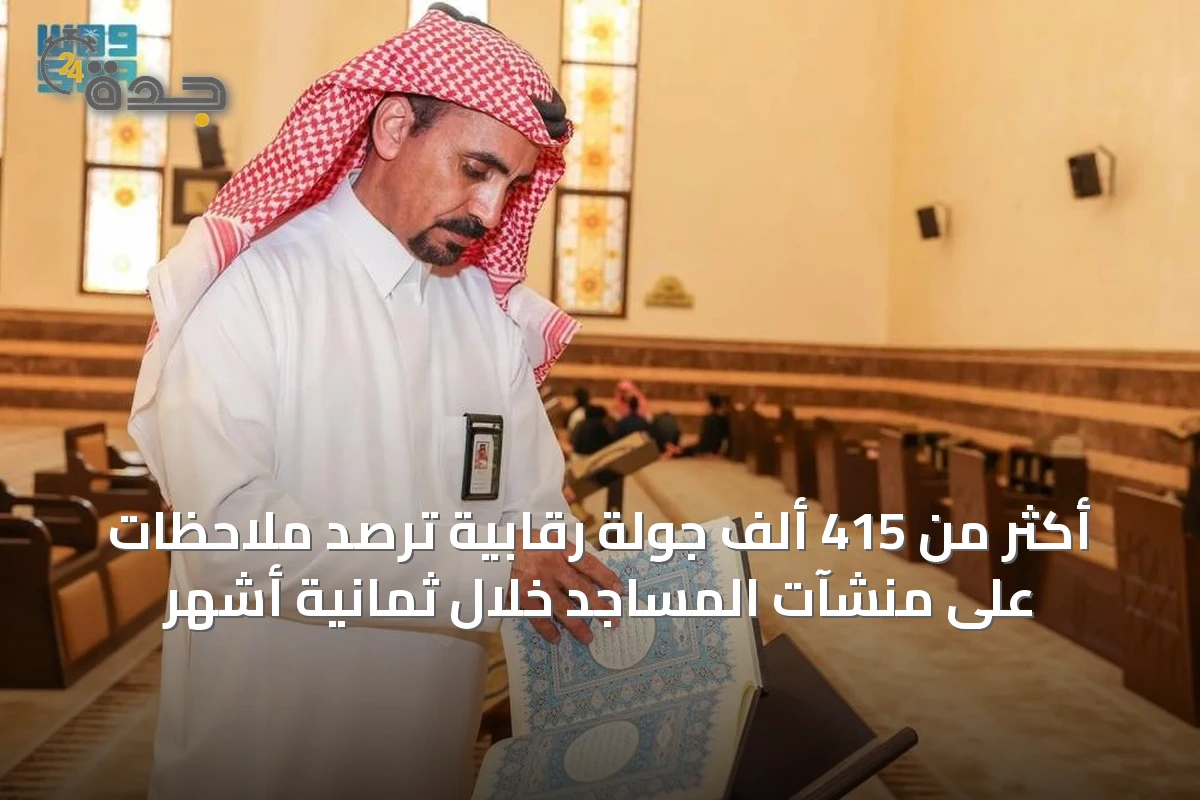
Summary of Inspection Rounds
Data from ministry branches in six regions shows more than 415,000 field inspections were conducted over eight months, from October 2025 to May 2026, covering mosques, prayer halls, women’s prayer areas, and Quran memorization centers and circles.
The inspections focused on monitoring maintenance, cleanliness, and operations; ensuring mosque staff compliance with regulations; verifying the safety of facilities and equipment; and addressing field observations and violations.
Some inspections in several regions recorded issues such as tampering with electricity meters and water networks or vandalism of service facilities, which were handled according to approved regulations and procedures.
Regional Details
In the Riyadh region, the branch recorded 128,186 inspections during March and April 2026, and added 31,263 inspections in May, distributed across various governorates, led by Al-Zulfi with 5,580 inspections, followed by Al-Dawadmi with 3,726 inspections, and Wadi Al-Dawasir with 2,650 inspections.
In the Jazan region, the branch conducted 48,715 inspections in April 2026 with the participation of 1,110 male and female inspectors, having previously carried out 31,480 inspections in preparation for Ramadan with 1,054 inspectors.
In the Asir region, the number of inspections reached 33,476 in April, targeting mosques, prayer halls, and women’s prayer areas, resulting in the identification and resolution of needs and observations.
In the Al-Baha region, the branch conducted 33,767 inspections during the first quarter of 2026, covering mosques, prayer halls, women’s prayer areas, and Quran memorization centers and circles, along with monitoring staff compliance with regulations.
The Tabuk branch recorded 60,573 field inspections in 2025, focusing on monitoring the level of services provided in mosques and prayer halls, identifying operational observations, and addressing them.
In Medina, the branch conducted 47,754 inspections in October and November 2025 as part of periodic monitoring programs aimed at enhancing mosque care and ensuring the readiness of their facilities and services.
Operational Observations and Inspection List
– Monitoring periodic maintenance work for mosques and prayer halls.
– Ensuring cleanliness levels inside mosques and their facilities.
– Identifying and addressing technical and operational needs.
– Monitoring the safety of electrical and plumbing systems.
– Ensuring the efficiency of sound systems.
– Ensuring the integrity of Quran copies and their freedom from wear.
– Addressing visual distortion in the surroundings of mosques.
– Verifying the absence of attacks or tampering with electricity and water generators.
Numerical details of inspections by region and period:
– Riyadh (March–April 2026): 128,186
– Riyadh (May 2026): 31,263
– Jazan (April 2026): 48,715
– Asir (April 2026): 33,476
– Al-Baha (January 1 – March 31, 2026): 33,767
– Jazan (February 2026): 31,480
– Tabuk (2025): 60,573
– Medina (October–November 2025): 47,754
Riyadh
Riyadh, the capital of Saudi Arabia, was originally a small, walled desert settlement known for its fertile oases and date palms. It rose to prominence in the early 20th century when Abdulaziz Ibn Saud recaptured the city in 1902, using it as the base to unify the kingdom. Today, it has transformed into a sprawling modern metropolis, blending its historic mud-brick landmarks like the Masmak Fortress with futuristic skyscrapers and cultural developments.
Jazan</h3
Masmak Fortress
Masmak Fortress, located in Riyadh, Saudi Arabia, is a historic clay and mudbrick fort that dates back to the late 19th century. It played a pivotal role in the unification of Saudi Arabia, as it was the site of a key battle in 1902 when King Abdulaziz Al Saud recaptured Riyadh, marking the beginning of the modern Saudi state. Today, the fortress has been restored and serves as a museum, showcasing artifacts and exhibits about the country’s history and heritage.
Al-Zulfi
Al-Zulfi is a city in central Saudi Arabia, located in the Al-Qassim Province, known for its historical role as a key agricultural and trade hub due to its fertile valleys and abundant groundwater. Historically, it was a significant stop along ancient caravan routes, and it later became famous for its traditional mud-brick architecture and the Al-Zulfi Palace, which reflects the region’s rich cultural heritage. Today, the city blends its historical legacy with modern development, offering visitors a glimpse into Saudi Arabia’s past through its preserved sites and local markets.
Al-Dawadmi
Al-Dawadmi is a historic town in central Saudi Arabia, known for its deep-rooted cultural heritage and role as a traditional stop along ancient trade and pilgrimage routes. It was historically a key settlement for the Dawasir tribe and later became a significant administrative and agricultural center. Today, Al-Dawadmi preserves its heritage through local festivals, traditional architecture, and its famous annual camel market.
Wadi Al-Dawasir
Wadi Al-Dawasir is a historical region and valley in central Saudi Arabia, known for its ancient trade routes and agricultural significance. It was once a key stop along the frankincense and spice routes, linking the Arabian Peninsula with other civilizations. Today, it remains an important cultural site with archaeological remains, traditional mud-brick architecture, and a vibrant local heritage.
Medina
Medina, known as “the Radiant City,” is the second holiest city in Islam, located in western Saudi Arabia. It is revered as the burial place of the Prophet Muhammad, who fled there in 622 CE during the Hijra, marking the beginning of the Islamic calendar. Today, millions of pilgrims visit the Prophet’s Mosque, which houses his tomb, making Medina a central spiritual and historical hub for Muslims worldwide.
Tabuk
Tabuk is a historic city in northwestern Saudi Arabia, known for its role as a key stop on the ancient incense trade route and later as a site connected to the Prophet Muhammad’s military expedition in 630 CE. The region features the Tabuk Fortress, a restored Ottoman-era castle, and the Hijaz Railway station built in the early 20th century. Today, it serves as a modern gateway to nearby archaeological sites and natural landscapes.
Asir
Asir is a mountainous region in southwestern Saudi Arabia, known for its stunning landscapes, terraced agriculture, and distinctive traditional architecture. Historically, the area was a key trade route and was influenced by various cultures, including the Ottoman Empire, before becoming part of modern Saudi Arabia in the early 20th century. Today, Asir is celebrated for its rich cultural heritage, including vibrant festivals, unique art forms like *al-Qatt* (wall painting), and the historic village of Rijal Almaa.
Al-Baha
Al-Baha is a mountainous region in southwestern Saudi Arabia known for its stunning natural beauty, including lush forests, valleys, and traditional villages. Historically, it served as a key trade route and was home to ancient tribes, with its unique architecture featuring stone and wood houses reflecting the local culture. Today, it is a popular tourist destination, offering visitors a glimpse into Saudi Arabia’s rich heritage and diverse landscapes.