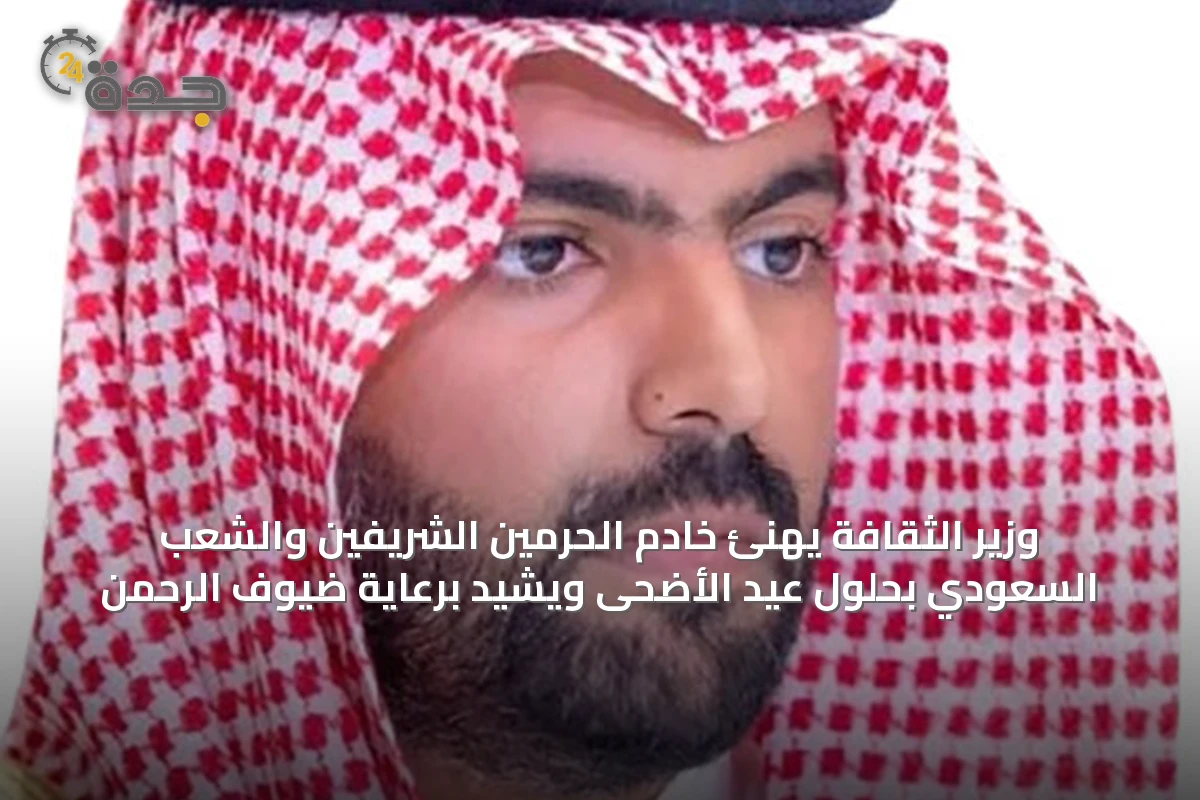
His Highness Prince Badr bin Abdullah bin Farhan, Minister of Culture and Governor of the Royal Commission for AlUla, expressed his sincere congratulations to the Custodian of the Two Holy Mosques King Salman bin Abdulaziz Al Saud, and to His Royal Highness Prince Mohammed bin Salman bin Abdulaziz Al Saud, Crown Prince and Prime Minister, may God protect them, to the Saudi people, and to the Arab and Islamic nations, on the occasion of the blessed Eid al-Adha.
Official Holiday Greeting
In his speech, His Highness emphasized the importance of this religious occasion that brings Muslims together around the world, expressing the highest wishes of blessing and joy for all Muslims.
Praise for National Efforts
His Highness noted the care and attention provided by the wise leadership to the guests of the Most Merciful, affirming that all services are dedicated to facilitating the performance of Hajj rituals with ease, tranquility, and safety, thanks to the continuous efforts of the relevant authorities.
Prayer for Security and Prosperity
His Highness prayed to God Almighty to preserve the security and prosperity of the Kingdom of Saudi Arabia, and for the Arab and Islamic nations, wishing that the wise leadership and the Saudi people be rewarded abundantly for their service and facilities provided to the guests of the Holy House of God.
Conclusion
In conclusion of his speech, the Minister of Culture expressed his hope that this sustainable giving would continue to provide a safe and comfortable environment for pilgrims, asking God Almighty to bless the Kingdom’s efforts and make them a credit to its account.
Custodian of the Two Holy Mosques
The title “Custodian of the Two Holy Mosques” is a royal honorific used by the kings of Saudi Arabia, signifying their responsibility for protecting and managing the two holiest sites in Islam: the Masjid al-Haram in Mecca and the Al-Masjid an-Nabawi in Medina. The title was first adopted in 1986 by King Fahd bin Abdulaziz, replacing the earlier term “His Majesty,” to emphasize the kingdom’s religious role. It reflects the Saudi monarchy’s duty to ensure the safety, maintenance, and accessibility of these sacred mosques for millions of pilgrims each year.
Royal Commission for AlUla
The Royal Commission for AlUla (RCU) is a Saudi government body established in 2017 to oversee the preservation and development of AlUla, a region of outstanding natural and cultural heritage in northwestern Saudi Arabia. Its mission includes transforming the area into a global destination for heritage, arts, and tourism, while protecting ancient sites like Hegra (Madain Saleh), a Nabataean city and UNESCO World Heritage site. The RCU works to balance modern sustainable development with the region’s 200,000-year human history, from prehistoric times through the Islamic era.
AlUla
AlUla is an ancient oasis city in northwestern Saudi Arabia, known for its rich history as a crossroads of civilization and trade. It was once the capital of the Lihyanite kingdom and later flourished under the Nabataeans, who carved the stunning tombs of Hegra (Madain Saleh), a UNESCO World Heritage site. Today, AlUla is celebrated for its archaeological treasures, dramatic desert landscapes, and ongoing cultural heritage projects.
<h3 class="text-lg font-sem
Masjid al-Haram
Masjid al-Haram, located in Mecca, Saudi Arabia, is the holiest site in Islam and the world’s largest mosque. It surrounds the Kaaba, which Muslims believe was built by the Prophet Ibrahim and his son Ismail, and has been a center of pilgrimage for centuries. The mosque has undergone numerous expansions, most notably in recent decades, to accommodate the millions of worshippers who visit during the annual Hajj and Umrah pilgrimages.
Al-Masjid an-Nabawi
Al-Masjid an-Nabawi, also known as the Prophet’s Mosque, is one of the holiest sites in Islam, located in Medina, Saudi Arabia. It was originally built by the Prophet Muhammad in 622 CE, adjacent to his home, and has since been expanded many times over the centuries. The mosque houses the tomb of the Prophet Muhammad and serves as a major pilgrimage destination for Muslims worldwide.
AlUla
AlUla is a historic region in northwestern Saudi Arabia, renowned for its stunning desert landscapes and ancient archaeological sites, including the Nabataean city of Hegra (Madain Saleh), Saudi Arabia’s first UNESCO World Heritage Site. The area has been inhabited for thousands of years, serving as a key crossroads for trade and pilgrimage routes, and is now being developed as a major cultural and tourism destination, with efforts to preserve its rich heritage and open it to global visitors.
Hegra (Madain Saleh)
Hegra, also known as Madain Saleh, is an ancient archaeological site in Saudi Arabia that was a major Nabataean city, second only to Petra. It flourished as a trading hub from the 1st century BCE to the 1st century CE, featuring well-preserved monumental tombs with elaborate facades carved into sandstone outcrops. Inscribed as a UNESCO World Heritage site in 2008, it provides key insights into Nabataean culture and architecture.