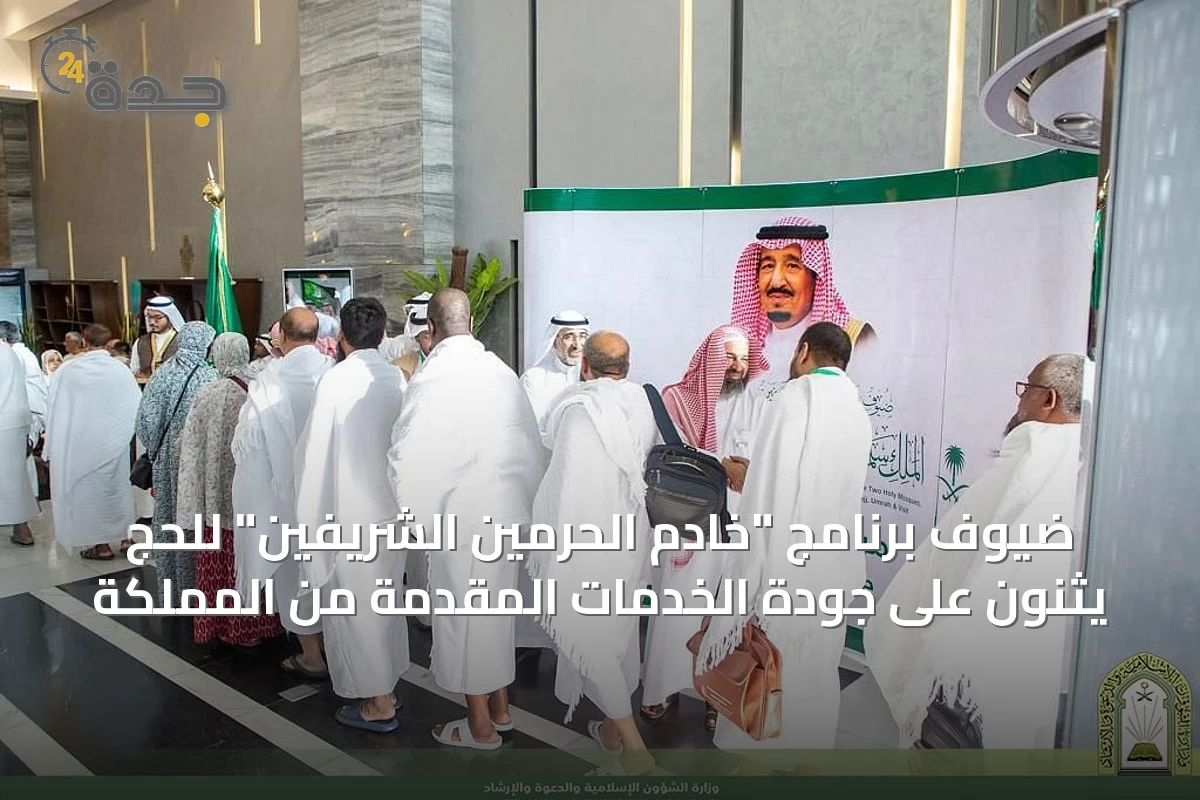
A number of guests of the Custodian of the Two Holy Mosques program for Hajj, Umrah, and visitation, implemented by the Ministry of Islamic Affairs, Dawah, and Guidance, praised the level of organization and services provided by the Kingdom to the guests of the Most Merciful. They affirmed that this level reflects the great care and attention given by the wise leadership to serving the guests of God’s Sacred House and providing all means of comfort for them.
Development of services and modern technologies
The guests highlighted the technological development and modern systems that facilitated pilgrims performing their rituals safely and with reassurance, starting from reception and transportation procedures, to the health, organizational, and guidance services provided to them.
Experience of pilgrim Mahmoud Al-Kuzbari (Syria)
Pilgrim Mahmoud Al-Kuzbari from Syria expressed his appreciation for the integrated services provided by the Kingdom since his first moments of arrival, pointing to the care of the “Guests of the Custodian of the Two Holy Mosques” program that made his stay in the holiest places an exceptional moment in his life, affirming that the precise organization and comprehensive care covered all his needs.
Story of pilgrim Taj El-Din Faisal (Sudan)
Pilgrim Taj El-Din Faisal from Sudan said that his happiness in performing the Hajj duty this year is indescribable, and that the advanced services and integrated organization exceeded his expectations. He explained that his mother’s participation in the program enabled her to perform Hajj for the first time, expressing his gratitude to the Kingdom’s government for this generous gesture and comprehensive care that will remain etched in the memory of the guests of the Most Merciful.
Words of pilgrim Yaman Al-Sayed (Syria)
Pilgrim Yaman Al-Sayed from Syria affirmed that the “Custodian of the Two Holy Mosques” program for Hajj, Umrah, and visitation embodies a great message in serving Islam and Muslims and caring for pilgrims from various countries around the world. He added that the distinguished organization across all relevant authorities reflects the Kingdom’s keenness to facilitate the performance of rituals in an atmosphere of ease and reassurance, praising the great efforts made by the Ministry of Islamic Affairs, Dawah, and Guidance to provide all the needs of the pilgrims hosted in the program during their stay and travels.
Custodian of the Two Holy Mosques
The title “Custodian of the Two Holy Mosques” is a royal honorific used by the kings of Saudi Arabia, signifying their role as protector of Islam’s two holiest sites: the Masjid al-Haram in Mecca and the Prophet’s Mosque in Medina. The title was first adopted by King Fahd in 1986, replacing “His Majesty,” to emphasize the kingdom’s religious duty rather than political power. It reflects Saudi Arabia’s central role in the Islamic world, overseeing the annual Hajj pilgrimage and maintaining the sacred mosques.
Sacred House
The “Sacred House” is the English translation of “Baitullah,” a name for the Kaaba in Mecca, Islam’s holiest site. According to Islamic tradition, it was originally built by the Prophet Ibrahim (Abraham) and his son Ismail, and it has served as a central point of worship and pilgrimage for Muslims for over 1,400 years. Today, it is the focal point of the Hajj pilgrimage, where millions of believers circle it in devotion.
Masjid al-Haram
Masjid al-Haram, located in Mecca, Saudi Arabia, is the holiest site in Islam and houses the Kaaba, towards which Muslims worldwide pray. Its history dates back to the time of Prophet Ibrahim and Ismail, who are believed to have built the Kaaba, and it has been expanded significantly over centuries, especially under Islamic rulers and the Saudi government. The mosque can accommodate millions of worshippers, particularly during the annual Hajj pilgrimage.
Prophet’s Mosque
The Prophet’s Mosque, located in Medina, Saudi Arabia, is one of the holiest sites in Islam, originally built by the Prophet Muhammad himself in 622 CE after his migration from Mecca. It served as the center of the early Muslim community, functioning as a mosque, school, and political hub. Over centuries, it has been expanded and renovated by various Islamic rulers, and today it houses the Prophet’s tomb, attracting millions of pilgrims annually.
Mecca
Mecca, located in Saudi Arabia, is the holiest city in Islam and the birthplace of the Prophet Muhammad. It is home to the Masjid al-Haram, which contains the Kaaba, the sacred structure toward which Muslims pray. As the destination of the annual Hajj pilgrimage, Mecca has been a vital religious and cultural center for over 1,400 years.
Medina
Medina, located in modern-day Saudi Arabia, is one of the holiest cities in Islam, second only to Mecca. Its history is deeply tied to the Prophet Muhammad, who migrated there in 622 CE—an event known as the Hijra—and established the first Muslim community. The city is home to Al-Masjid an-Nabawi (the Prophet’s Mosque), which contains Muhammad’s tomb and serves as a major pilgrimage site.
Kaaba
The Kaaba is a sacred cube-shaped building located in the center of the Great Mosque in Mecca, Saudi Arabia, and is the most important site in Islam. According to Islamic tradition, it was originally built by the Prophet Abraham and his son Ishmael, and it has been a focal point for pilgrimage and prayer for centuries. Muslims around the world face the Kaaba during their daily prayers, and it is the central destination of the Hajj pilgrimage, a duty for every able-bodied Muslim who can afford to do so.