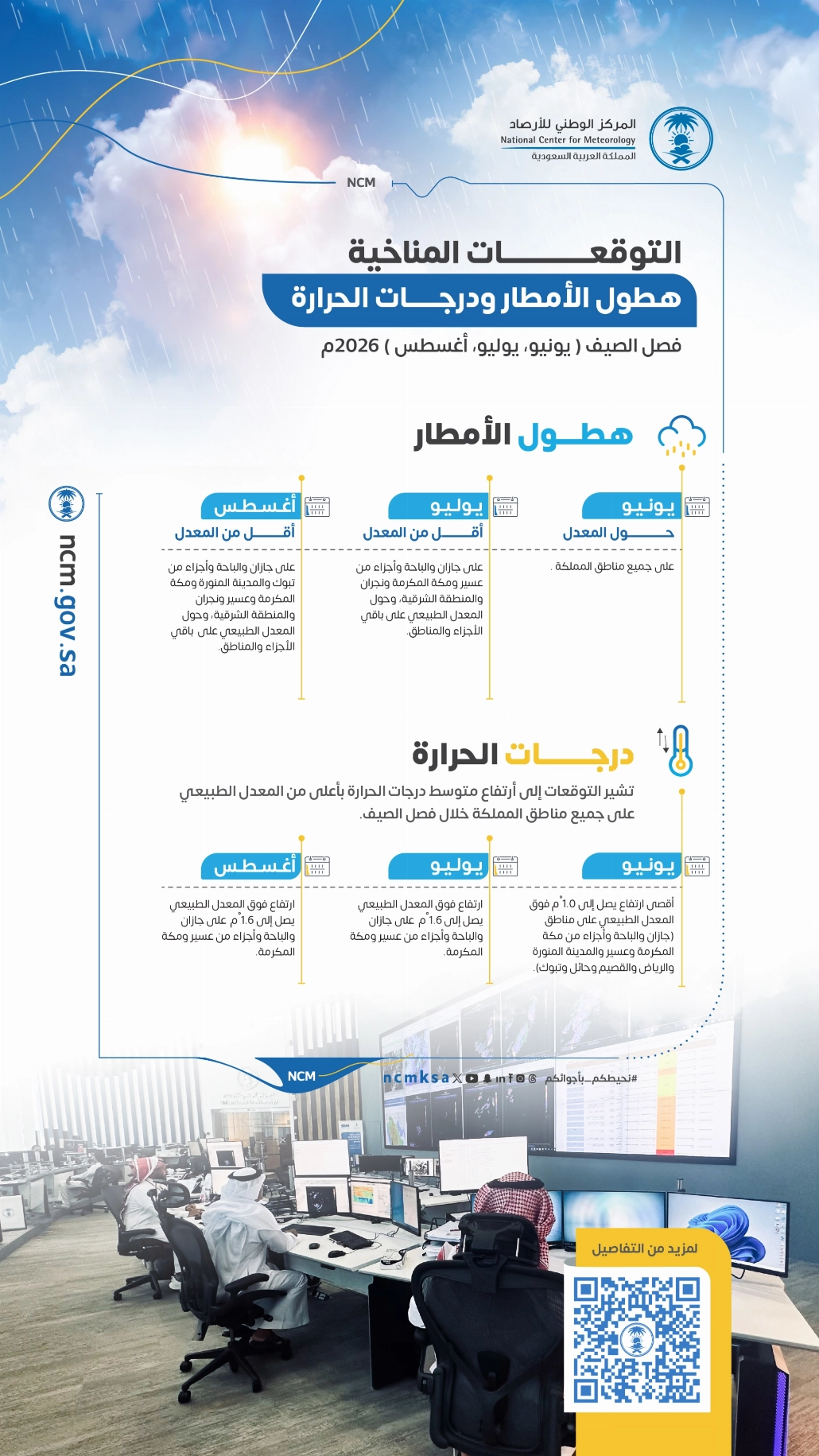
The National Center for Meteorology forecasts that summer 2026 will see an increase in average surface temperatures across most regions of the country, with expectations of lower-than-normal rainfall in several areas, especially the southern and southwestern regions.
The center stated in its seasonal climate forecast report for summer (June, July, and August 2026) that temperatures will be above the normal climate average in various regions of the country, with the rise becoming more intense during July and August compared to June.
The report indicated that June will witness a temperature increase of up to about one degree Celsius above normal in parts of Mecca, Al-Baha, and Asir, as well as Riyadh, Al-Qassim, Hail, and Tabuk.
The center predicted that July will be the hottest month, with a rise of up to 1.6 degrees Celsius above normal in parts of Jazan, Al-Baha, Asir, and Mecca, before the increase continues during August at levels exceeding usual climate averages, especially in Jazan and parts of the southwestern highlands.
In contrast, eastern and central regions are expected to experience high temperatures during intermittent periods of summer, with continued hot daytime weather in most inland areas. Regarding rainfall, forecasts indicate that June will be close to normal rates in most regions of the country, while precipitation chances decrease during July and August, becoming below the usual average.
The center explained that the areas most affected by reduced rainfall include Jazan, Asir, Al-Baha, and Najran, in addition to parts of Mecca and Medina regions, as well as some eastern and central areas.
The report confirmed that these forecasts reflect general climate trends expected during the season and do not include extreme weather phenomena or short-term weather conditions.
Mecca
Mecca is the holiest city in Islam, located in western Saudi Arabia and the birthplace of the Prophet Muhammad. It is home to the Masjid al-Haram, which contains the Kaaba, the sacred structure toward which Muslims pray. For centuries, Mecca has served as the destination for the Hajj pilgrimage, a religious duty required of all able-bodied Muslims.
Al-Baha
Al-Baha is a mountainous region in southwestern Saudi Arabia, known for its stunning natural landscapes of terraced farms, forests, and ancient stone villages. Historically, it served as a key stop along ancient trade routes and was home to the Ghamid and Zahran tribes, whose traditional architecture and culture remain prominent. Today, it is a popular tourist destination, celebrated for its cooler climate, rich heritage, and sites like the historic village of Dhee Ayn.
Asir
Asir is a mountainous region in southwestern Saudi Arabia known for its stunning terraced landscapes, traditional stone architecture, and unique cultural heritage. Historically, the area was a key stop along ancient trade routes and later became part of the Saudi state in the early 20th century after the 1934 Treaty of Taif. Today, Asir is celebrated for its vibrant arts, including the famous “Qatt” folk art, and its role in preserving Yemeni-influenced traditions.
Riyadh
Riyadh is the capital and largest city of Saudi Arabia, located in the heart of the Arabian Peninsula. Its history dates back to the 18th century as a small oasis settlement, but it grew into a major political and economic hub after being captured by the Al Saud dynasty in 1824 and later becoming the capital of the unified Kingdom of Saudi Arabia in 1932. Today, Riyadh is a modern metropolis blending ancient heritage with futuristic skyscrapers, serving as the country’s center for government, finance, and culture.
Al-Qassim
Al-Qassim is a region in central Saudi Arabia known for its rich agricultural heritage, particularly as a major producer of dates. Historically, it served as a vital crossroads for trade and pilgrimage routes, and its capital, Buraydah, has long been a cultural and commercial hub. The area also played a role in the unification of Saudi Arabia in the early 20th century.
Hail
Hail is a historic city in northwestern Saudi Arabia, known for its rich cultural heritage and role as a major crossroads for trade and pilgrimage routes. It was once the capital of the Al Rashid dynasty in the 19th century, whose rivalry with the Al Saud family shaped much of the region’s history. Today, Hail is celebrated for its traditional architecture, such as the mud-brick fortress of A’arif, and its vibrant annual festivals highlighting Bedouin culture.
Tabuk
Tabuk is a historic city in northwestern Saudi Arabia, known for its strategic location along ancient trade and pilgrimage routes. It gained prominence during the time of the Prophet Muhammad, who led the Expedition of Tabuk in 630 CE, a significant event in early Islamic history. Today, the city blends its rich past with modern development, featuring landmarks like the Tabuk Castle and nearby archaeological sites.
Jazan
Jazan is a coastal city in southwestern Saudi Arabia, known for its rich agricultural heritage and stunning natural landscapes, including the Farasan Islands. Historically, it served as an important trade port along the Red Sea, with roots dating back to ancient civilizations. Today, it blends traditional culture with modern development, featuring bustling souks, historic mud-brick architecture, and annual festivals like the Jazan Winter Festival.