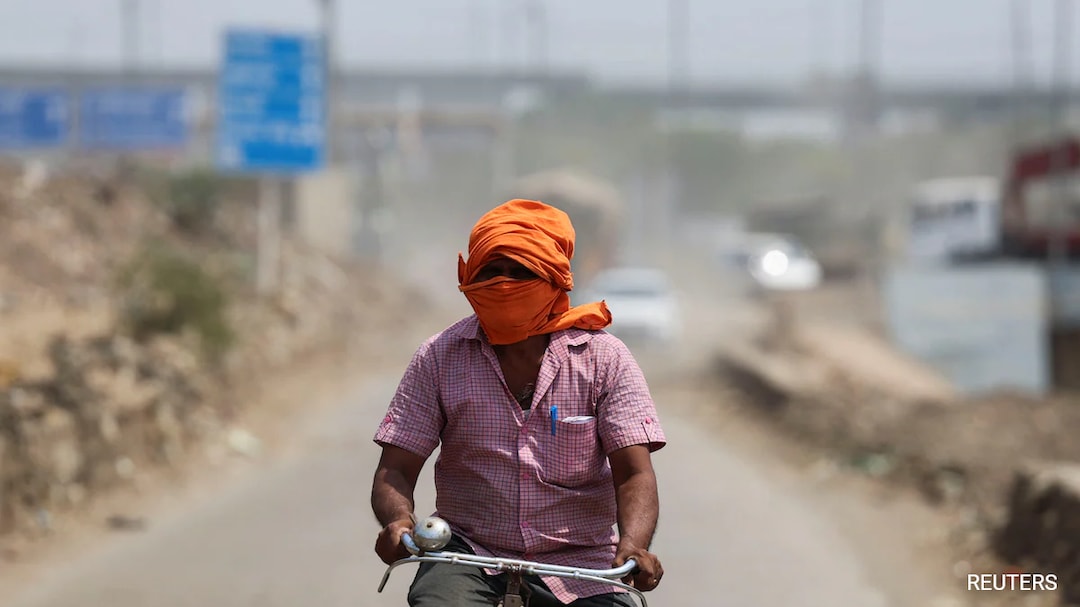
Heatwave likely to continue over central and northwest India for the next few days.
The India Meteorological Department (IMD) on Monday predicted that heatwave to severe heatwave conditions are likely to continue over Central and Northwest India for the next 4-5 days, and in the east and adjoining Peninsular India for the next 3-4 days.
A reduction in maximum temperatures and an abatement of heatwave conditions are likely from May 29 onwards across Central and adjoining northern Peninsular, East and Northwest India, except in some parts of Rajasthan.
The weather office also predicted isolated heavy to very heavy rainfall likely over Northeast India for the next 6-7 days and over Kerala and Tamil Nadu for the next 2-3 days.
Delhi Swelters At 43.5 Degrees, Respite Likely On Friday
Delhi reeled under sweltering heat on Tuesday as the maximum temperature settled at 43.5 degrees Celsius, 3.1 notches above normal, at the benchmark Safdarjung observatory, according to the India Meteorological Department (IMD).
The weather office said stations at Ayanagar, Ridge and Lodhi Road fell short of official heatwave criteria by 0.2 degree, 0.4 degree and 0.7 degree Celsius respectively.
City residents are expected to get some respite from May 29 onwards, with the weather office predicting thunderstorm and rain activity.
Heatwave Alert News LIVE: Heatwave Conditions Continue In Rajasthan
Rajasthan continued to reel under intense heatwave conditions on Tuesday, with Sri Ganganagar recording the highest maximum temperature at 47 degrees Celsius, making it the hottest place in the state.
Bikaner and Phalodi followed closely at 46 degrees Celsius each, while Jaisalmer recorded 45.6 degrees Celsius and Kota 45.4 degrees Celsius. The state capital, Jaipur, also witnessed severe heat, recording a maximum of 43.2 degrees Celsius.
Most major cities reported temperatures above the 40-degree mark on Tuesday.
Jaipur Meteorological Centre said the ongoing heatwave and warm night conditions are likely to persist for the next two to three days, with maximum temperatures expected to hover between 44-46 degrees Celsius across most regions.
In parts of Bikaner, Kota division and Shekhawati region, temperatures may touch 46-47 degrees Celsius.
Relief is likely towards the end of the week as a fresh western disturbance is expected to become active from May 28, bringing chances of dust storms and light rain in parts of the state. Weather activity is expected to intensify from May 30 and may continue into the first week of June.
Due to these changes, temperatures are likely to drop by 2-3 degrees Celsius from May 29 onwards, offering some respite from the prevailing heatwave conditions, officials said.
Heatwave Alert News LIVE: Intense Heat In Haryana, Punjab
Haryana and Punjab on Tuesday witnessed intense heat, with Sirsa once again turning out to be the hottest place in the two neighboring states at a maximum temperature of 46 degrees Celsius.
Haryana’s Sirsa has been reeling under heatwave for the past few days.
Sizzling weather also prevailed in Rohtak and Bhiwani, which recorded respective maximums of 45.6 degrees Celsius and 44.5 degrees Celsius.
Ambala recorded a high of 42.5 degrees Celsius, Hisar 44.5 degrees, Karnal 42.6 degrees while Narnaul recorded 44 degrees Celsius.
The common capital of the two states also experienced hot weather at 41.6 degrees Celsius.
In Punjab, Bathinda sizzled at 45.8 degrees Celsius while Patiala registered a maximum of 43.4 degrees Celsius.
Ludhiana lodged a maximum of 42.5 degrees Celsius while Amritsar’s high settled at 41.6 degrees Celsius.
Pathankot, Ferozepur and Mohali recorded respective maximums of 40 degrees, 40.3 degrees and 40 degrees Celsius.
Large swathes of northern and central India continue to bake under intense heatwave conditions, with the India Meteorological Department
Safdarjung Observatory
The Safdarjung Observatory, located in New Delhi, India, is a historic astronomical observatory built in the 18th century as part of the larger Jantar Mantar complex. It was commissioned by the Mughal ruler Muhammad Shah and later associated with Safdarjung, a prime minister of the Mughal Empire, serving as a site for precise celestial observations using innovative stone instruments. Today, it stands as a testament to Mughal-era scientific achievement and is a protected monument under the Archaeological Survey of India.
Ayanagar
Ayanagar is a village located on the southwestern outskirts of New Delhi, India, known for its rural charm and proximity to the Delhi Ridge forest. Historically, it was a small agricultural settlement, but it gained prominence in the 1960s when the Indian government established the National Defence College (NDC) campus there. Today, Ayanagar is also recognized for its annual Ayanagar Mela, a traditional fair that showcases local culture and crafts.
Ridge
Ridge typically refers to a long, narrow landform with elevated terrain, often found in mountainous regions. In a cultural context, “Ridge” may denote specific locations like the Ridge in Shimla, India—a prominent hill station built by the British in the 19th century, serving as a social and recreational hub. Its history includes colonial-era architecture and its role as a gathering place for locals and tourists, offering panoramic views of the Himalayas.
Lodhi Road
Lodhi Road is a major thoroughfare in New Delhi, India, named after the Lodi dynasty that ruled the region in the 15th and 16th centuries. The road is famous for the nearby Lodhi Gardens, a historic park containing the tombs of Lodi rulers such as Muhammad Shah and Sikandar Lodi, which were built between 1444 and 1517. Today, the area is a blend of lush green spaces, diplomatic missions, and upscale residential neighborhoods, reflecting Delhi’s layered history from medieval times to the modern capital.
Sri Ganganagar
Sri Ganganagar, located in the northern Indian state of Rajasthan, is a planned city and the northernmost district of the state. Founded in the early 20th century by the Maharaja of Bikaner, Sir Ganga Singh, it was developed as a major agricultural hub after the construction of the Gang Canal irrigation system, which transformed the arid region into fertile farmland. Today, it is known for its rich agricultural output, particularly in wheat and cotton, and is often called the “Food Basket of Rajasthan.”
Bikaner
Bikaner is a historic city in the northwestern Indian state of Rajasthan, founded in 1488 by Rao Bika, a Rajput prince. It is renowned for its well-preserved medieval architecture, most notably the red sandstone Junagarh Fort, which was built in the late 16th century and never conquered. The city also serves as a gateway to the Thar Desert and is famous for its vibrant culture, camel festivals, and as a center for traditional crafts.
Phalodi
Phalodi is a historic town located in the Jodhpur district of Rajasthan, India, known for its salt industry and as a gateway to the Thar Desert. It was founded in the 15th century by the Rathore ruler Rao Jodha, and later became an important trading center along the caravan routes. The town is also famous for its stunning architectural heritage, including the Phalodi Fort and intricately carved Jain temples.
Jaisalmer
Jaisalmer, often called the “Golden City” of India, is a historic fort city located in the heart of the Thar Desert in Rajasthan. Founded in 1156 AD by Rawal Jaisal, the city is dominated by its magnificent sandstone fort, Jaisalmer Fort, which is one of the few living forts in the world where thousands of residents still live within its walls. Its rich history as a strategic trading post on the ancient Silk Road is reflected in its ornate havelis, temples, and vibrant culture.