New floating pier near Ishikawacho Station. The name of the new pier will be announced on May 24 at 1:15 PM.
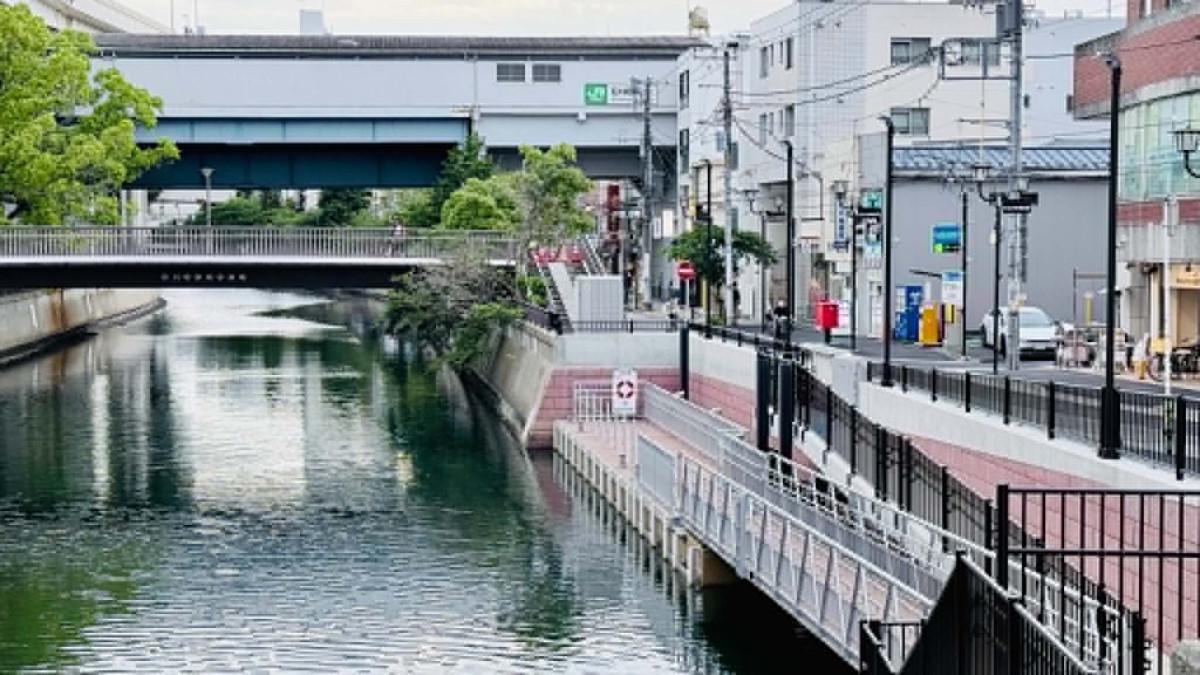
A new floating pier, tentatively named “Ishikawacho New Floating Pier,” has been completed on the Nakamura River near JR Ishikawacho Station. A completion ceremony will be held on May 24, and operations will begin.
Kanagawa Prefecture is developing nine waterfront facilities along the Ooka River system (Ooka River, Nakamura River, Hori River, and Horiwari River) to enhance the city’s appeal through water recreation and disaster prevention. The Ishikawacho floating pier is one of them. Five facilities have already been completed, making this the sixth.
The completion ceremony is scheduled from 1:00 PM to 3:00 PM and will take place at the event stage of the “Ura Fest” organized by local groups. At 1:15 PM, there will be a naming ceremony for the floating pier and a community exchange stage. At 1:40 PM, a water rescue demonstration by the Naka Fire Department will take place. At 2:00 PM, the pier completion ceremony and Ura Fest ceremony will be held, followed by a ribbon-cutting at 2:40 PM. The name of the floating pier was chosen through a local public征集 and will be announced during the ceremony. The event will begin at 12:00 PM with a concert by Yokohama Municipal Minato Junior High School, and activities near the floating pier will continue until 7:00 PM. Water transportation will be operated by Keihin Ferry Boat, including the inaugural voyage of the new open-deck vessel “CANALLINE,” along with two other ships.
The CANALLINE will operate between Ishikawacho and Yokohama Hino De Pier. Departures from Ishikawacho are at 12:00 PM and 1:20 PM, while departures from Hino De are at 12:40 PM and 2:20 PM. The travel time is 25 minutes (40 minutes for the last trip only). A hand-cranked organ and bubble street performance will be held on board, with a ticket price of 1,500 yen.
Two routes are available for the Yokohama Harbor cruise. The electric propulsion boat “e-Float Terrace,” equipped with a Yamaha engine, departs from Ishikawacho at 12:45 PM, 3:35 PM, and 4:30 PM, with a travel time of 40 minutes. It includes commemorative photos and a guided tour for 2,500 yen. The “Needs II” departs at 11:00 AM, 11:45 AM, 4:05 PM, 4:50 PM, and 5:35 PM, with a travel time of 30 minutes and a guided tour for 2,000 yen.
On the same day, in areas connected by rivers, local food and music events will be held, including “Ura Fest” (Ishikawacho) where food and merchandise can be enjoyed for 500 yen, “Ooka River Water Theater” (near Hino De Pier), and “Hatsukoi Market / Nokisaki Art Fair” (Hinodecho). These events aim to create vibrancy in the town by combining water and waterfront activities.
Shigenobu Oshima, chairman of the NPO “HamaBridge Hamakyo Kai,” which has promoted the construction of the new floating pier by operating the “Yokohama Canal Challenge” using temporary piers, said, “Although the river is owned by the prefecture, the city obtained permits between administrative bodies, and local operating groups manage it, making the construction of the new pier possible. We want citizens to enjoy water transportation on a daily basis.” In the future, the “Ishikawacho River Station Management Committee” will support the operation of the pier locally.
Regarding the new ship “CANALLINE,” which will make its maiden voyage from the new floating pier, a representative from Keihin Ferry Boat said, “The ship features a classical design. Its colors are inspired by the lily colors that spread from Yokohama Port to the world and the green of the shoots of Yoshida Shinden. It is designed to pass under low canal bridges. We want to connect Yokohama’s historic canals and ports, creating new waterfront vibrancy with the people of the town.”
<div class="my