University-born venture development aims to create a funding cycle, with academic consulting for companies showing promising results.
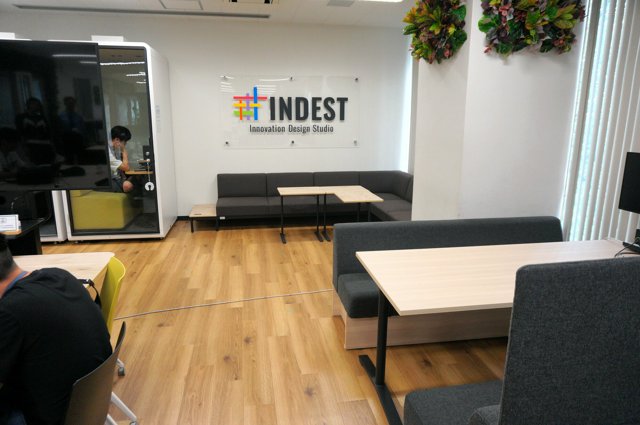
The Tamachi campus of the Tokyo University of Science, next to the JR station. On the second floor, there was a sign reading “INDEST.” The space, originally lecture rooms on the second to fourth floors, was renovated and opened in 2021 as a rental office for university-launched venture companies.
The second floor is a free-address coworking space. Companies that start here can secure a “fixed seat” in the large room on the third floor. As the company grows, it can move up to a “semi-private” space on the same floor and then to a “private room” on the fourth floor. Each stage has a three-year limit in principle.
By incorporating and registering the company, it can use the address of the Tokyo University of Science, highlighting its university origin. Since April, registration has also been allowed even with a “free seat.”
Aiming for a Venture Version of “Tokiwa-sō”
Currently, 36 companies are renting here, and 90% of them were founded by graduates or faculty members of the university. The goal is to create a venture version of “Tokiwa-sō,” the post-war apartment building where young manga artists inspired each other.
“Aiwell” (Minato-ku), which “graduated” from here in March, is advancing the commercial use of a protein analysis technology developed by a professor at the Tokyo University of Science. In April, it announced joint research with a company to establish a method for objectively evaluating health conditions based on changes in blood proteins, such as those in the blood.
Tokyo University of Science, School of Environment and Society Engineering…
Tamachi campus of the Tokyo University of Science
The Tamachi campus of the Tokyo University of Science, located in Minato-ku, Tokyo, serves as a central hub for the university’s graduate and research activities. Established in 1881 as the Tokyo Academy of Physics, the university has a long history of scientific education and innovation. The campus is known for its modern facilities and proximity to Tokyo Tower, blending historical academic tradition with urban development.
JR station
A “JR station” refers to a railway station operated by the Japan Railways Group (JR), a network formed in 1987 after the privatization and breakup of the state-owned Japanese National Railways (JNR). These stations are central to Japan’s extensive and efficient rail system, connecting major cities and rural areas through Shinkansen (bullet trains) and local lines. Many JR stations, like Tokyo Station with its historic red-brick facade, have become iconic landmarks that reflect Japan’s modern transportation history and cultural identity.
Tokyo University of Science
The Tokyo University of Science (TUS) is a prestigious private research university in Japan, founded in 1881 as the Tokyo Academy of Physics. It was established by a group of 21 graduates of the Imperial University of Tokyo (now the University of Tokyo) with the aim of promoting scientific education and research. Today, TUS is known for its strong emphasis on science and technology, and it has produced numerous influential scientists and engineers.
Tokiwa-sō
Tokiwa-sō is a historic apartment complex in Tokyo, Japan, best known as the former residence of several pioneering manga artists in the 1950s, including Osamu Tezuka, the “God of Manga.” It became a creative hub where artists like Shotaro Ishinomori and Fujiko Fujio lived and collaborated, significantly shaping modern Japanese manga. Though the original building was demolished in 198<div class="my-4
Tamachi campus of the Tokyo University of Science
The Tamachi campus of the Tokyo University of Science is located in Minato-ku, Tokyo, and serves as a key urban hub for the university’s graduate programs and research facilities. Established in 1881 as the Tokyo College of Science, the university has a long history of advancing scientific education and research in Japan. The campus is known for its modern laboratories and close proximity to the bustling business and technology districts of Tokyo.
JR station
A “JR station” refers to a railway station operated by the Japan Railways Group (JR), which was formed in 1987 after the privatization and breakup of the state-owned Japanese National Railways (JNR). These stations are central to Japan’s extensive rail network, serving as hubs for Shinkansen (bullet trains) and local lines, and many are located in historically significant areas. JR stations often feature modern amenities while preserving architectural or cultural elements from the earlier JNR era, reflecting Japan’s post-war modernization and rail history.
Tokyo University of Science
The Tokyo University of Science (TUS) is a prestigious private research university in Japan, founded in 1881 as the “Tokyo Physics School” by a group of 21 scientists and educators. It was established with the mission to promote the advancement of science and technology, and it later changed its name to its current form in 1914. Today, TUS is known for its strong emphasis on scientific research and innovation, contributing significantly to various fields of science and engineering.
Tokiwa-sō
Tokiwa-sō was a famous apartment building in Tokyo, Japan, known as a legendary birthplace of modern manga. Built in 1952, it housed several pioneering manga artists in the 1950s, including Osamu Tezuka and Fujio Akatsuka, who created iconic works there. Though demolished in 1982, it remains a significant cultural landmark in manga history.
Minato-ku
Minato-ku is a special ward in Tokyo, Japan, known for its blend of modernity and tradition. Historically, it developed as a residential and commercial area during the Edo period, and today it houses landmarks like Tokyo Tower, the Imperial Palace gardens, and numerous foreign embassies. The district is also famous for its upscale neighborhoods such as Roppongi and Shibuya, reflecting Tokyo’s dynamic urban culture.
Aiwell
Aiwell is a small village located in the district of Limburg-Weilburg in Hesse, Germany, known for its tranquil rural setting. Historically, it was first documented in the 13th century and has long been shaped by agriculture and the surrounding forests. Today, it remains a quiet community that preserves its traditional character while offering a peaceful retreat in the German countryside.