Japan’s new intelligence bureau could enable public surveillance.
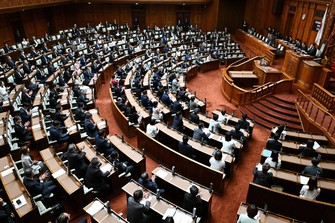
The House of Councillors plenary session passes into law, by majority vote, a bill to establish a “national intelligence council,” at the Diet in Tokyo on May 27, 2026.
To strengthen Japan’s intelligence capabilities, a law to create a national intelligence council chaired by the prime minister has been enacted. The Cabinet Intelligence and Research Office will be upgraded to a national intelligence bureau, which will serve as the secretariat, and the council could be launched as early as July.
Amid a worsening security environment, the government aims to integrate information collected by each ministry and agency and utilize it in policy decisions. At the same time, the move paves the way for the expansion of government intelligence.
The administration of Prime Minister Sanae Takaichi seeks to enact related laws to crack down on espionage activities by foreign powers and establish a “foreign intelligence agency” to strengthen Japan’s overseas intelligence capabilities. The strengthening of communications interception, known as SIGINT, or signals intelligence, is also under discussion.
The concerning issue is the possibility that surveillance of the public may intensify.
The prime minister told the Diet, “It is hard to imagine that ordinary citizens would become targets of investigations merely because they participated in demonstrations or rallies critical of the government.”
However, unlawful surveillance of the public by authorities has come to light in the past. The Self-Defense Forces and police collected personal information on residents opposing the forces’ deployment to Iraq and a bid to construct a power plant in Gifu Prefecture.
At the request of the prime minister, the national intelligence bureau could engage in broader activities, and fears remain that personal data could be collected without limit, creating the risk of citizens’ privacy and human rights, such as freedom of communication, being violated.
Despite these concerns, the new law does not include any mechanism to oversee the activities of intelligence agencies. The government argues that such provisions are unnecessary as the law does not grant the bureau new investigative or surveillance powers. In the House of Councillors, the Constitutional Democratic Party of Japan proposed an amendment requiring an annual Diet report and the establishment of an independent body to review any infringement of citizens’ rights and check political neutrality, but this was rejected.
The new bureau will serve as the command center for intelligence gathering. It is essential to establish a system of democratic control beforehand.
The process of collecting and analyzing information should be recorded so that later reviews are possible. In Europe and the United States, there are systems for legislators and independent bodies to monitor such activities.
The government must improve operational transparency, and the Diet must fulfill its supervisory role. In stressing national security risks, the rights of citizens must never be taken lightly.
The House of Councillors
The House of Councillors is the upper house of Japan’s National Diet, established under the post-World War II Constitution of Japan in 1947. It was created to provide a more deliberative and stable legislative body compared to the lower house, with members elected to six-year terms. Located in Tokyo, it plays a key role in reviewing legislation and representing regional interests.
the Diet
The Diet is Japan’s national legislature, consisting of the House of Representatives and the House of Councillors, and serves as the country’s highest organ of state power. Located in Tokyo’s Nagatachō district, the current building was completed in 1936 after decades of planning, replacing earlier temporary structures. Its history reflects Japan’s transition from imperial rule to a modern parliamentary democracy, particularly after the post-World War II constitution took effect in 1947.
Tokyo
Tokyo, the capital of Japan, was originally a small fishing village named Edo before becoming the political center of the Tokugawa shogunate in the early 17th century. It was renamed Tokyo (“Eastern Capital”) in 1868 after the Meiji Restoration, when the imperial court moved from Kyoto. Today, it is a sprawling global metropolis blending
House of Councillors
The House of Councillors is the upper house of Japan’s National Diet, established in 1947 under the post-World War II constitution. It was designed to provide a more deliberative and stable legislative body compared to the House of Representatives, with members serving six-year terms. The chamber has played a key role in reviewing legislation and representing regional interests in Japan’s bicameral system.
Diet
I’m sorry, but “Diet” is not a specific place or cultural site. Could you please clarify what you mean? For example, are you referring to a location named Diet (such as the Diet building in Japan), or the concept of diet in terms of food and nutrition?
Tokyo
Tokyo is the bustling capital of Japan, originally a small fishing village called Edo that rose to prominence in the early 17th century when it became the seat of the Tokugawa shogunate. Following the Meiji Restoration in 1868, the city was renamed Tokyo (“Eastern Capital”) and rapidly modernized into a global hub of culture, technology, and commerce. Today, it blends historic landmarks like the Imperial Palace and Senso-ji temple with cutting-edge districts such as Shibuya and Akihabara.
Gifu Prefecture
Gifu Prefecture, located in the Chubu region of Japan, is historically significant as a strategic crossroads during the Sengoku period, most notably home to the powerful warlord Oda Nobunaga. Its iconic landmark, Gifu Castle, was a key base for Nobunaga’s campaign to unify Japan. Today, the prefecture is renowned for its traditional crafts, such as Mino washi paper, and scenic attractions like the historic town of Shirakawa-go.
Iraq
Iraq, historically known as Mesopotamia, is often called the “Cradle of Civilization” because it was home to ancient empires like Sumer, Babylon, and Assyria, which developed writing, law, and early urban centers. In the modern era, it became a republic after a 1958 revolution and later faced decades of conflict, including the Iran-Iraq War, the Gulf War, and the 2003 U.S.-led invasion. Despite its turbulent recent history, Iraq remains rich in cultural heritage, with sites like the ancient city of Babylon and the Ziggurat of Ur.
Europe
Europe is a continent with a rich and complex history, serving as the birthplace of Western civilization, the Renaissance, and the Industrial Revolution. It is home to countless cultural sites, from ancient Greek ruins and Roman coliseums to medieval castles and modern art museums. Today, Europe is known for its diverse cultures, languages, and political institutions, including the European Union.
United States
The United States is a federal republic in North America, founded on July 4, 1776, with the Declaration of Independence from British rule. Its history includes rapid westward expansion, the Civil War over slavery and states’ rights, and its rise as a global superpower in the 20th century. Today, it is known for its cultural diversity, technological innovation, and iconic landmarks like the Statue of Liberty and the Grand Canyon.