Japanese convenience store’s ‘almost too kind’ sign goes viral abroad, owner explains its meaning.
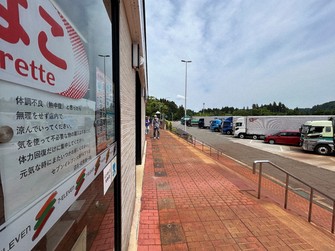
Large trucks are parked outside a 7-Eleven convenience store at the Ozumi Parking Area on the Hokuriku Expressway in Nagaoka, Niigata Prefecture, on May 27, 2026. A sign on the left invites people to come inside and cool off.
NIIGATA — “If you think you may have heatstroke, please don’t push yourself — come inside and cool off.”
A notice bearing that message was posted last summer outside convenience stores in Niigata Prefecture, earning praise on social media as “almost too kind” and drawing attention overseas. With another spell of extreme heat forecast this year, the widely lauded notice has once again appeared outside the stores.
The person behind it is Tatsuya Takahashi, 63, who runs three 7-Eleven outlets in the prefecture. The idea came to him last July, when the region was experiencing day after day of temperatures exceeding 30 degrees Celsius. While searching online for something he could do, he came across a message posted outside a store somewhere that immediately caught his attention.
“If you feel unwell and think it may be heatstroke, please don’t push yourself — come inside and cool off,” the notice read, adding: “There is no need to purchase anything out of courtesy. Please focus solely on recovering your strength.” Struck by the sentiment, Takahashi thought, “This is it.” He promptly created a notice using the same wording and first put it up at his Sarusawa outlet in the city of Murakami. Before long, similar posters were displayed at his two other locations.
Within days, the notice began circulating online, where users described it as “almost too kind.” A customer who happened to see it shared a photo on X, and the post quickly gained traction, eventually surpassing 420,000 likes. It also resonated overseas, where many praised the line stating that purchases were unnecessary as an example of exceptional hospitality.
When the hot season gave way to Niigata’s long, severe winter, Takahashi put up a new message of his own. “You must be tired of driving on snowy roads. Then, please don’t hesitate to come inside and warm up.” It likewise noted that buying anything was unnecessary and concluded with the words, “We pray for your safety.”
Those who may have felt the message most strongly were truck drivers stopping at the Ozumi Parking Area outbound on the Hokuriku Expressway in the city of Nagaoka, an area known for heavy snowfall. Online comments included remarks such as, “This really resonates with those of us who drive at night and sleep in our vehicles,” and “It reflects the warmth unique to snowy regions.”
Takahashi says the idea behind the initiative is to “pay it forward.” About a decade ago, he suffered heatstroke while traveling and sought refuge in a restaurant, where he was treated with great kindness. “They led me to a cooler seat and let me stay until I felt better. I was deeply grateful for their selfless kindness.”
This summer, Seven-Eleven Japan has also launched a “cool share” campaign as a measure against heatstroke, placing posters at participating locations inviting people to come inside and cool off.
“Even small acts of kindness can come full circle,” Takahashi said with a broad smile.
Ozumi Parking Area
The Ozumi Parking Area is a rest stop located along the Hokuriku Expressway in Japan, primarily serving travelers between Fukui and Ishikawa prefectures. Its history is tied to the development of Japan’s expressway network, having been established to provide a convenient rest point with basic amenities like parking, restrooms, and vending machines. While not a major cultural site, it offers views of the surrounding natural landscape and reflects the modern infrastructure supporting road travel in the region.
Hokuriku Expressway
The Hokuriku Expressway is a major toll road in Japan that connects the Kansai region (near Osaka and Kyoto) with the Hokuriku region along the Sea of Japan coast. Construction began in the 1960s, and the expressway was fully opened in stages, with the final section completed in 1997, significantly improving travel and trade between these areas. It passes through scenic mountainous terrain and serves as a vital transportation link for cities like Kanazawa and Toyama.
Nagaoka
Nagaoka is a city in Niigata Prefecture, Japan, known for its rich history as a castle town during the Edo period under the Makino clan. It was largely destroyed in the Boshin War (1868–1869) but later rebuilt, and today it is famous for its spectacular Nagaoka Fireworks Festival, which commemorates the city’s recovery and honors those lost in war.
Niigata Prefecture
Niigata Prefecture, located on the northwestern coast of Honshu, Japan, is renowned for its rich agricultural heritage, particularly as a top producer of high-quality rice and sake. Historically, it was a key port region along the Sea of Japan, serving as a major trade and cultural exchange hub during the Edo period. Today, it is also famous for its scenic landscapes, including the Sado Island gold mines and world-class ski resorts.
Sarusawa outlet
The Sarusawa Pond (Sarusawa-ike) is a scenic, lotus-filled pond located in Nara Park, Japan, near the famous Kofuku-ji Temple. Historically, it was part of the temple’s grounds and is said to have been created during the Nara period (8th century). The pond is also a popular spot for viewing the reflection of the five-story pagoda of Kofuku-ji, especially at sunset.
Murakami
Murakami is a city in Niigata Prefecture, Japan, known for its historic samurai district and as a major producer of high-quality salmon. During the Edo period, it flourished as a castle town under the Murakami clan, and today it preserves traditional architecture and cultural heritage. The city also offers scenic landscapes, including the Miomote River and nearby mountains, making it a destination for both history and nature enthusiasts.
Seven-Eleven Japan
Seven-Eleven Japan, a subsidiary of the Japanese retail and convenience store giant, revolutionized the country’s retail landscape after opening its first store in Tokyo in 1974. Originally a licensing agreement with the American 7-Eleven brand, the company pioneered the franchise model and just-in-time inventory systems in Japan, becoming a cultural institution known for its high-quality ready-to-eat meals and ubiquitous presence. Today, it operates over 21,000 stores nationwide, offering a wide range of services from bill payment to package delivery.