Isabella Bird’s ‘Unbeaten Tracks in Japan’: The struggle to find a competent guide (Part 3)
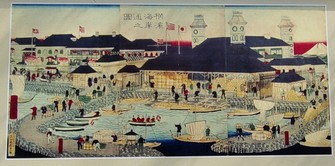
This photo taken in Yokoyama in April 2024 shows “A View of the Waterfront Street in Yokohama,” painted in 1870 by Utagawa Hiroshige III. The building at the center was used for inspecting imported and exported goods. Behind it stands the British Consulate, identifiable by its three towers. (Image from the Yokohama Archives of History)
Isabella Bird arrived in Japan in May 1878 (the 11th year of the Meiji era). After completing the necessary entry formalities, she spent some time based in Yokohama, preparing for the long journey that lay ahead. At the time, a number of American and British residents lived in Yokohama, and among those on whom she relied was Dr. Hepburn, an American missionary and physician later renowned for devising what came to be known as the Hepburn system of romanization.
Dr. Hepburn had first come to Japan in 1859, in the closing years of the Tokugawa period, and during the Namamugi Incident of 1862, in which a British merchant was killed by armed samurai, he attended to the wounded. In the following year he opened a small private school in the Yokohama Settlement, which was later to become the source from which Meiji Gakuin and Ferris Girls’ Junior & Senior High School would develop. By 1867 he had compiled the first Japanese-English dictionary published in Japan, and among the American and British residents of Yokohama, he was widely regarded as the man most thoroughly versed in the country and its people.
At this time Hepburn’s residence stood on the heights of Yamate, where the Yokohama Foreign General Cemetery now lies, and it was here that Bird stayed for about a week. She first laid her plans for the journey before him. He might have seemed the ideal counsellor, yet he appears to have opposed the undertaking, a circumstance upon which Bird herself comments with a trace of dissatisfaction. Let us turn to “Unbeaten Tracks in Japan.”
As no English lady has yet travelled alone through the interior, my project excites a very friendly interest among my friends, and I receive much warning and dissuasion, and a little encouragement. The strongest, because the most intelligent, dissuasion comes from Dr. Hepburn, who thinks that I ought not to undertake the journey, and that I shall never get through to the Tsugaru Strait. If I accepted much of the advice given to me, as to taking tinned meats and soups, claret, and a Japanese maid, I should need a train of at least six pack-horses!
Bird’s journey was, in its essence, a solitary one. She was determined to reduce her baggage to the barest minimum, relying as far as possible upon the resources of the places through which she travelled, and in this resolve, she was unwilling to listen even to Hepburn’s counsels. Yet a minimum requirement remained unavoidable: She had to secure the services of an interpreter-assistant, and the search for a suitable and capable person thus became her first major undertaking.
At that time in Japan, individuals able to speak English with sufficient fluency to allow for nuanced communication with foreigners were exceedingly rare. Still, in ports such as Yokohama or Kobe, it seemed reasonable to hope that a young assistant might be found — someone with a measure of experience, and with the resilience required to accompany a traveller on a long and demanding journey. Let us now trace the course of events that led to her eventual choice.
A panel displaying a photograph from 1880 is exhibited in front of Yokoyama Chinatown’s east gate (Choyomon). The Oriental Hotel, where Isabella Bird stayed during her first visit to Yokohama, once stood near this spot. It is a place that feels like the starting point of Yokohama, where Japanese, Western and Chinese influences mingled.
Several of my kind new acquaintances interested themselves about the (to me) vital matter of a servant interpreter, and many Japanese came to “see after the place.” The speaking of intelligible English is a sine qua non, and it was wonderful to find the few words badly pronounced and worse put together, which were regarded by the candidates as a sufficient qualification. Can you speak English? “Yes.” What wages do you ask? “Twelve dollars a month.” This was always said glibly, and in each case sounded hopeful. Whom have you lived with? A foreign name distorted out of all recognition, as was natural, was then given. Where have you travelled?
This question usually had to be translated into Japanese, and the usual answer
Yokohama
Yokohama is Japan’s second-largest city and a major port located just south of Tokyo. It rose to international prominence in the mid-19th century when it was one of the first ports opened to foreign trade after Japan’s period of isolation, quickly developing into a cosmopolitan hub with a blend of Western and Japanese influences. Today, it is known for its vibrant waterfront, historic district like the Yamate Bluff area, and modern attractions such as the Minato Mirai 21 complex.
British Consulate
The British Consulate is a diplomatic mission representing the United Kingdom in a foreign city, providing services to British citizens and facilitating bilateral relations. Historically, many British consulates were established during the height of the British Empire to protect trade interests and support colonial administration. Today, they continue to serve as key hubs for diplomacy, visa processing, and cultural exchange.
Yokohama Archives of History
The Yokohama Archives of History is a museum located in Yokohama, Japan, that preserves and exhibits materials related to the city’s history, particularly its role as a gateway for international trade and cultural exchange after the port opened in 1859. Housed in a former British Consulate building constructed in 1931, the archives feature documents, maps, and artifacts from the late Edo period through the Meiji era. It offers insight into how Yokohama transformed from a small fishing village into a modern, cosmopolitan port city.
Yamate
Yamate is a historic district in Yokohama, Japan, known for its Western-style houses and international heritage. Developed after the port opened in 1859, it was a residential area for foreign merchants and diplomats during the late 19th and early 20th centuries. Today, it features preserved buildings, scenic parks, and a blend of Japanese and Western cultural influences.
Yokohama Foreign General Cemetery
The Yokohama Foreign General Cemetery is a historic burial ground in Yokohama, Japan, established in 1854 to inter foreign residents who died in the treaty port after the country opened to international trade. It holds the graves of over 4,000 individuals from more than 40 countries, including early diplomats, merchants, and missionaries, reflecting the multicultural history of Japan’s modernization. The cemetery remains a significant cultural site, symbolizing the international exchanges and challenges of the late Edo and Meiji periods.
Tsugaru Strait
The Tsugaru Strait is a sea passage located between the Japanese islands of Honshu and Hokkaido, connecting the Sea of Japan to the Pacific Ocean. Historically, it has been a crucial maritime route for trade and travel, and it gained international attention in 1988 with the completion of the Seikan Tunnel, the world’s longest undersea tunnel, which now links the two islands by rail. The strait is also known for its strong currents and challenging navigation, famously depicted in literature such as Dazai Osamu’s “Tsugaru.”
Yokohama Chinatown’s east gate (Choyomon)
Yokohama Chinatown’s east gate, known as Choyomon, is one of the main entrances to one of the largest Chinatowns in the world. Built in 1955, the gate features traditional Chinese architectural design with vibrant colors and intricate carvings, symbolizing good fortune and prosperity. It marks the historic heart of Yokohama’s Chinese community, which began forming after the port opened to foreign trade in 1859.
Oriental Hotel
The Oriental Hotel, located in Bangkok, Thailand, is a historic luxury hotel that opened in 1876 as the first hotel in the country. It quickly became a renowned social hub for travelers, writers, and dignitaries, famously hosting guests like Joseph Conrad and Somerset Maugham. Today, it remains an iconic symbol of elegance and Thai hospitality, blending its rich colonial-era heritage with modern luxury.