A former homeless middle school student becomes a nurse at Keio Hospital and then goes global at the Children’s Expo.
In early April, I met her at a nearby café. It was our first reunion in a year and a half since I first heard her story in Osaka.
I remember…
She used to work as a nurse in Tokyo, but now she has three children. Renting a large room in Tokyo was too expensive, so she made the bold decision to move to Kobe…
That was it, right? Elusive as always, impressive.
“I moved to…”
Wait, really?
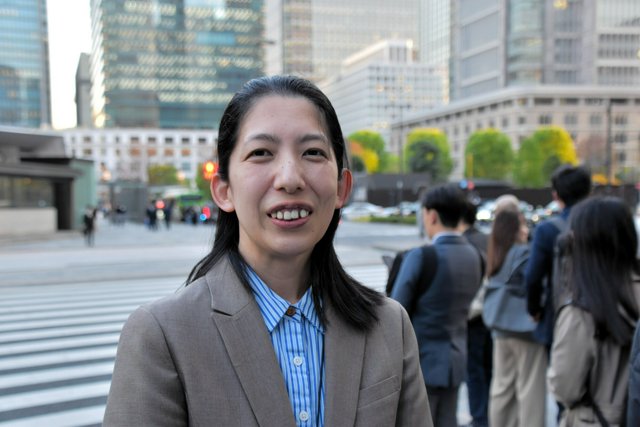
Mari Tezuka, 41 years old. She encourages children to share their dreams and make them come true. Under the name “Children’s Expo,” she has organized about 40 such events across Japan over the past three years, attracting a total of 100,000 participants.
For Tezuka, Tokyo is the place where she grasped her dream. And now, it is the place where she is about to open the door to an even grander dream.
She grew up in Yokohama and attended a private school. She dreamed of becoming a nurse.
In the fall of her third year of middle school, her father was caught up in a fraud case, and her mother and brother fled at night. Tezuka approached the principal to withdraw from school. The principal said, “You may attend for free until you graduate high school. However, there is a condition.”
The condition was to do something for the next generation of children.
Her mother worked tirelessly. Her brother was studying hard to get a degree. Not wanting to be a burden, Tezuka became homeless.
She stayed at friends’ houses or moved around parks and buildings. The three family members lived largely apart.
Her main source of calories was lunchtime at school. Her classmates brought enormous bento boxes. “I can’t eat all this, Mari, please have some,” they said.
At night, she would gulp water in the park to stave off hunger. Once, an older homeless man shared some bread with her.
By her second year of high school, she was able to live with her mother and brother. Her mother said, “I’m sorry I can’t send you to college.”
Her dream continued. Wanting her mother to know that, Tezuka applied to a nursing and medical department. Since she hadn’t studied much, she naturally failed.
After graduating high school, she worked part-time jobs and…
Osaka
Osaka is a major port and commercial hub in Japan with a history dating back to ancient times, serving as a vital center for trade and culture. It was once the imperial capital in the 7th and 8th centuries and later flourished as the “nation’s kitchen” during the Edo period due to its role in rice distribution. Today, Osaka is known for its vibrant food scene, historic landmarks like Osaka Castle, and modern attractions.
Tokyo
Tokyo, the capital of Japan, was originally a small fishing village called Edo before becoming the political center of the Tokugawa shogunate in the early 17th century. It was renamed Tokyo (“Eastern Capital”) in 1868 when the imperial court moved from Kyoto, marking the start of the Meiji Restoration. Today, Tokyo is a sprawling metropolis blending historic temples, modern skyscrapers, and vibrant pop culture, having rebuilt itself after the Great Kanto Earthquake of 1923 and World War II bombings.
Kobe
Kobe is a major port city in Japan’s Hyōgo Prefecture, known for its scenic location between the Rokko Mountains and Osaka Bay. Its history as an international trade hub began in the mid-19th century when it was one of the first ports opened to foreign commerce, leading to
Osaka
Osaka is a major port and commercial hub in Japan, with a history dating back to ancient times when it served as the nation’s political and economic center. During the 16th century, Toyotomi Hideyoshi built Osaka Castle, which became a symbol of the city’s power and later played a key role in the unification of Japan. Today, Osaka is known for its vibrant food culture, modern architecture, and historic landmarks like the castle and the Dotonbori entertainment district.
Tokyo
Tokyo, Japan’s bustling capital, was originally a small fishing village called Edo before becoming the seat of the Tokugawa shogunate in 1603. After the Meiji Restoration in 1868, the city was renamed Tokyo (“Eastern Capital”) and rapidly modernized into a global hub of culture, technology, and commerce. Despite being largely destroyed by the 1923 Great Kanto earthquake and World War II firebombing, Tokyo rebuilt into a dazzling metropolis that blends historic temples with cutting-edge skyscrapers.
Kobe
Kobe is a major port city in Japan, located on the island of Honshu, known for its scenic location between the Rokko Mountains and Osaka Bay. Its history as an international trading hub began in the mid-19th century when it was one of the first ports opened to foreign trade, leading to rapid modernization and a distinctive blend of Western and Japanese architecture. Today, Kobe is famous for its world-renowned Kobe beef, vibrant waterfront district, and its resilient recovery from the devastating 1995 Great Hanshin Earthquake.
Yokohama
Yokohama is a major port city in Japan, located just south of Tokyo, that rose to prominence after the 1853 arrival of Commodore Matthew Perry, which led to the opening of the port to international trade in 1859. It quickly developed into a hub of foreign influence and modernization, blending Western architecture and culture with traditional Japanese elements. Today, Yokohama is known for its vibrant Chinatown, the iconic Landmark Tower, and its historic waterfront district, reflecting a unique fusion of past and present.