35 years after Japan’s Mount Unzen disaster, a former rookie reporter shares lessons with students.
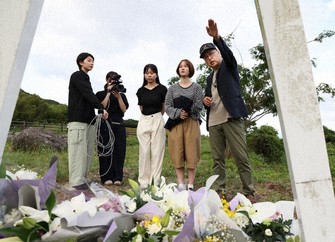
Professor Kanebumi Kanbe of the University of Nagasaki, far right, explains the situation at the time of the disaster to students, in Shimabara, Nagasaki Prefecture, on June 3, 2026.
SHIMABARA, Nagasaki — June 3 marked 35 years since a major pyroclastic flow on Mount Unzen’s Fugen peak in Nagasaki Prefecture claimed the lives of 43 people in 1991. As the number of people with firsthand knowledge of the disaster dwindles, a former newspaper reporter who covered the disaster on the front lines is now working to pass on memories of the tragedy to the next generation.
The man is Kanebumi Kanbe, 59, now a professor at the University of Nagasaki’s Faculty of Global and Media Studies. He joined a national daily newspaper in April 1991, about five months after the eruption of the Fugen peak began, and was assigned to the Nagasaki bureau. He traveled daily to Shimabara for reporting, and from the following spring was stationed at the paper’s “Shimabara front-line headquarters” as a resident reporter, covering the disaster until the eruption effectively ended in 1995.
Just a few days before the massive pyroclastic flow, Kanbe had been reporting from a “fixed point” where many victims ultimately perished. Although he had returned to Nagasaki on June 3, 1991, he reentered Shimabara that night, covering police and fire departments and hospitals to check on colleagues’ safety, as well as to interview victims’ families.
His long-term coverage extended beyond the repeated pyroclastic and debris flows to include a series portraying the thoughts of more than 10,000 evacuees, examinations of the ways relief supplies were delivered to disaster areas, and analyses of flaws in legislation for victims’ recovery.
After moving to a TV broadcaster in Fukuoka in 2005, Kanbe returned to Nagasaki this spring for the first time in 31 years. “The people of Shimabara were so kind to me, a then rookie reporter covered in ash,” he recalled. “They were comrades who fought through the disaster together for years. I wanted to end my working life in Nagasaki.”
Currently, he teaches a seminar in visual media theory and has proposed to his seven students that they study the volcanic disaster. The third-year students — all natives of Nagasaki — expressed interest in the disaster that had taken place before they were born.
In late May, Kanbe and his students visited Shimabara, where he explained the events on-site. They were accompanied by Shinichi Sugimoto, 76, director of the Mt. Unzen Disaster Memorial Hall and a former city official, who recounted how he narrowly escaped danger because he happened to be in a community center downstream when the massive pyroclastic flow struck.
The students later interviewed Sugimoto at the memorial hall, which conveys the lessons of the volcanic disaster. For more than 20 minutes, they asked questions on camera such as “What are the lessons of the Fugen peak disaster?” “What challenges remain unresolved?” and “How can we pass the memory of the disaster on to children?”
Student Saki Miyachi, 20, said, “I realized how close to the mountain reporters worked to cover the event. Disaster reporting is important, but I want to think about where to draw the line.” Another student, Wakaba Sato, 20, said, “Moving forward, I want to interview those affected by the disaster, as well as young people in the same generation as us and elementary school students in Shimabara, who didn’t experience the disaster.”
The group plans to assign members to speak with former local volunteer fire squad chiefs, ex-city officials, survivors and members of the press, reconstruct the movements of people on the afternoon of June 3, 1991, and consider donating their findings to the memorial hall and preserving them at the university.
“There are many lessons from the Unzen disaster that we must not forget, and perhaps some things can only be spoken about for the first time now,” Kanbe said. “I look forward to seeing what the students, who are around the same age I was as a newcomer then, will feel, what they want to ask, and how they want to present these to others. I hope we can record not only the stories but also how the media worked hand in hand with local residents during coverage.”
This is how Kanbe reflects today, having remained on the scene as a reporter until the eruption finally subsided.
University of Nagasaki
The University of Nagasaki is a prominent public university in Japan, established in 1949 through the merger of several prewar institutions, including the Nagasaki Medical College, which had a tragic history as it was destroyed by the atomic bomb in 1945. The university is renowned for its strong focus on international exchange and peace studies, reflecting the city’s unique history as a historical gateway for foreign trade and its role in World War II. Today, it offers a wide range of programs across multiple campuses, emphasizing global perspectives and research.
Mount Unzen
Mount Unzen is an active volcanic group in Japan, located on the Shimabara Peninsula in Nagasaki Prefecture. Its most devastating eruption occurred in 1792, triggering a massive landslide and tsunami that killed approximately 15,000 people in Japan’s worst volcanic disaster. More recently, a series of eruptions in the early 1990s destroyed nearby towns and created the famous “Unzen Domes,” making it a significant site for both natural history and geological study.
Fugen peak
Fugen Peak is one of the highest points on Japan’s Mount Tateyama, located in the Tateyama Kurobe Alpine Route. It is historically significant as a sacred site for mountain worship in Shugendo, a syncretic religion blending Buddhism, Shinto, and ancient animist traditions. The peak offers panoramic views of the surrounding Japanese Alps and is a popular destination for hikers and pilgrims.
Shimabara
Shimabara is a city in Nagasaki Prefecture, Japan, known for its tragic history during the Shimabara Rebellion (1637–1638), when local Christian peasants and ronin rose against oppressive feudal rule. The rebellion was brutally suppressed by the Tokugawa shogunate, leading to the near-total prohibition of Christianity and the closure of Japan to the outside world. Today, the site features Hara Castle ruins and the Shimabara Castle, which was rebuilt in the 1960s, serving as a reminder of the region’s turbulent past.
Nagasaki
Nagasaki is a city on the island of Kyushu, Japan, known historically as a major port for international trade during Japan’s period of national isolation, where it served as the only gateway for Dutch and Chinese merchants. Its modern history is tragically marked by the atomic bombing on August 9, 1945, which devastated the city and contributed to the end of World War II. Today, Nagasaki is a symbol of peace and resilience, featuring memorials like the Peace Park and the Atomic Bomb Museum, alongside well-preserved historic districts showcasing its unique cultural heritage.
Fukuoka
Fukuoka is a vibrant city on Japan’s Kyushu island, historically significant as a major port and gateway for cultural exchange with Asia. It was once the site of the ancient Dazaifu administrative center and later developed around the twin castle towns of Fukuoka and Hakata, which merged in the 19th century. Today, it is known for its rich history, including the Hakata Gion Yamakasa festival, and its blend of traditional temples with modern urban life.
Mt. Unzen Disaster Memorial Hall
The Mt. Unzen Disaster Memorial Hall, located in Shimabara, Japan, commemorates the devastating 1991 eruption of Mt. Unzen, which triggered deadly pyroclastic flows that killed 43 people, including renowned volcanologists Katia and Maurice Krafft. The facility documents the volcano’s history, the disaster’s impact, and the region’s recovery through exhibits, films, and preserved artifacts. It serves both as a memorial to the victims and an educational center for disaster preparedness and volcanic science.
University of Nagasaki’s Faculty of Global and Media Studies
The University of Nagasaki’s Faculty of Global and Media Studies is a modern academic unit focused on international communication, media, and cultural studies. Established in 2003 as part of the university’s reorganization, it builds on Nagasaki’s historical role as a crossroads of global exchange during Japan’s period of isolation. The faculty aims to equip students with multilingual and media skills to navigate today’s interconnected world.