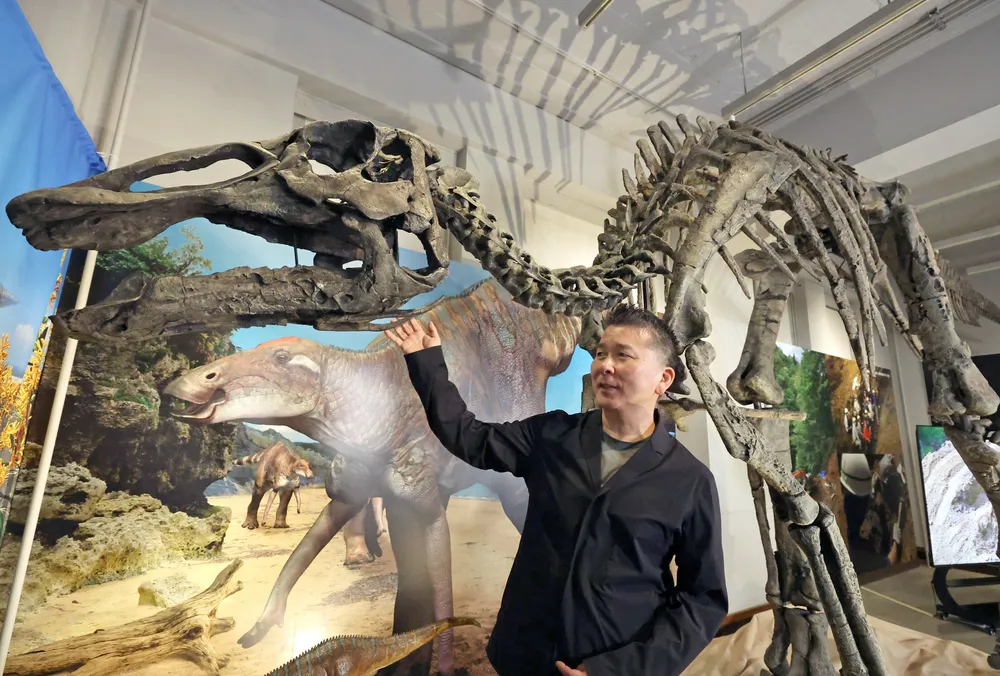
The Hokkaido University Museum has reopened after renovations to commemorate the university’s 150th anniversary. For the first time at a university facility, the full skeleton of Japan’s largest dinosaur, “Kamuysaurus japonicus” (commonly known as the Mukawa Dragon), has been put on display.
Hokkaido University Museum
The Hokkaido University Museum, located in Sapporo, Japan, is the official museum of Hokkaido University, which was founded in 1876 as Sapporo Agricultural College. Housed in a historic building from 1929, its collections and exhibits focus on the natural history, indigenous Ainu culture, and pioneering scientific research of Hokkaido and the wider northern regions.
Mukawa Dragon
The “Mukawa Dragon” refers to the fossilized remains of a hadrosaurid dinosaur discovered in the town of Mukawa, Hokkaido, Japan. It is a nearly complete and exceptionally well-preserved skeleton, later given the scientific name *Kamuysaurus japonicus*. The find is historically significant as one of the largest and most complete dinosaur skeletons ever unearthed in Japan, providing important insights into the dinosaur ecosystems of ancient East Asia.
Kamuysaurus japonicus
Kamuysaurus japonicus is a species of herbivorous dinosaur, whose fossils were discovered in Hokkaido, Japan. It is a type of hadrosaurid, or “duck-billed” dinosaur, that lived approximately 72 million years ago during the Late Cretaceous period. The nearly complete skeleton is significant for providing insights into dinosaur evolution and the ancient ecosystems of Japan.
Hokkaido University Museum
The Hokkaido University Museum, located in Sapporo, Japan, is the official museum of Hokkaido University, which was founded in 1876 as Sapporo Agricultural College. Housed in a historic building from 1929, its collections and exhibits focus on the natural history, indigenous Ainu culture, and pioneering scientific research of Hokkaido and the wider northern regions.
Mukawa Dragon
The “Mukawa Dragon” refers to a significant archaeological discovery in the town of Mukawa, Hokkaido, Japan. It is the nickname given to the near-complete fossil skeleton of a *Kamuysaurus japonicus*, a type of duck-billed dinosaur that lived about 72 million years ago. Discovered in 2013, it is the largest dinosaur skeleton ever found in Japan and provides crucial insights into the ecosystem of ancient East Asia.
Kamuysaurus japonicus
Kamuysaurus japonicus is not a cultural site, but a species of herbivorous dinosaur discovered in Japan. Its fossils, including a nearly complete skeleton, were unearthed in Hokkaido and formally described in 2019. The discovery is historically significant as one of the most complete dinosaur skeletons ever found in Japan, providing insights into the region’s prehistoric ecosystem.
<div class="my-4 p-4
Hokkaido University Museum
The Hokkaido University Museum, located in Sapporo, is the university’s central institution for preserving and exhibiting its vast academic collections, which began accumulating from the university’s founding in 1876. Housed in a historic building from 1929, the museum showcases over 4 million specimens and artifacts related to the natural history, culture, and pioneering science of Hokkaido and the northern regions. It serves as a key public resource for understanding the island’s unique environment and the university’s role in its modern development.
Mukawa Dragon
The “Mukawa Dragon” refers to the fossil of a Cretaceous-period hadrosaurid dinosaur discovered in the town of Mukawa, Hokkaido, Japan, in 2017. It is the most complete dinosaur skeleton ever found in Japan and was given the nickname “Mukawa Ryu” (Mukawa Dragon) by locals. The remarkably well-preserved fossil, scientifically named *Kamuysaurus japonicus* in 2019, provides significant insights into dinosaur evolution and migration in East Asia.
Kamuysaurus japonicus
Kamuysaurus japonicus is not a cultural site, but a species of herbivorous dinosaur whose fossils were discovered in Japan. It is a type of hadrosaur, or “duck-billed” dinosaur, that lived approximately 72 million years ago during the Late Cretaceous period. The nearly complete skeleton, found in Hokkaido in 2013, was given its official scientific name in 2019, making it a significant paleontological discovery for Japan.
Sapporo Agricultural College
Sapporo Agricultural College was founded in 1876 in Hokkaido, Japan, as the nation’s first higher education institution dedicated to modern agricultural science and development. Established under the guidance of American educator William S. Clark, its pioneering curriculum and famous motto, “Boys, be ambitious!”, were instrumental in training leaders to cultivate Japan’s northern frontier. It later evolved into the prestigious Hokkaido University.