Northern Territories grave visits remain uncertain; ocean and aerial memorial services to be held as former islanders’ average age exceeds 90… reducing burden on participants.
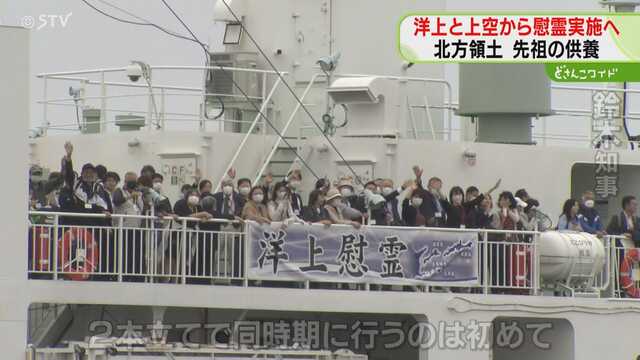
Amid the ongoing suspension of visits to ancestral graves in the Northern Territories, the Chishima League, an organization of former island residents, and the Hokkaido prefectural government have announced plans to conduct memorial services at sea and also from the air using aircraft.
This marks the first time both methods will be used.
Due to the COVID-19 pandemic and deteriorating Japan-Russia relations, grave visits to the Northern Territories have been suspended since 2019.
The Chishima League and the Hokkaido prefectural government have announced that in 2026, they will hold a memorial service at sea as well as an aerial memorial service using a chartered aircraft.
(Governor Suzuki) “In addition to the memorial service at sea, we will newly conduct an aerial memorial service using a chartered aircraft. It will be the first time we hold both simultaneously.”
With the average age of former island residents exceeding 90, the aim is to reduce the burden on participants.
The memorial service at sea is scheduled for six trips from July 25 to September 3, with four of them being day trips from Nemuro Port to the waters off Shibetsu Town, and the remaining two being overnight trips.
The aerial memorial service is scheduled for October 31 and November 7, with flights from Nakashibetsu Airport toward the Shiretoko Peninsula and the Nemuro Peninsula.
Northern Territories
The Northern Territories, known in Japan as the “Northern Territories” and in Russia as the Southern Kuril Islands, are a group of four disputed islands located off the coast of Hokkaido, Japan. They were seized by the Soviet Union at the end of World War II in 1945, leading to a long-standing territorial dispute between Japan and Russia that has prevented the two countries from signing a formal peace treaty. The islands remain under Russian administration, while Japan continues to claim sovereignty over them.
Nemuro Port
Nemuro Port, located on the eastern coast of Hokkaido, Japan, has historically served as a vital hub for fishing and trade, particularly in the 19th and early 20th centuries. It played a key role in the development of the region’s marine industries, including crab and salmon fishing, and was a major departure point for shipping routes to the Kuril Islands. Today, the port remains an important center for local fisheries and tourism, offering ferry access to nearby islands and scenic views of the Nemuro Strait.
Shibetsu Town
Shibetsu Town is a rural municipality located in Hokkaido, Japan, known for its agricultural landscape and the scenic Shibetsu River. Historically, the area was developed during the Meiji era as part of Japan’s colonization of Hokkaido, with settlers establishing farms and communities. Today, it offers visitors a glimpse into traditional Japanese countryside life, with attractions like the Shibetsu Salmon Museum highlighting the region’s rich natural heritage.
Nakashibetsu Airport
Nakashibetsu Airport is a regional airport located in Nakashibetsu, Hokkaido, Japan. Originally opened in 1965 as a third-class airport, it primarily serves domestic flights and is known for its role in connecting eastern Hokkaido to major cities like Tokyo. The airport also supports local agriculture and tourism, including access to the nearby Shiretoko Peninsula, a UNESCO World Heritage site.
Shiretoko Peninsula
The Shiretoko Peninsula, located in eastern Hokkaido, Japan, is a remote and rugged wilderness designated as a UNESCO World Heritage Site in 2005. Its name, derived from the Ainu language meaning “end of the Earth,” reflects its pristine natural state, featuring dense forests, volcanoes, and dramatic coastlines. Historically, the area was home to the indigenous Ainu people and later saw limited development for fishing and logging, but it is now celebrated for its rich biodiversity, including brown bears and seasonal drift ice.
Nemuro Peninsula
The Nemuro Peninsula is a remote, scenic region in eastern Hokkaido, Japan, known for its rugged coastline and abundant wildlife, including the Steller’s sea eagle. Historically, the area was a key site for the Ainu people and later became a contested border region between Japan and Russia, with Cape Nosappu at its tip serving as the closest point to the disputed Kuril Islands. Today, it is a popular destination for nature lovers and birdwatchers, offering stunning views of the Sea of Okhotsk.