MAGETAN – The figure before being appointed as (BGN) once toured Magetan. Their attitude showed a firm leader in overseeing the implementation of the Free (Nutrition) Program.
During an evaluation of 12 Nutrition Fulfillment Service Units (SPPG) in Magetan Regency, East Java, Nanik did not hesitate to issue stern warnings to MBG kitchens that did not meet operational standards.
The evaluation was conducted to ensure all MBG services ran according to established food safety, hygiene, and governance regulations set by the government. According to Nanik, the existence of MBG kitchens should not only focus on economic profit but must bring social impact to the surrounding community.
“Those operating here must have a sociopreneur orientation. This is social investment. If they only seek profit, eventually kitchens that do not meet standards will emerge, risking problems, including poisoning cases,” Nanik emphasized while inspecting several SPPGs in Magetan.
In the evaluation, BGN found several discrepancies deemed potentially disruptive. One related to the kitchen building area being far below standard.
Nanik revealed that there was a kitchen with an area of only about 70 square meters, whereas applicable regulations require a kitchen area of 400 square meters to ensure safe and controlled food production.
“We cannot just give leeway and wait for improvements without certainty. If it truly does not meet standards, some must be closed to maintain service quality and the safety of beneficiaries,” she said.
Not only highlighting the physical condition of buildings, the BGN team also checked administrative completeness, operational systems, and environmental aspects at each MBG kitchen.
Evaluation results showed there were still SPPGs that had not completed operational permits and Wastewater Treatment Plant (IPAL) facilities. Additionally, food production flows were found that did not meet food safety standards, risking contamination.
“Cooking in large quantities cannot be equated with regular food stalls or restaurants. There must be a clear flow of entry and exit to prevent contamination. This is often the cause of extraordinary incidents like food poisoning,” she explained.
BGN also monitors the supply chain of raw materials. Nanik emphasized that every MBG kitchen must involve multiple suppliers so economic benefits can be widely felt by the community.
“If the suppliers are fewer than 15, we suspend them. We want the local economy to move and not be controlled by a handful of parties,” she said.
MBG Program Drives Magetan’s Economy Nearly Rp1 Trillion per Year
Behind the nutrition fulfillment program, Nanik sees enormous economic potential. Currently, there are 71 MBG kitchens operating in Magetan with transaction values reaching approximately Rp71 billion each month.
Calculated annually, the financial turnover from the program is estimated to approach Rp1 trillion.
“Imagine, nearly one trillion rupiah circulates every year just from this program. Farmers, breeders, MSMEs, and the surrounding community should also feel the benefits,” she stated.
According to Nanik, the demand for food ingredients for MBG has created a multiplier effect for the agricultural and livestock sectors in Magetan, Ngawi, Madiun, and surrounding areas. The increasing demand for raw materials opens new business opportunities while strengthening the rural economy.
Raising Egg Prices for Local Breeders
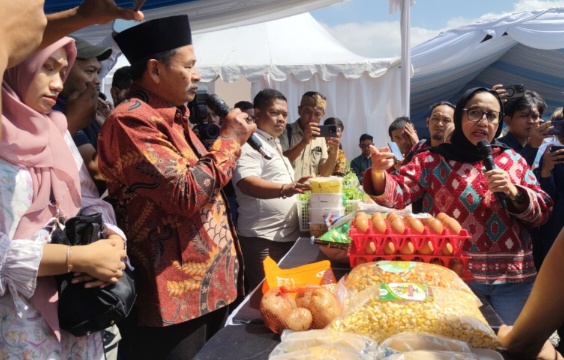
On that occasion, Nanik also highlighted the important role of egg breeders in supporting the success of the Free Nutritious Meal Program. She hopes the high demand for eggs from MBG kitchens will directly impact improving the welfare of small-scale breeders.
“If egg demand continues to increase, of course we want breeders to get better and fair prices. Don’t let economic benefits only be enjoyed by certain parties,” she stressed.
She added that the government is currently pushing to strengthen the national livestock industry through investment and partnership models that directly involve the community.
Responding to issues circulating on social media regarding alleged Chinese dominance in the national livestock sector, Nanik gave a firm clarification. According to her, the information is incorrect and does not align with government policy direction.
She explained that the government, together with state-owned enterprises, is actually preparing large investments aimed at strengthening small-scale breeders through sustainable partnership schemes.
“It is not true that China has entered and controls Indonesia’s livestock