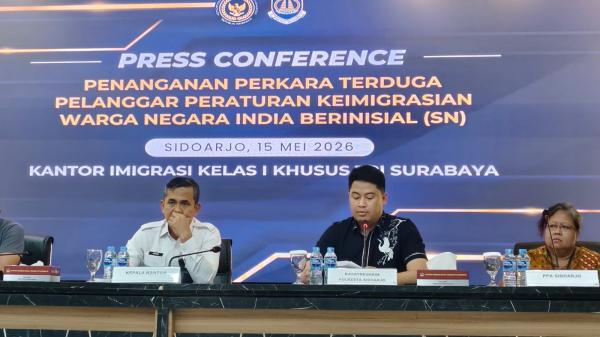
SURABAYA — The death of an Indian citizen with the initials SN at the Class I Special TPI Surabaya Immigration Detention Center has shocked many. The man was previously undergoing a detention process due to overstaying his visa by 248 days in Indonesia.
This case has now become a public concern after SN was found dead while his deportation process was still ongoing. The authorities have ensured that the case is being handled professionally, involving the police and related agencies.
Based on gathered information, SN held a Visit Stay Permit that had expired several months ago. The alleged immigration violation refers to Article 78 Paragraph (3) of Law Number 6 of 2011 concerning Immigration.
The matter originated from a report by the Regional Technical Implementation Unit for the Protection of Women and Children (UPTD PPA) of Sidoarjo Regency regarding family issues and the fulfillment of children’s rights involving this foreign national. The report was then followed up by Immigration officers through monitoring and checking immigration documents.
From checks through the immigration system, officers found that SN had been in Indonesia beyond his stay permit limit for 248 days.
On May 6, 2026, SN responded to an examination summons at the Surabaya Immigration Office, accompanied by the UPTD PPA Sidoarjo. During the examination, SN reportedly admitted to the overstay violation he had committed.
After the examination process was completed, the Surabaya Immigration Office imposed an Immigration Administrative Action in the form of detention on May 11, 2026, while awaiting the deportation process scheduled for May 17, 2026.
However, before the deportation could be carried out, an unexpected event occurred. On Thursday morning, May 14, 2026, at around 7:50 AM local time, officers conducted a routine check in the detention room and found SN already lifeless.
The Immigration authorities immediately coordinated with the police and medical personnel for further handling. Currently, the investigation is ongoing together with the Sidoarjo Resort Police, Sedati Sector Police, and the hospital through a forensic examination and autopsy.
Additionally, communication has been established with the Honorary Consulate of India in Surabaya to convey the information to the victim’s family and to handle the remains according to consular procedures.
The Head of the Class I Special TPI Surabaya Immigration Office expressed condolences over SN’s death and assured that the entire process will be conducted transparently.
“We extend our deepest condolences over this incident. We are currently coordinating with law enforcement and related agencies to ensure the entire process proceeds according to regulations,” he said.
He also emphasized that the office is conducting an internal evaluation of the security and monitoring system of the detention room to prevent similar incidents from recurring.
On the other hand, Surabaya Immigration ensures that the protection of the child related to this case remains a primary focus through cross-agency coordination.
Surabaya Immigration Detention Center
The Surabaya Immigration Detention Center, located in East Java, Indonesia, is a facility used to hold foreign nationals awaiting deportation or processing of their immigration status. Established under the jurisdiction of the Indonesian Ministry of Law and Human Rights, the center has historically dealt with cases of overstaying visas, illegal entry, and violations of immigration laws. While specific details of its founding are limited, it functions as part of Indonesia’s broader immigration enforcement system, reflecting the country’s efforts to regulate foreign presence and uphold legal procedures.
Surabaya Immigration Office
The Surabaya Immigration Office, located in East Java, Indonesia, serves as a key government facility for processing visas, passports, and other immigration documents. Historically, its role has evolved alongside Indonesia’s national immigration system, which was formalized after the country’s independence in 1945. The office plays a vital part in managing the movement of people in and out
Surabaya Immigration Detention Center
The Surabaya Immigration Detention Center, located in East Java, Indonesia, is a facility used to hold foreign nationals who have violated immigration laws, such as overstaying visas or entering the country illegally. It operates under Indonesia’s Directorate General of Immigration and has a history tied to the nation’s evolving immigration enforcement policies. The center has occasionally drawn attention from human rights organizations regarding the conditions and length of detention for its inhabitants.
Surabaya Immigration Office
The Surabaya Immigration Office, located in East Java, Indonesia, serves as a key government facility for managing immigration services such as passport issuance and visa processing. Its history is tied to Indonesia’s post-independence administrative development, with the office evolving to meet the needs of Surabaya’s growing population and status as a major port city. Today, it operates under the Directorate General of Immigration, reflecting modernized procedures and digital systems.
Indonesia
Indonesia is a Southeast Asian archipelago nation with over 17,000 islands, known for its rich cultural diversity and history as a major hub for trade and colonialism. Its history includes powerful Hindu-Buddhist kingdoms like Srivijaya and Majapahit, followed by centuries of Dutch colonial rule before gaining independence in 1945. Today, Indonesia is the world’s largest Muslim-majority country and home to iconic sites such as Borobudur temple and Bali’s unique Hindu traditions.
East Java
East Java is a province in Indonesia known for its rich cultural heritage and historical significance. It was once the heart of the powerful Majapahit Empire, which flourished from the 13th to the 16th centuries. Today, the region is famous for landmarks like Mount Bromo, the ancient temples of Trowulan, and its vibrant traditional arts and cuisine.
Sidoarjo Regency
Sidoarjo Regency is a region in East Java, Indonesia, known for its historical role as a center of the powerful Majapahit Kingdom, with remnants like the Trowulan archaeological site. Economically, it thrives on shrimp and fish farming, as well as industry. The regency gained global attention in 2006 due to the devastating Lapindo mudflow disaster, which submerged several villages and caused significant social and environmental disruption.
Sidoarjo Resort Police
The Sidoarjo Resort Police is the local police headquarters in Sidoarjo, East Java, Indonesia, overseeing security and law enforcement in the region. Historically, it has been involved in managing public safety during major events, such as the 2006 Lapindo mudflow disaster, which heavily impacted the area. Today, it continues to serve as a key institution for maintaining order and supporting community outreach in Sidoarjo.
Sedati Sector Police
The Sedati Sector Police is a law enforcement station located in the Sedati District of Sidoarjo, East Java, Indonesia. It serves as a local police sector responsible for maintaining public order and safety in the area. While specific historical details about the station are limited, it forms part of the broader Indonesian National Police structure, which has evolved since the country’s independence to provide community-based policing services.
Honorary Consulate of India in Surabaya
The Honorary Consulate of India in Surabaya serves as a diplomatic mission representing Indian interests in East Java, Indonesia. It facilitates trade, cultural exchange, and consular services for Indian nationals and locals. The consulate reflects the long-standing historical and economic ties between India and Indonesia, which date back to ancient maritime trade routes.