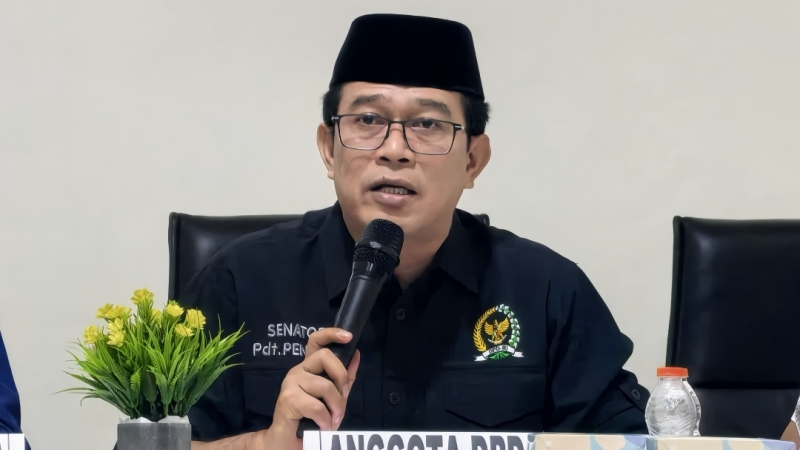
Member of the Regional Representative Council (DPD), Penrad Siagian, presented several critical notes regarding the implementation of Law Number 20 of 2023 on the State Civil Apparatus (ASN) during a public hearing session of Committee I of the DPD with Abdullah Azwar Anas and Prof. Dr. Agus Pramusinto at the Kutai Meeting Room, 3rd Floor of Building B, DPD.
The hearing, held on Tuesday (June 2, 2026), discussed the inventory of oversight materials on the implementation of the ASN Law while gathering input on potential future revisions of the regulation.
In the forum, Penrad highlighted several issues he considered obstacles to achieving a fair, professional bureaucracy capable of providing equitable public services.
Penrad assessed that the existence of Government Employees with Work Agreements (PPPK), including part-time PPPK, has created injustice in the national employment system.
“I strongly perceive a very unfair paradigm in this law; this is the first thing we need to revise—with the terms ASN, then P3K, and part-time—I think this is a form of injustice and discrimination,” said Penrad in his statement on Wednesday (June 3, 2026).
According to Penrad, the initial goal of establishing PPPK has not fully materialized as intended. In practice, the scheme has instead created differential treatment of public servants.
“We know well that some P3K, especially part-time P3K, receive, let’s say, a salary of IDR 150,000 to IDR 300,000. I think this is unfair, especially when they dedicate themselves more than ASN in remote areas,” he said.
Therefore, he proposed that all state apparatus be unified into a single ASN category with a fairer system and work scheme arrangement.
Beyond the issue of employment status, Penrad also highlighted the disparity in ASN distribution between Java Island and other regions.
According to him, the concentration of ASN is still too high in urban areas and Java, while disadvantaged, frontier, and outermost (3T) regions experience a shortage of public service personnel.
“We clearly see that in big cities, let’s say Java, perhaps more than 60 percent of ASN are on Java, but in other regions outside Java—Sumatra, Kalimantan, NTT, Papua—it’s very small,” he said.
He assessed that this condition impacts the quality of public services, especially in the education sector and other basic services.
“In 3T areas, we see that in one school, let’s say when we talk about schools, there are relatively almost no teachers,” he said.
Penrad urged that the revision of the ASN Law should include a more proportional ASN distribution scheme based on the real needs of each region.
During the occasion, Penrad also criticized the ASN recruitment mechanism, which he considered overly centralized through the National Civil Service Agency (BKN) and the Ministry of Administrative and Bureaucratic Reform (PANRB).
He revealed that many regional governments complain that the staffing needs they submit are not fully accommodated in the formation determination.
“Regional heads often complain that the needs, which are then decided through a very centralized recruitment process via BKN and Kemenpan RB, ultimately do not reflect the real needs of the region,” he said.
According to him, the central government needs to build a more intensive coordination pattern with regional governments so that the recruitment process truly addresses public service needs on the ground.
Penrad also highlighted the implementation of the merit system, which he said is still not functioning as it should.
“Actually, we are just talking nonsense about our merit system; it is proven that even in the DPD itself, the merit system is not working,” he said.
He assessed that many policies are still not aligned with the principle of placing employees based on competence and expertise.
According to Penrad, the government needs to remap various personnel regulations in ministries and institutions to align with the spirit of the merit system regulated in the ASN Law.
At the end of his presentation, Penrad highlighted the differences in ASN welfare levels influenced by the fiscal capacity of each region.
He assessed that this condition creates significant inequality, especially for educators and health workers serving in the regions.
<p