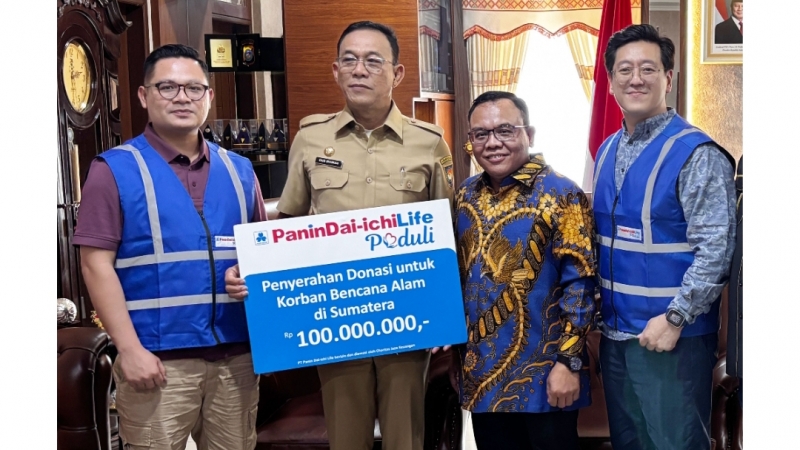
Panin Dai-ichi Life has provided Rp100 million in aid for communities affected by hydrometeorological disasters in Aceh, North Sumatra, and West Sumatra. The assistance was handed over in Sipirok, South Tapanuli Regency, in collaboration with local government authorities as part of the company’s corporate social responsibility commitment.
Impact of Hydrometeorological Disasters in Sumatra
The hydrometeorological disasters occurring in several regions of Sumatra have caused damage to homes, disrupted economic activities, and forced residents to evacuate. Conditions on several provincial routes, including the access road from Silangit Airport to South Tapanuli Regency, were also affected by flash floods and landslides, hindering mobility and the distribution of logistics.
Donation Handover in Sipirok, South Tapanuli
The aid distribution was carried out through a collaboration between Panin Dai-ichi Life and the local government of South Tapanuli Regency. This collaboration aims to ensure the aid is distributed in a coordinated, targeted manner and in accordance with the priority needs of the affected communities.
In a separate statement, the President Director of Panin Dai-ichi Life conveyed that this support is the company’s tangible response to the difficult conditions experienced by the community.
“Areas in Aceh, North Sumatra, and West Sumatra are striving to recover after being impacted by a significant disaster. We hope that aid through our CSR program, Panin Dai-ichi Life Cares, can fulfill some urgent needs and support community recovery,” the statement said.
Panin Dai-ichi Life’s Commitment to Community Recovery
As a life insurance company with over 50 years of experience, Panin Dai-ichi Life consistently implements various humanitarian initiatives and corporate social responsibility programs. Panin Dai-ichi Life will continue to monitor the situation’s development to support the recovery process in disaster-affected areas.
Aceh
Aceh is a province on the northern tip of Sumatra, Indonesia, historically significant as a powerful and independent Islamic sultanate from the 16th century and a key hub for trade and the spread of Islam in Southeast Asia. It is also known for its strong cultural identity and for being the region most severely impacted by the 2004 Indian Ocean earthquake and tsunami. Today, it is a special autonomous region that implements Sharia law.
North Sumatra
North Sumatra is a province on the Indonesian island of Sumatra, renowned for its stunning natural landscapes like Lake Toba—the world’s largest volcanic lake, formed by a super-eruption around 74,000 years ago. Culturally, it is the homeland of the Batak people, whose distinct traditions, vibrant *ulos* textiles, and unique traditional houses are central to the region’s identity. Historically, it was also home to several significant kingdoms and later became a major center for trade and plantation agriculture under Dutch colonial rule.
West Sumatra
West Sumatra is a province on the island of Sumatra, Indonesia, renowned as the homeland of the Minangkabau people, known for their unique matrilineal society and distinctive Rumah Gadang architecture. Historically, the region was the seat of the Pagaruyung Kingdom, a significant center of trade and culture from the 14th to 19th centuries. Today, it is famous for its scenic highlands, Lake Maninjau, and the vibrant city of Bukittinggi.
South Tapanuli Regency
South Tapanuli Regency is a regency located in North Sumatra, Indonesia, established in 2007 after being split from its northern counterpart. It is historically significant as part of the heartland of the Batak Angkola people and contains important cultural sites, including traditional villages and the ancient **Batu Hobon** stone vault on Samosir Island, which is linked to local Batak mythology.
Sipirok
Sipirok is a historic town in North Sumatra, Indonesia, known as a cultural and educational center for the Batak Angkola people. It was historically a significant stop on the trade route between the port of Sibolga and the interior highlands. Today, it is recognized for its traditional woven cloth (ulos), distinctive architecture, and as the origin of the Sipirok coffee variety.
Silangit Airport
Silangit Airport, located in North Sumatra, Indonesia, is the primary gateway to Lake Toba and the surrounding Batak highlands. It was originally built for military purposes in the 1970s but was significantly upgraded and opened for commercial flights in 2017 to boost tourism. Today, it serves as a vital access point for visitors traveling to one of Southeast Asia’s largest volcanic lakes.
Sumatra
Sumatra is the sixth-largest island in the world, located in western Indonesia and known for its immense biodiversity and tropical rainforests. Historically, it was home to several influential kingdoms, most notably the Srivijaya Empire, a major Buddhist maritime and commercial power that dominated the region from the 7th to the 13th centuries. Today, its cultural landscape is shaped by diverse ethnic groups like the Batak and Minangkabau, and it remains famous for landmarks like Lake Toba—the site of a massive supervolcanic eruption.