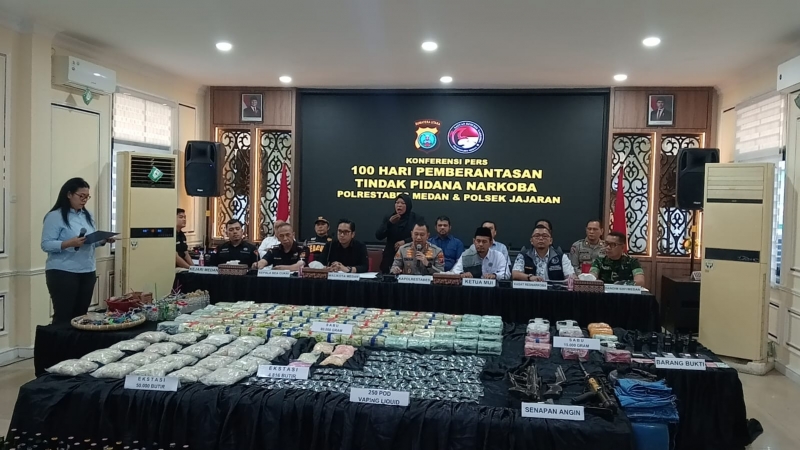
The Medan City Police have uncovered a large-scale international drug trafficking network that smuggled evidence using boats in the Asahan-Tanjungbalai waters.
From this operation, two individuals with the initials YNP (30) and SB (59) were arrested, with drug evidence consisting of 80 kg of crystal meth and 50,000 ecstasy pills.
Based on the investigation, the two suspects were ordered by an individual with the initial L (a wanted person) to transport the drugs to Pekanbaru, Riau.
Furthermore, the Medan City Police arrested two illegal migrant worker suspects with the initials RF (19) and AP (21) for being caught carrying 5,000 ecstasy pills and 250 bottles of vape liquid containing narcotics from Malaysia. Both were arrested in Tanjungbalai waters.
Not only that, personnel from the Medan City Police also thwarted the smuggling of 15 kg of crystal meth using a ship-to-ship transfer method. Five individuals with the initials MR, ZS, MF, MH, and HP were secured. In their operation, the perpetrators disguised the crystal meth evidence in modified jerry cans to make it appear as if they contained diesel fuel.
“The uncovering of this case is a form of the Medan City Police’s commitment to eradicating drug trafficking and preventing drugs from entering the Medan City area,” stated the Medan City Police Chief.
He explained that the enforcement action against this drug trafficking crime is the result of 100 days of work following up on the presidential directives for the eradication of narcotics in Medan City, North Sumatra, Indonesia.
“The suspects have been detained. The seized drug evidence will later be destroyed,” he concluded.
Medan City
Medan is the capital and largest city of North Sumatra, Indonesia, historically developing from a small village into a major economic hub due to the late 19th-century plantation boom, particularly for tobacco and rubber. The city’s multicultural heritage is reflected in its architecture, with landmarks like the Maimun Palace showcasing its history as the seat of the Deli Sultanate and the Grand Mosque representing its significant Muslim population. Today, it serves as the bustling gateway to Lake Toba and the diverse highlands of Sumatra.
Asahan
Asahan is a small village located in the mountains of East Java, Indonesia, known for its historic colonial-era plantation and cool highland climate. It was established in the mid-19th century as a coffee estate and later a retreat for Dutch planters, with its core being the beautifully preserved **Asahan Mountain Resort**, originally built in the 1930s. Today, it is a tranquil heritage site offering a glimpse into Indonesia’s colonial past and serving as a quiet getaway with period architecture and scenic tea plantations.
Tanjungbalai
Tanjungbalai is a port city on the northeastern coast of Sumatra, Indonesia, historically significant as a trading hub for the Malay and Karo Batak peoples. It was later developed during the Dutch colonial era in the 19th century for the export of local commodities like rubber and palm oil. Today, it remains an important regional center for trade and fishing in North Sumatra province.
Pekanbaru
Pekanbaru is the capital city of Riau province on the Indonesian island of Sumatra. Founded in the 18th century as a small trading post by Malay and Minangkabau settlers, it grew significantly due to its strategic location on the Siak River. Today, it is a major economic hub, largely driven by the oil and palm oil industries.
Riau
Riau is a province on the central eastern coast of Sumatra, Indonesia, historically significant as the heart of the Malay sultanates and the Riau-Lingga Kingdom from the 16th to 19th centuries. Today, it is known as a major center of Malay culture and language, as well as a key economic region due to its vast natural resources like petroleum, palm oil, and natural gas. Its capital, Pekanbaru, is a modern city that serves as a gateway to the region’s cultural heritage and natural landscapes.
Malaysia
Malaysia is a modern Southeast Asian nation formed in 1963, but its history spans ancient maritime kingdoms, Islamic sultanates, and European colonial rule by the Portuguese, Dutch, and British. Culturally, it is a vibrant multi-ethnic society, predominantly Malay, Chinese, and Indian, known for landmarks like the Petronas Twin Towers in Kuala Lumpur and historic UNESCO sites such as Melaka and George Town.
North Sumatra
North Sumatra is an Indonesian province on the island of Sumatra, most famous for being home to Lake Toba—the world’s largest volcanic lake, formed by a cataclysmic super-eruption around 74,000 years ago. The region has a rich cultural history as the heartland of the Batak people, whose distinct traditions, architecture (like the boat-shaped *rumah adat*), and Christian faith are central to its identity. Its capital, Medan, also showcases a colonial past through landmarks like the Maimun Palace, built during the era of the Deli Sultanate.
Indonesia
Indonesia is a Southeast Asian archipelago of over 17,000 islands, home to hundreds of distinct ethnic groups and languages. Its history is marked by powerful Hindu-Buddhist empires like Srivijaya and Majapahit, followed by centuries of Dutch colonial rule before gaining independence in 1945. Today, it is the world’s largest Muslim-majority nation, renowned for its diverse cultural heritage, from ancient temples like Borobudur to vibrant traditional arts and natural wonders.