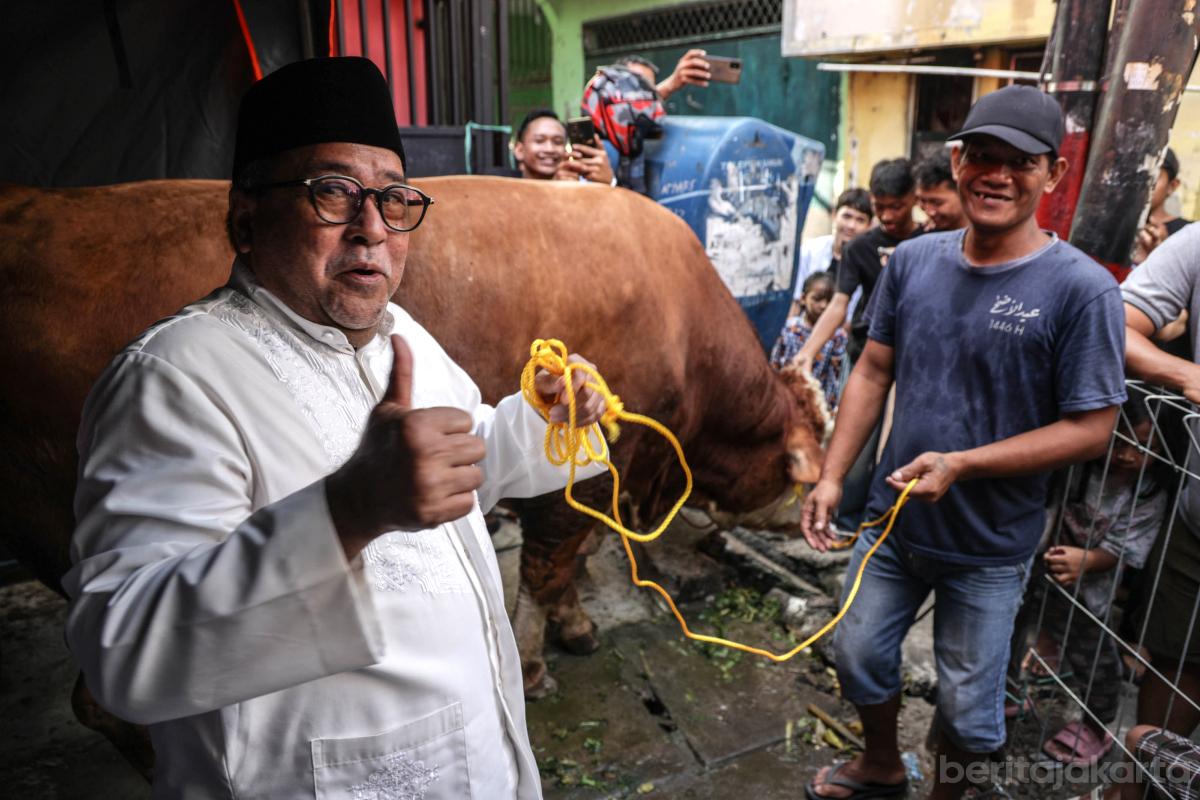
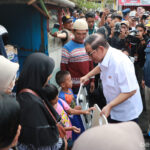
Rano donates a sacrificial cow for the residents of Tangki.
Deputy Governor sacrificial cow kelurahan tangki bilal
Deputy Governor of DKI Jakarta handed over a sacrificial cow to residents of RW 06, Tangki, Taman Sari, West Jakarta, on Wednesday.
Hopefully the cow sent for slaughter will be beneficial,
The arrival was greeted enthusiastically by Tangki residents who had been waiting since morning.
The sacrificial cow from the Governor of DKI Jakarta is a Simmental breed weighing 1.1 tons, and was given to residents of RW 06, Tangki to be slaughtered on Eid al-Adha 1447 Hijriah.
“Today, I am handing over the cow on behalf of the Governor. This is not from the Deputy Governor. Hopefully the cow sent for slaughter will be beneficial for the people of Tangki,” it was said.
It is hoped that the slaughter and distribution of the sacrificial cow meat from the Governor of DKI Jakarta will proceed orderly.
“I also advise the committee who will slaughter the sacrificial cow to not dispose of slaughter waste carelessly,” it was stated.
The Mayor of West Jakarta said that residents of RW 06, Tangki are very happy to receive a sacrificial cow from the Governor of DKI Jakarta.
“The manure from the slaughtered sacrificial cow can be processed into compost,” it was concluded.
Tangki
Tangki is a traditional water storage tank or reservoir commonly found in parts of Indonesia, particularly in Java, where it historically served as a key component of ancient irrigation and bathing complexes. These structures often date back to the Hindu-Buddhist period, such as those associated with the 14th-century Majapahit kingdom, and were used for both practical water management and ritual purification. Today, many tangki sites are preserved as cultural heritage, reflecting the advanced engineering and spiritual practices of early Indonesian civilizations.
Taman Sari
Taman Sari is a historic water castle and garden complex located in Yogyakarta, Indonesia, built in the mid-18th century during the reign of Sultan Hamengkubuwono I. Originally serving as a royal pleasure garden, bathing complex, and meditation retreat for the Sultan and his family, it featured elaborate pools, pavilions, and an intricate underground mosque. Today, much of the site lies in ruins, but its remaining structures and restored pools offer a glimpse into the opulence and cultural sophistication of the Mataram Sultanate.
West Jakarta
West Jakarta is a diverse administrative city in Indonesia’s capital, known for its historic Old Town (Kota Tua), which preserves Dutch colonial-era architecture from the 17th and 18th centuries when the area was the center of the Dutch East India Company’s trade. It features landmarks like the Fatahillah Museum and Glodok, one of the world’s oldest Chinatowns, reflecting centuries of multicultural heritage. Today, West Jakarta blends this rich history with modern urban life, including shopping centers and residential areas.
Tangki
Tangki is a traditional Chinese ink-wash painting technique that involves using water and ink on paper or silk to create expressive, often monochrome artworks. Originating during the Tang Dynasty (618–907 CE), it became a highly respected art form that emphasizes simplicity, spontaneity, and harmony with nature. This style is closely associated with Chinese literati painting, where artists sought to capture the essence of a subject rather than its realistic details.
Taman Sari
Taman Sari is a historic water castle and garden complex located in Yogyakarta, Indonesia, built in the mid-18th century during the reign of Sultan Hamengkubuwono I. Originally serving as a royal pleasure garden, bathing complex, and meditation retreat for the Sultan and his family, it also featured underground mosques and secret passages. Today, much of the site lies in ruins due to earthquakes and neglect, but it remains a popular tourist attraction showcasing Javanese-Islamic architecture and the grandeur of the Mataram Sultanate.
West Jakarta
West Jakarta is a diverse and historically rich administrative city within the Indonesian capital. It is home to the Old Town (Kota Tua), a colonial-era district that served as the center of the Dutch East India Company (VOC) in the 17th and 18th centuries. Today, it blends this colonial heritage with bustling markets and a vibrant Chinese-Indonesian community.
Fatahillah Museum
The Fatahillah Museum, also known as the Jakarta History Museum, is located in Jakarta’s Old Town (Kota Tua) and occupies a former Dutch colonial city hall built in 1710. It showcases Jakarta’s history from prehistoric times to the present, with exhibits including furniture, maps, and artifacts from the era of the Dutch East India Company. The building itself once served as the administrative center and even a prison, famously holding the Indonesian national hero Prince Diponegoro before his exile.
Glodok
Glodok is a historic neighborhood in Jakarta, Indonesia, known as the city’s oldest Chinatown, dating back to the Dutch colonial era when Chinese immigrants were confined to this area. It features a vibrant mix of traditional markets, temples like the 17th-century Jin De Yuan, and colonial architecture, reflecting centuries of Chinese-Indonesian culture. Today, Glodok is famous for its bustling street food, electronics markets, and cultural heritage, making it a key landmark in Jakarta.