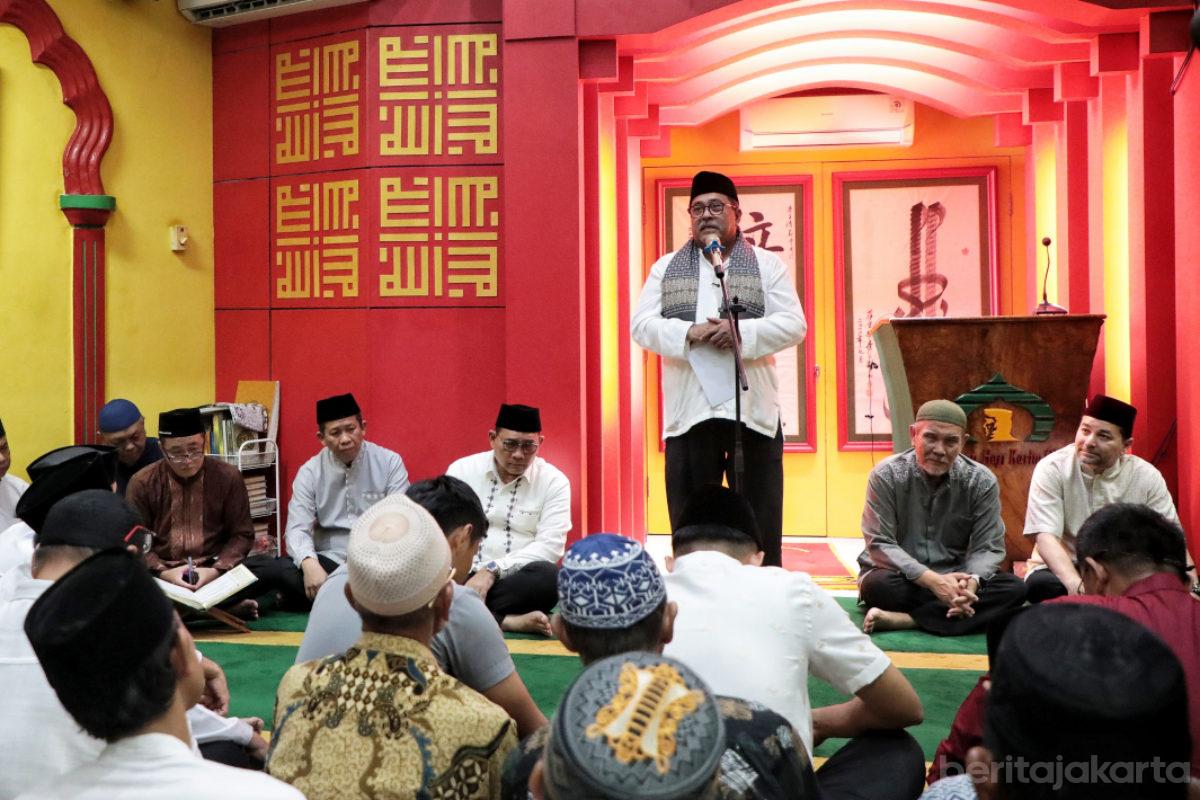
The Deputy Governor of Jakarta, Rano Karno, visited religious figures and residents at the Lautze Mosque in Karang Anyar Village, Sawah Besar, Central Jakarta.
“To directly absorb the aspirations of the residents,”
Rano stated that this first series of Ramadan visits to the mosque managed by the Haji Karim Oei Foundation was not merely a formality, but an effort to strengthen social cohesion.
“The Ramadan visits are conducted to strengthen the relationship between the regional government and the community, enhance Islamic outreach, and directly absorb the aspirations of the residents,” said Rano.
Rano expressed his happiness and pride in being able to start the series of events at Lautze Mosque, which holds significant historical and architectural value.
“I feel honored to begin the series of events at the iconic Lautze Mosque with its distinctive Chinese architecture, initiated by the late Mr. Haji Ali Karim Oei,” he explained.
Rano also expressed gratitude for the prayers offered by the residents for himself and Governor Pramono Anung.
“Alhamdulillah, yesterday we celebrated one year of leading Jakarta. Of course, in one year we haven’t been able to accomplish much, because Jakarta’s problems are indeed vast,” he said.
Furthermore, Rano reminded residents to protect the environment and strengthen interfaith tolerance.
“Let’s work together to protect this neighborhood. Religious tolerance is one of the foundational teachings from our elders. That is where we see how collaboration among Jakarta’s diverse communities has been nurtured since the neighborhood level. May this Ramadan bring blessings to Jakarta,” he hoped.
Lautze Mosque
The Lautze Mosque, located in Jakarta, Indonesia, is a unique cultural and religious site built in 1991. It is notable for its distinct Chinese architectural style, featuring red lanterns and pagoda-like structures, reflecting the history and integration of Indonesia’s ethnic Chinese Muslim community. The mosque serves as both a place of worship and a symbol of religious harmony and cultural synthesis in the country.
Karang Anyar Village
Karang Anyar Village is a traditional Balinese village located in the Klungkung regency of Indonesia, known for its well-preserved customs and unique **geringsing** double-ikat weaving, a rare and sacred textile tradition. Historically, the village was established by communities seeking to maintain cultural practices, and its weavers are considered guardians of a craft that dates back centuries, often linked to spiritual and ceremonial purposes. Today, it serves as a cultural site where visitors can observe this intricate handicraft and experience authentic Balinese village life.
Sawah Besar
Sawah Besar is a district in central Jakarta, Indonesia, historically known as a vast rice field (*sawah*) during the Dutch colonial era. It transformed into a commercial and transportation hub in the 20th century, now home to the historic Pasar Baru market and close to landmarks like the Jakarta Cathedral.
Central Jakarta
Central Jakarta is the administrative and political heart of Indonesia’s capital, housing key government institutions like the National Monument (Monas) and the Presidential Palace. Historically, its modern layout was largely planned during the Dutch colonial era, with the area known as Weltevreden serving as a central hub. Today, it is a bustling business and government district, contrasting colonial-era buildings with modern skyscrapers.
Haji Karim Oei Foundation
The Haji Karim Oei Foundation is a social and educational institution in Jakarta, Indonesia, established in 1951 by the philanthropist and community leader Haji Karim Oei. It was founded to support the local Chinese-Indonesian community, particularly in the areas of education, healthcare, and religious life, reflecting its history of promoting welfare and cultural integration in the post-colonial era.
Haji Ali Karim Oei
Haji Ali Karim Oei is a prominent figure in Indonesian history, not a place. He was a wealthy and influential Chinese-Indonesian businessman, philanthropist, and community leader in the early 20th century. He is best known for his significant contributions to the founding of the **Haji Ali Karim Oei Foundation** and the **Al-Azhar Mosque and Islamic Center** in Kebayoran Baru, Jakarta, which became a major hub for Islamic education and community activities.
Jakarta
Jakarta is the capital and largest city of Indonesia, located on the northwest coast of Java. Historically known as Sunda Kelapa and later Batavia under Dutch colonial rule, it became the center of the Dutch East India Company’s trading empire in the 17th century before being renamed Jakarta after Indonesia’s independence. Today, it is a bustling, sprawling metropolis that serves as the nation’s political and economic hub.
Ramadan
Ramadan is not a physical place or cultural site, but rather the ninth month of the Islamic lunar calendar, observed by Muslims worldwide as a holy period of fasting, prayer, and reflection. Its history dates to the 7th century CE when, according to Islamic belief, the first verses of the Quran were revealed to the Prophet Muhammad during this month. The observance commemorates this revelation and is one of the Five Pillars of Islam, centered on spiritual purification and community.