Jakarta –
Several countries around the world are beginning to build giant sea walls as a measure to address the threat of rising sea levels and coastal flooding.
This infrastructure is becoming a key solution in mitigating the impacts of climate change, especially for cities located in low-lying and sinking-prone areas.
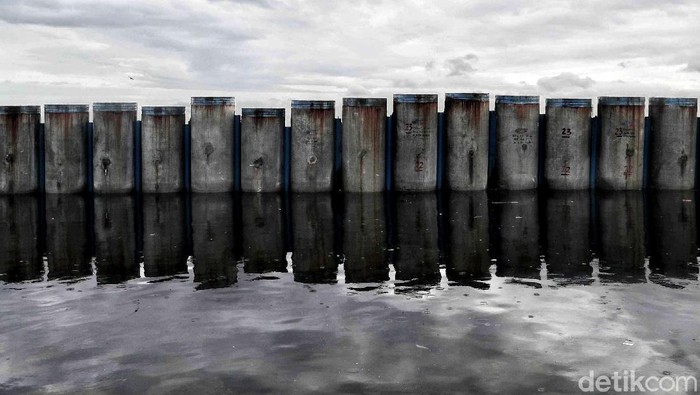
The construction of The Great Sea Wall Jakarta is part of the National Capital Integrated Coastal Development (NCICD). This project is designed as an integrated protection system for the coastal area of the capital, which is frequently hit by tidal flooding.
The sea wall is approximately 32 kilometers long and is being built on the coast of North Jakarta. Its function is not only to hold back seawater but also to prevent saltwater intrusion into the land and protect residential areas located below sea level.
This situation is increasingly urgent, given data from the World Economic Forum (WEF) in 2024 indicating that the land surface in Jakarta is sinking by an average of up to 17 centimeters per year.
This figure makes Jakarta one of the most vulnerable cities in the world to the risk of sinking.
With these conditions, the presence of The Great Sea Wall Jakarta is expected to enhance the capital’s resilience to the threat of climate change while also serving as a long-term solution for coastal zone management.
Not only Indonesia, but several other countries have also already built giant sea walls as a form of protection against coastal erosion and tidal flooding. This infrastructure has proven to play an important role in safeguarding coastal areas from increasingly severe disaster threats.
Here are several countries in the world that have implemented giant sea wall systems:
1. South Korea
South Korea is one of the countries with a giant sea wall through the Saemangeum Seawall project. This structure is known as the longest sea wall in the world, with a length of approximately 33.9 kilometers, stretching along the country’s west coast.
The construction of this wall is not only aimed at holding back seawater but is also part of a large reclamation project.
Through the Saemangeum Seawall, the South Korean government has succeeded in creating new land utilized for the agricultural sector, particularly to support national food security.
Additionally, the area around the wall has been developed into an industrial and tourism center. Thus, this project not only functions as coastal protection but also drives economic growth in the region.
2. Netherlands
As a country where much of its territory lies below sea level, the Netherlands is known for having a highly advanced water management system. One of the most monumental projects is Delta Works, a coastal protection system consisting of dams, sluices, and modern sea walls.
This project was built in response to the great flood disaster of 1953, which killed thousands of people and caused widespread damage.
Since then, the Netherlands has been committed to strengthening defenses against the threat of seawater through technology and infrastructure engineering.
Today, Delta Works is one of the most sophisticated flood protection systems in the world. Its presence protects the Dutch coast from storms, high waves, and rising sea levels due to climate change.
3. Italy
Italy also has a modern sea wall system known as the MOSE Project. This project is specifically designed to protect the city of Venice from the threat of flooding that frequently occurs due to high tides.
MOSE consists of a series of giant gates that can be raised when sea levels rise. This system works by closing off the seawater access to the Venice lagoon during extreme high tides, thus preventing flooding in the city area.
The project began testing in 2020 and is one of Italy’s major efforts to preserve this historic city.
With MOSE, Venice is expected to be more resilient to the phenomenon of acqua alta, the seasonal flooding that has long been a major threat to the city.
Which of these four mega projects is the most impressive?